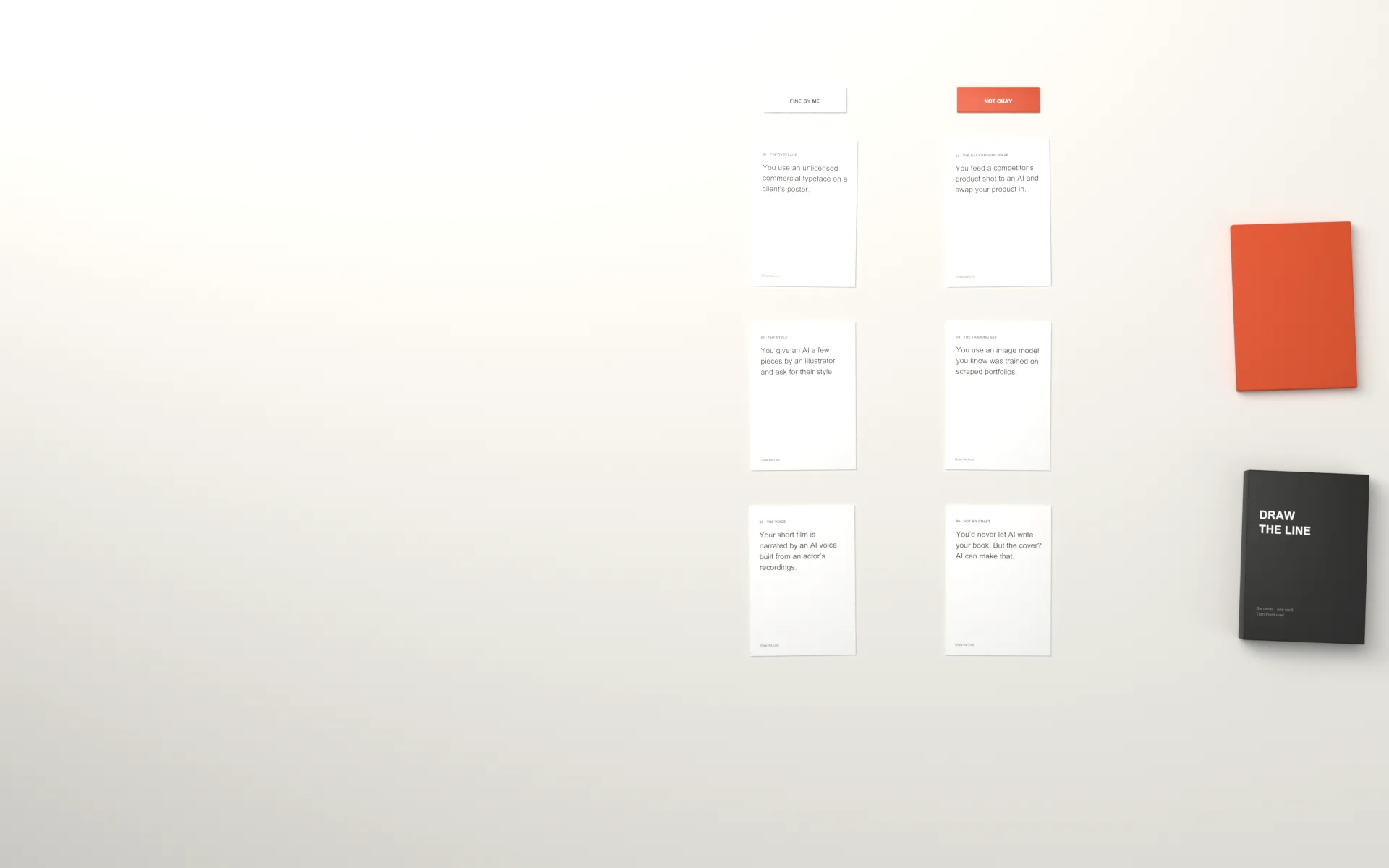
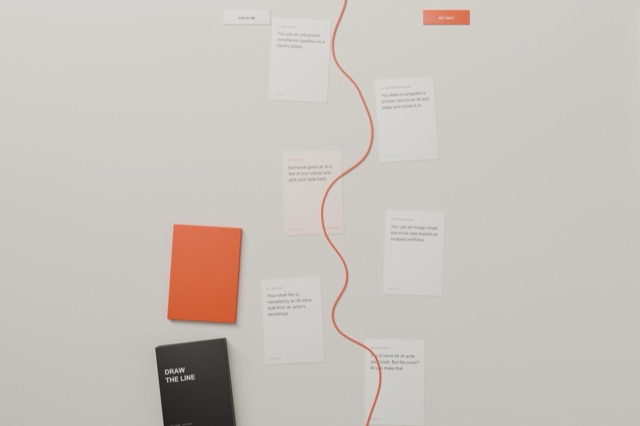
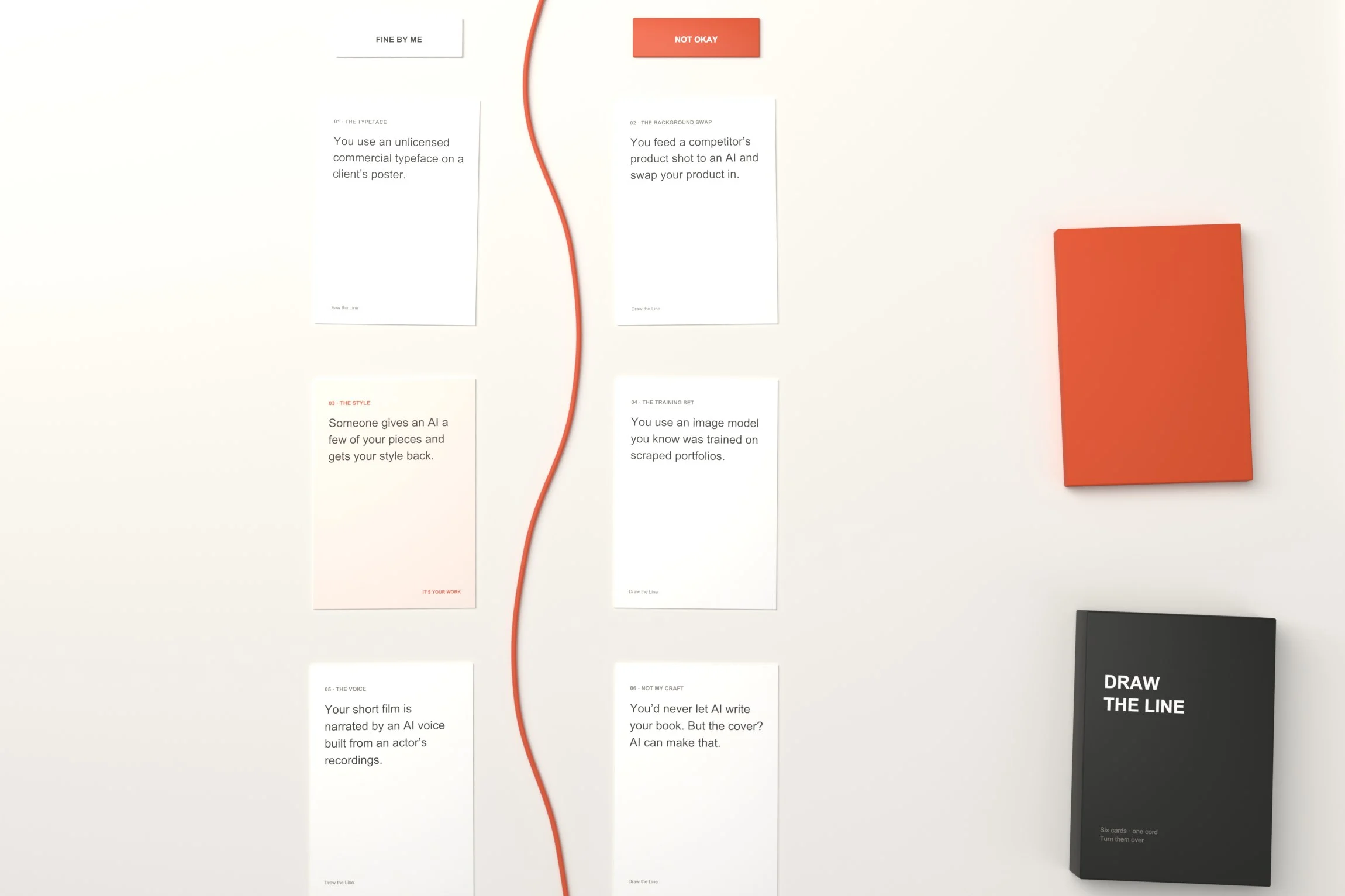
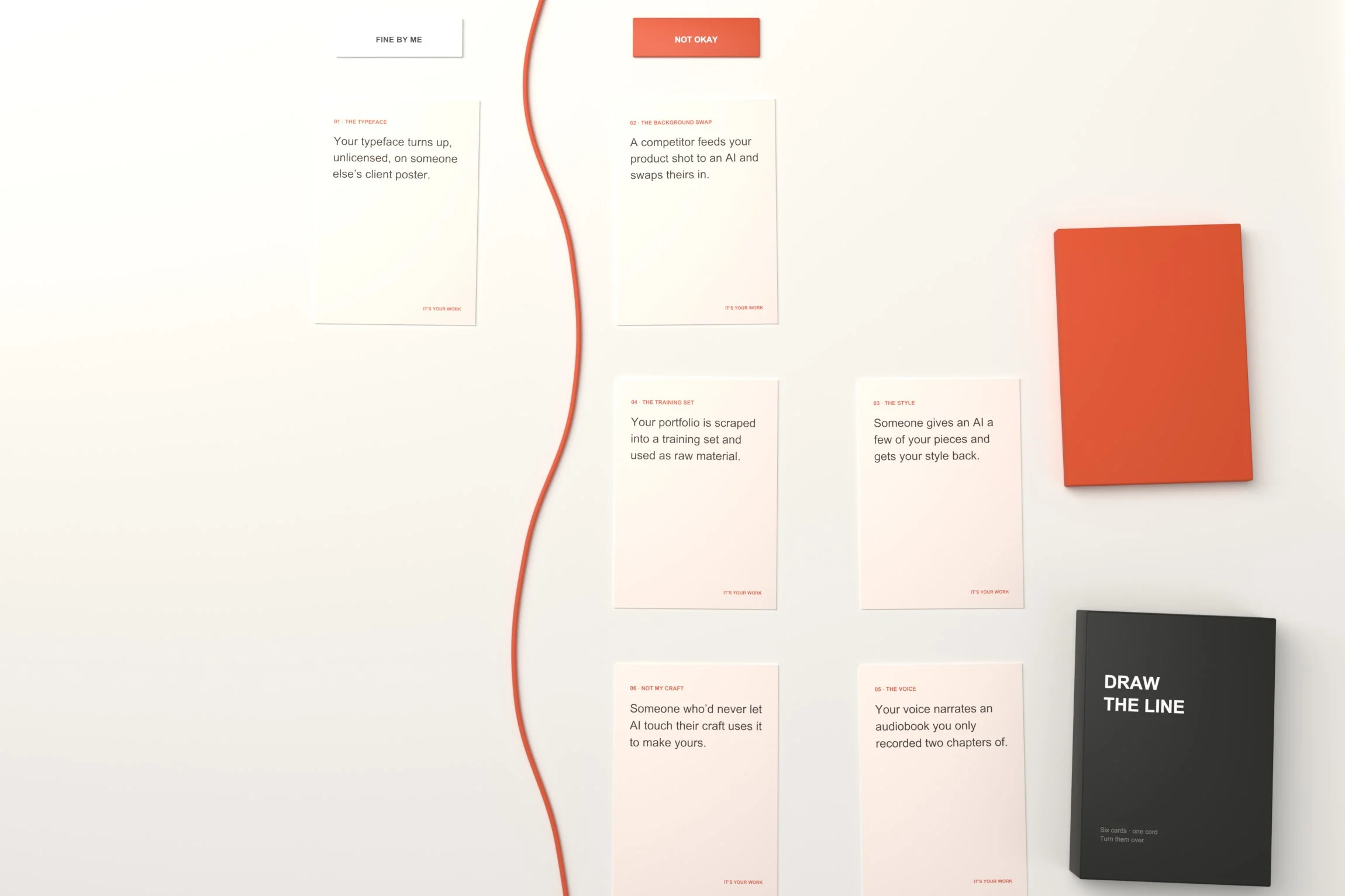
Six situation cards in two columns on a white table, with the card tray and the black box beside them, before any line is drawn

AI, consent & creative practice

Draw
the line.

We use other people’s work. Other people use ours.
Where do we draw the line?

My part
Research, interviews, both original tools and the 2.0 rebuild.
Context
MDes graduation project, The Glasgow School of Art, 2026.
Status
The original tools were tested and iterated. The 2.0 rebuild is not yet tested.
Skip to the case
Follow the line

Six things people do with other people’s work. One line between them: fine by me on one side, not okay on the other.

Turn them over. The same act, now done to your work.

Some cards cross the line.

The cord follows one piece of work out of my process and into someone else’s.

Context

MDes graduation project, The Glasgow School of Art, 2026. Shown at the GSA Postgrad Showcase.

My work

Research, interviews, both original tools, and the 2.0 rebuild: the interactive and the workshop kit.

Outcomes

Draw your line · Workshop Kit 2.0. Originally: My AI Practice Statement and Trace the Line.

The original tools
All projects

Visible enough to be found.
Visible enough to be taken.

Making work visible helps it circulate. It also exposes it to scraping, imitation and AI-mediated reuse.

Even people who have long shared their work under open licences are now rethinking it. And the designer who worries about this may be feeding someone else’s work into an AI the same afternoon.

Maj’s library

  • Good Services
  • Enshittification
  • Design Justice
  • Sway
  • Speculative Everything
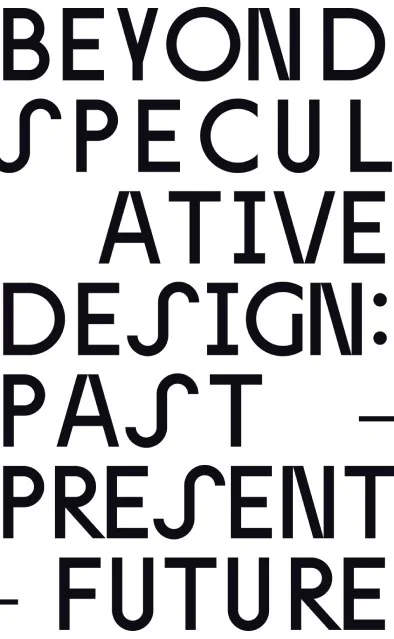
  • Beyond Speculative Design
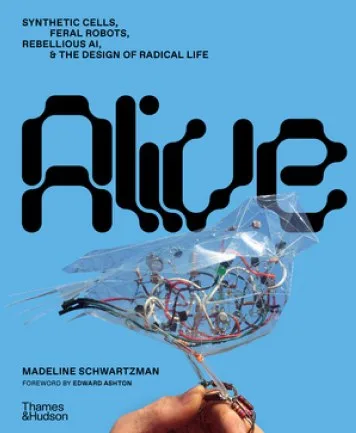
  • Alive
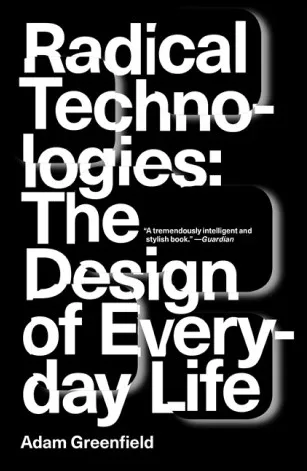
  • Radical Technologies
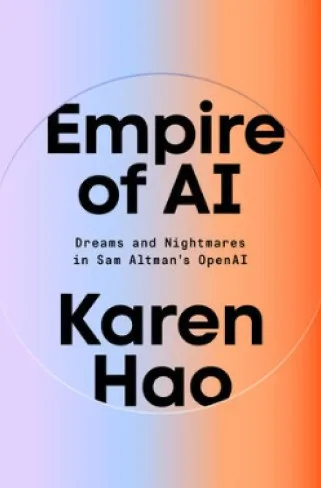
  • Empire of AI
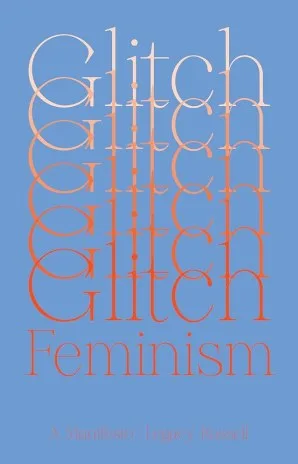
  • Glitch Feminism
Training data

Which side of the line?

A situation from one of my interviews. Decide where it falls.

02 · The background swap

You feed a competitor’s product shot to an AI and swap your product in.

Draw the Line1 of 6 situations
02 · Turned over

A competitor feeds your product shot to an AI and swaps theirs in.

Draw the LineIt’s your work

Contextual

It depends.

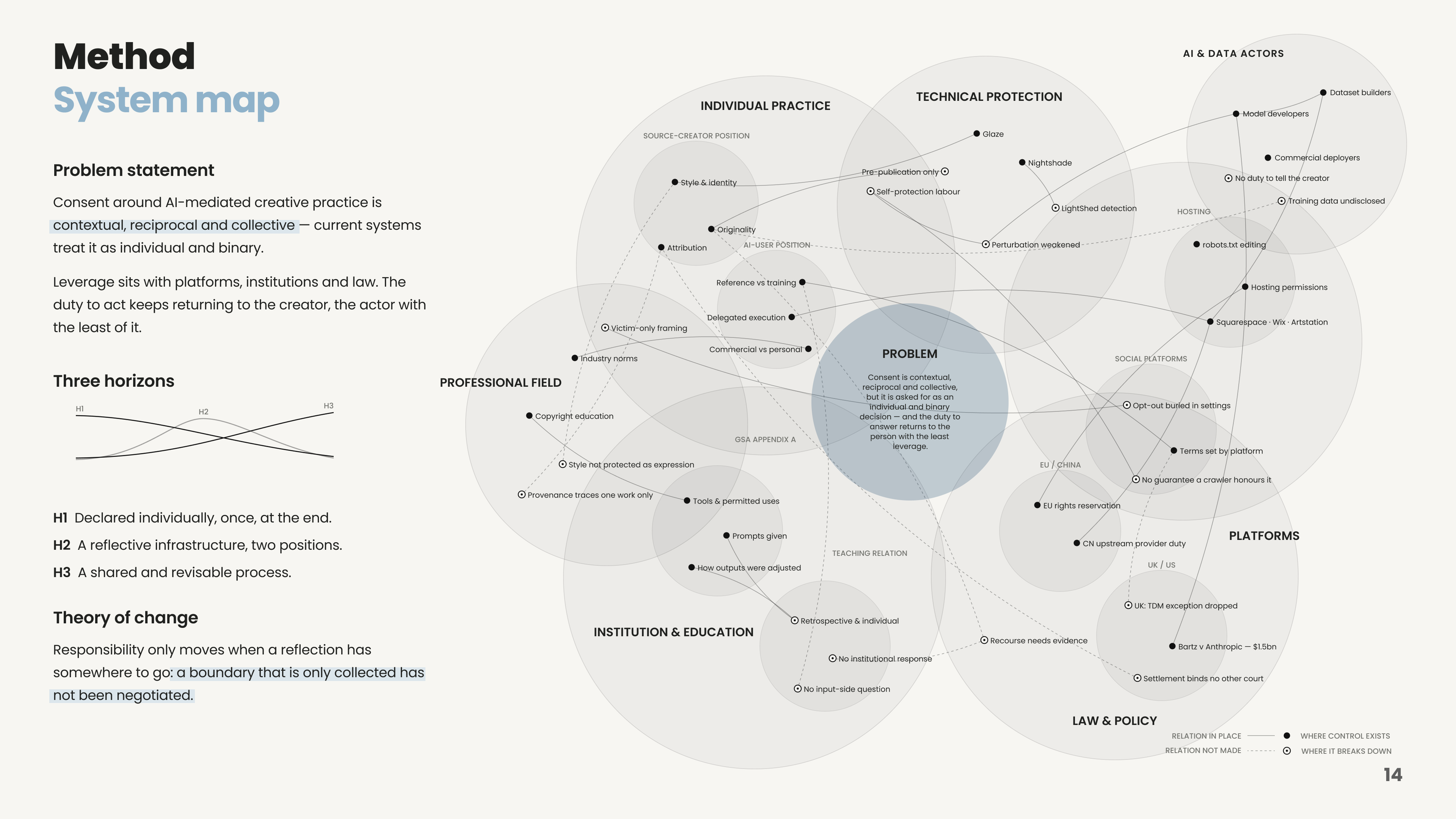
I read literature, platform terms and UK policy documents, mapped the system, and talked to three creative practitioners and two copyright experts. I read everything for conditions: where did a judgement change, and why?

System map from the research document: problem statement on the left, and circles for individual practice, technical protection, AI and data actors, platforms, law and policy, institution and education and the professional field, with relations in place drawn solid and relations not made drawn dashed around the central problem
System map, from the original research document. Leverage sits with platforms, institutions and law; the duty to act keeps returning to the creator.Full size ↗

Five ways
to draw it.

Nobody I spoke to drew the line in the same place, or by the same measure. I kept the disagreement in the picture instead of averaging it out.

The original research analysis ↗
  1. How much is borrowed

    It’s the share of your own creativity and effort. Is it more original, or more borrowed?

    Serena · Photographer

  2. Whether the rule is clear

    When we make posters, we’re very careful. We use licensed commercial fonts.

    Zoey · Product designer

    On styling, the same studio works in a grey zone.

  3. Who made the zero to one

    I can accept it making some of it. But the zero to one has to be the creator’s own.

    Lulia · Former film practitioner

  4. Who has the leverage

    Right now it seems the best option is to be part of a collective organisation that can represent your interests.

    Dr Amy Thomas · Copyright and creator-earnings researcher

  5. What the law protects

    Imitating the style of that work should not be an issue.

    Bartolomeo Meletti · CREATe, University of Glasgow

    Copyright protects expression, not style.

Where it feels wrong

I meant to make the finished product, and what I made was treated as a component.

Serena · Photographer

The space between
became the brief.

Literacy alone can’t close this gap: the law doesn’t reach where the harm is felt. A design could at least make the gap discussable.

Where the law draws it

Imitating the style of that work should not be an issue.

Bartolomeo Meletti · on UK copyright

Reciprocal

Both sides.

As the AI user

How do I use someone else’s work?

To save effort, we’d find a background from a similar product, feed it to the AI with ours, and have it swap ours in.Zoey, in the same hour she argued that creators should be paid

As the source creator

How do I want others to use my work?

If I’m using AI to do the cover of my book, I’m not paying an artist to do that. They don’t see that problem.Dr Amy Thomas, on authors who refuse AI for their writing

It isn’t hypocrisy. Nothing in a working day asks the question from both sides. That became the brief: put the two positions next to each other, around one real situation.

Moving tokens was easy.
Moving perspective took more.

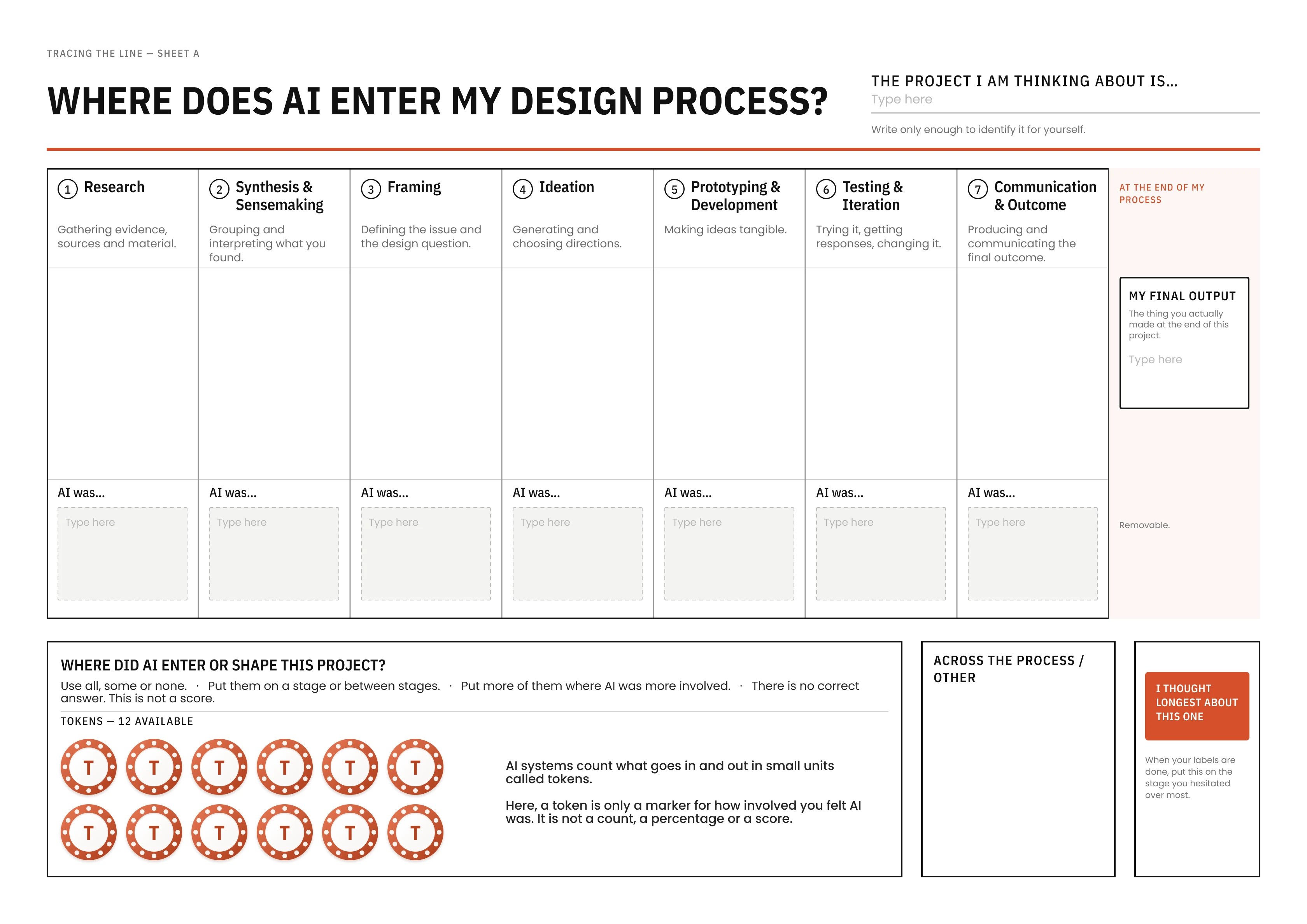
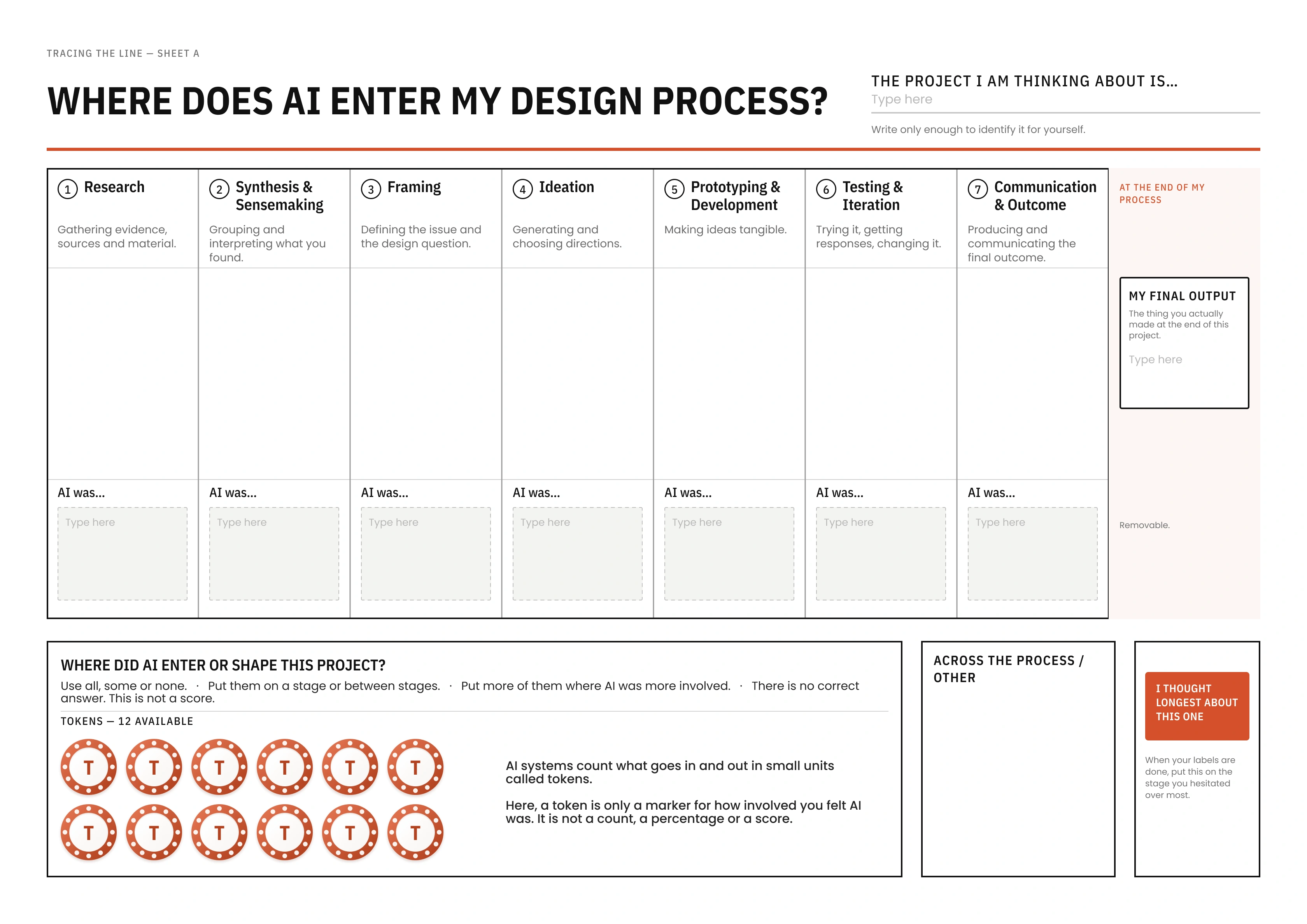
Trace the Line put a process on the table: seven stages, and tokens to mark where AI came in.

01Research02Synthesis03Framing04Ideation05Prototyping06Testing07Communication TTTTTTTTTT
  1. Observed

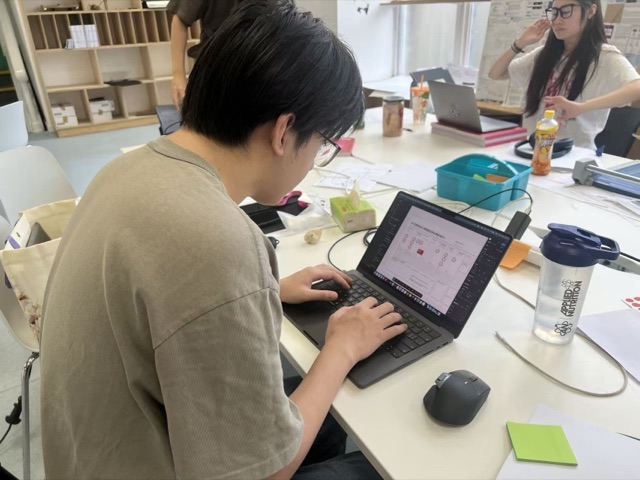
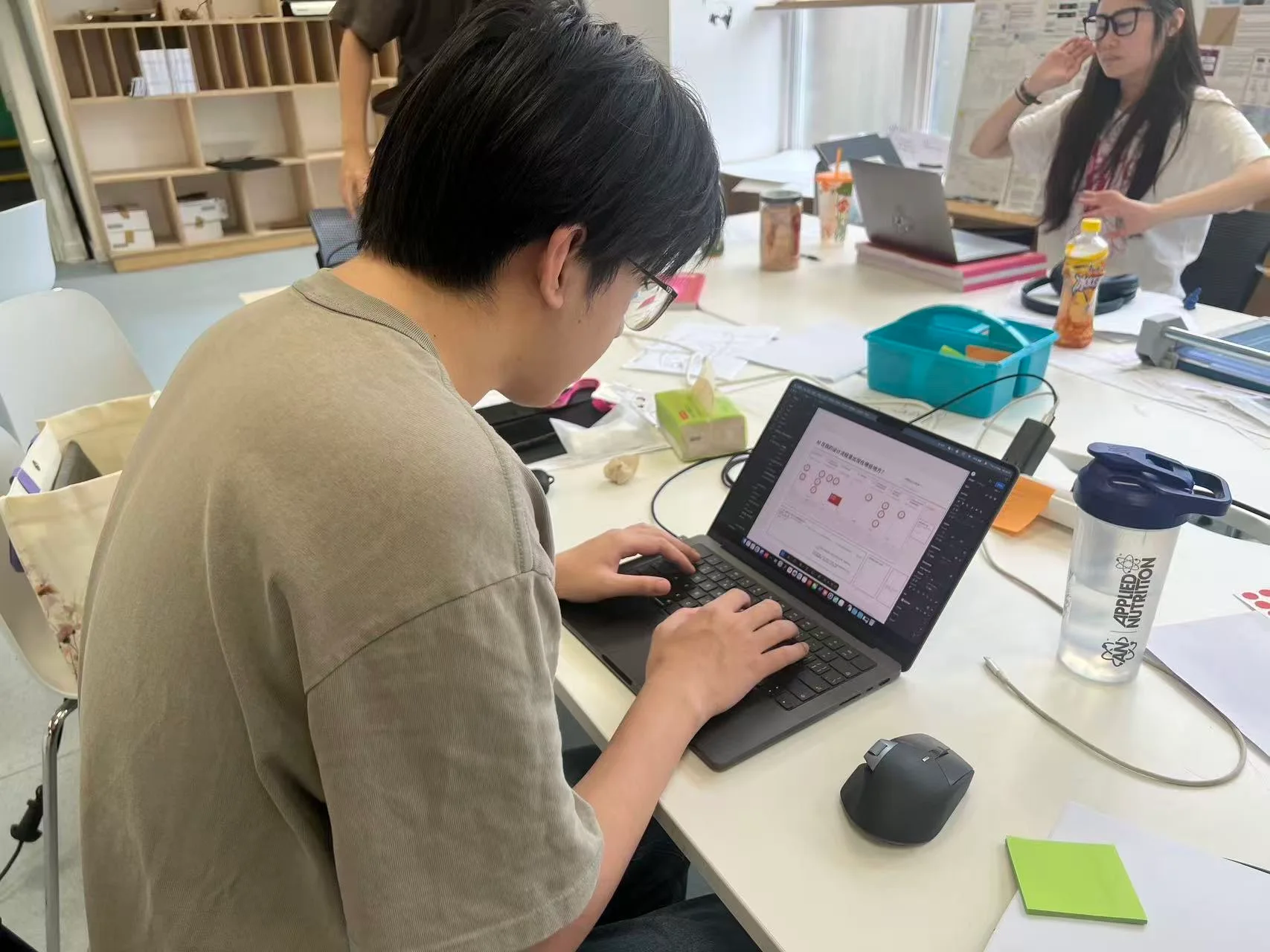
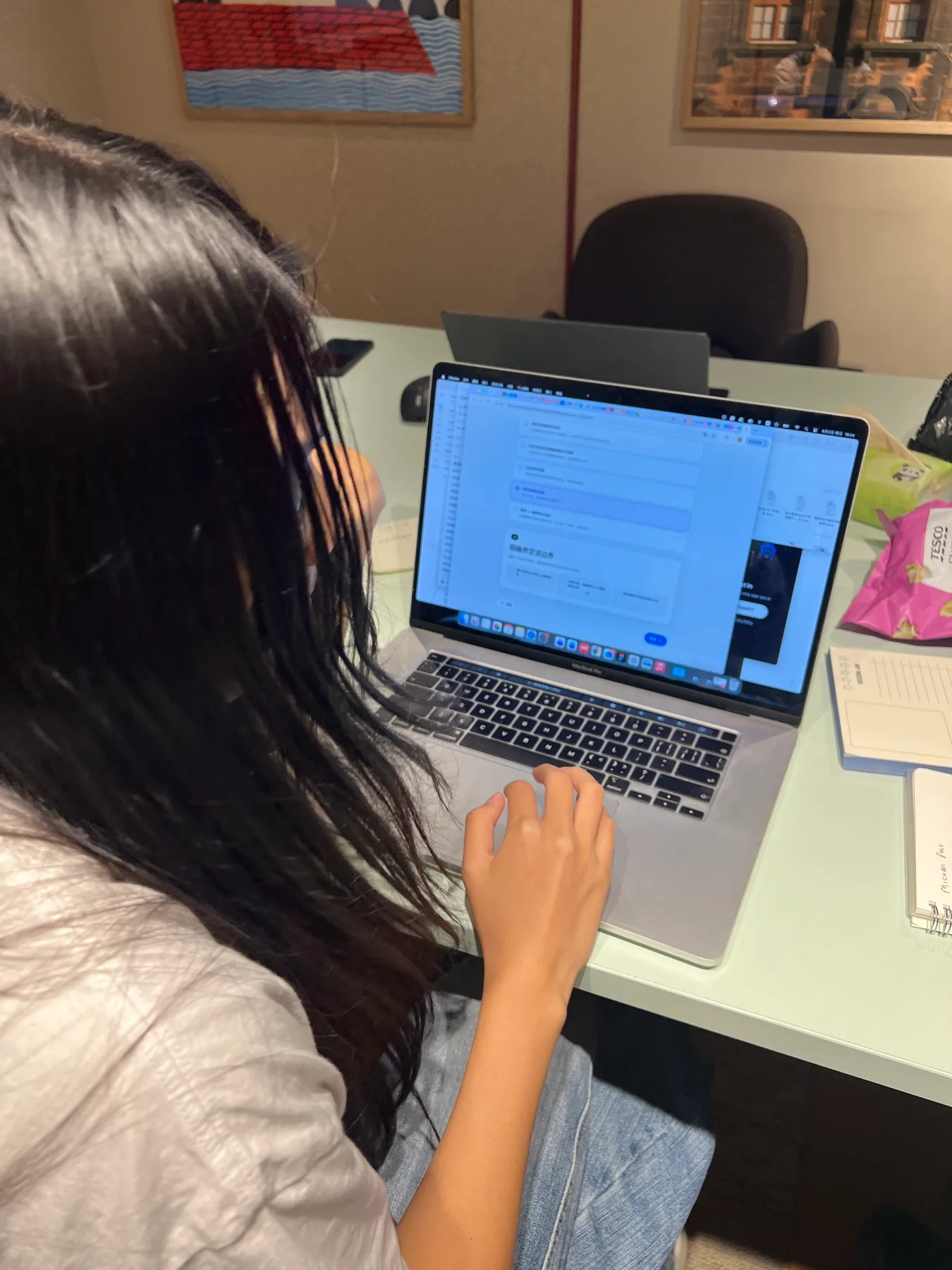
    A participant at a laptop working on the Trace the Line process map during the first in-person session

    Round one: Sheets A and B, three GSA design peers, one in-person session. The tokens helped people look back across their process. But the talk stayed on where, and how much, AI had been used. Some read it as being asked to use less.

  2. Read

    Original Sheet A: where does AI enter my design process, with seven stage columns and tokens

    The problem wasn’t the tokens. Sheet A was carrying too much of the reflective work, and the encounter ended before anyone could compare the two positions.

  3. Changed

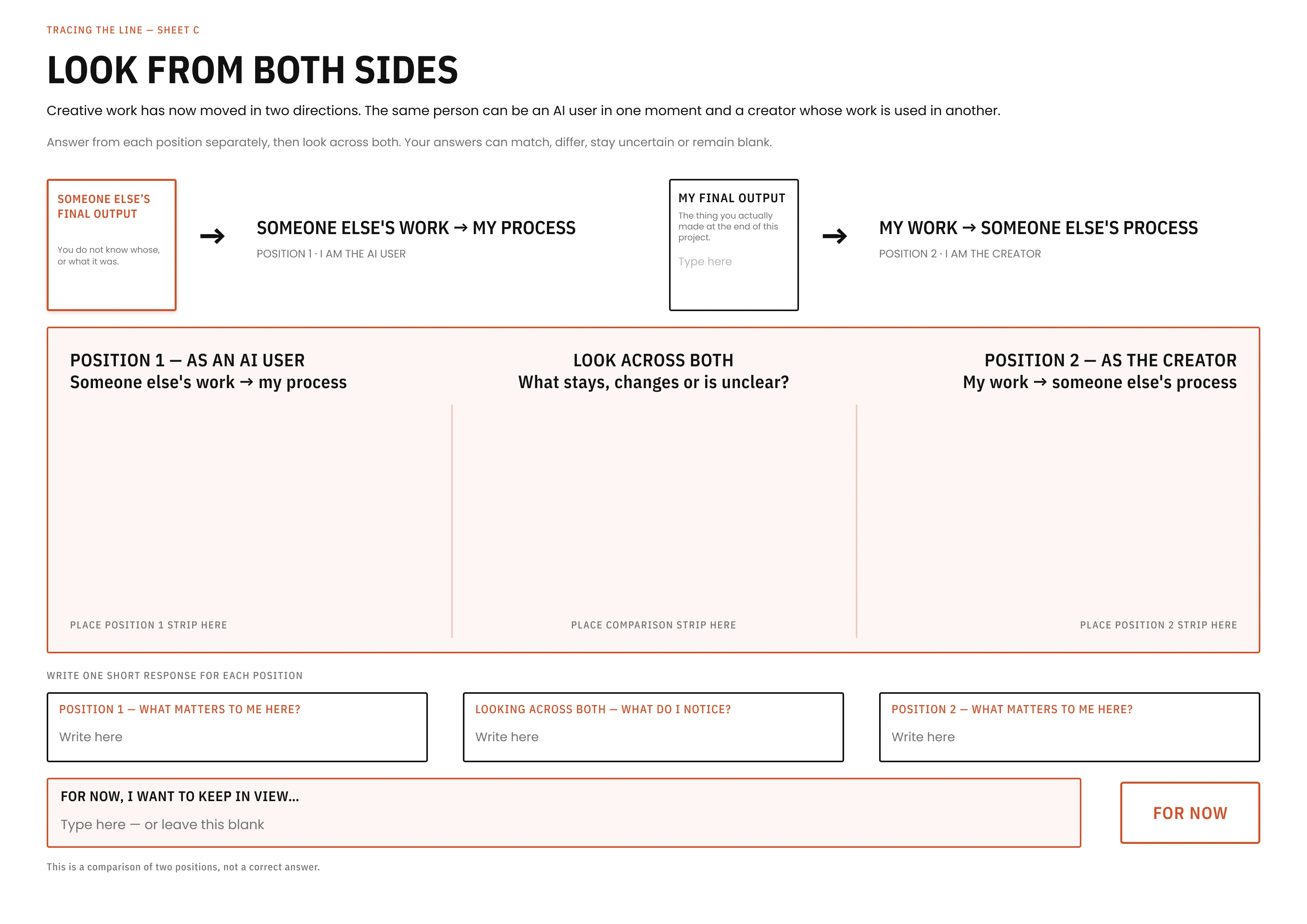
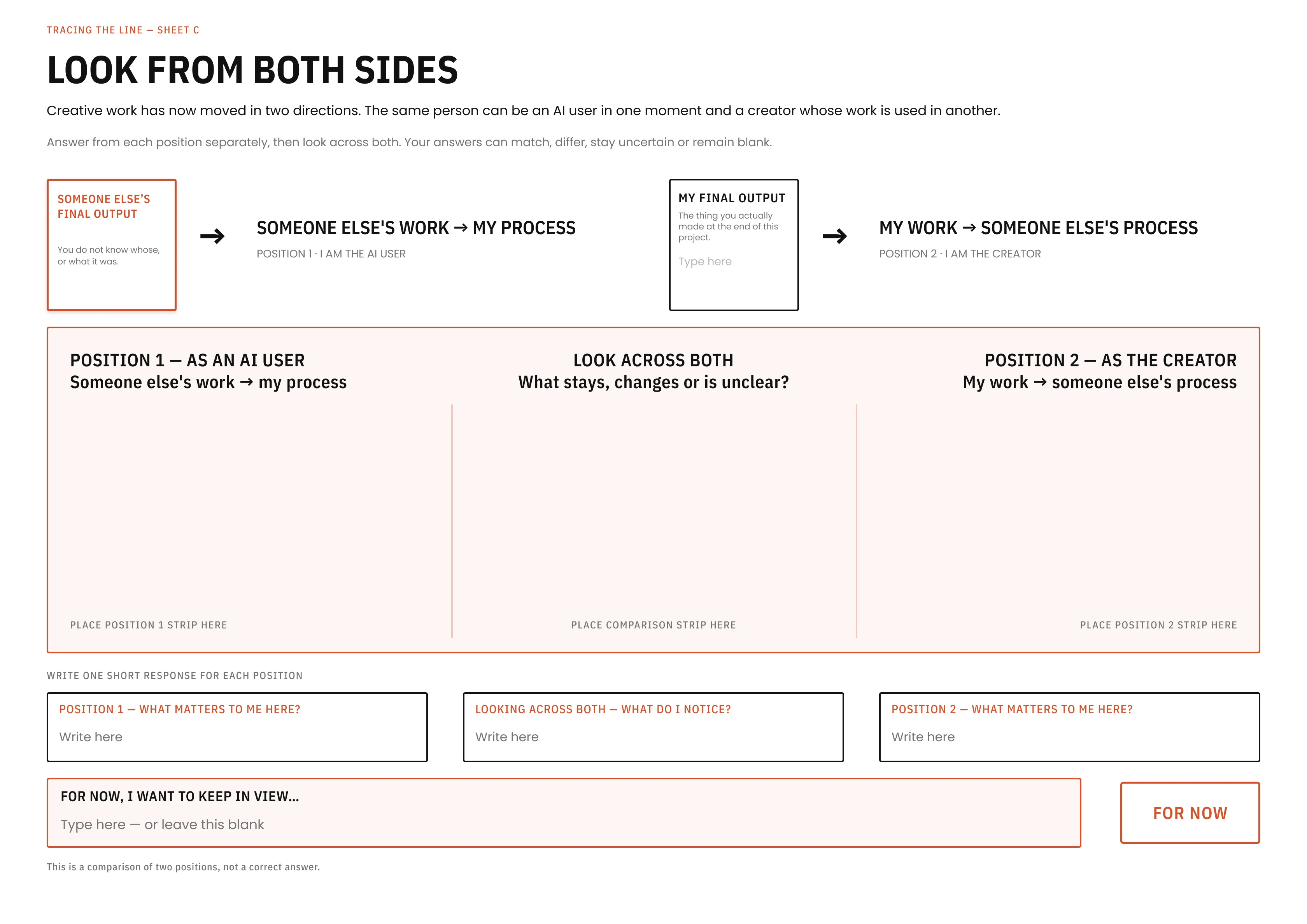
    Original Sheet C: look from both sides, with two positions and a comparison strip

    I brought Sheet C back, after the action: look from both sides. In round two, the next day with three participants, the encounter felt more coherent. That supports the redistribution. It doesn’t show lasting change.

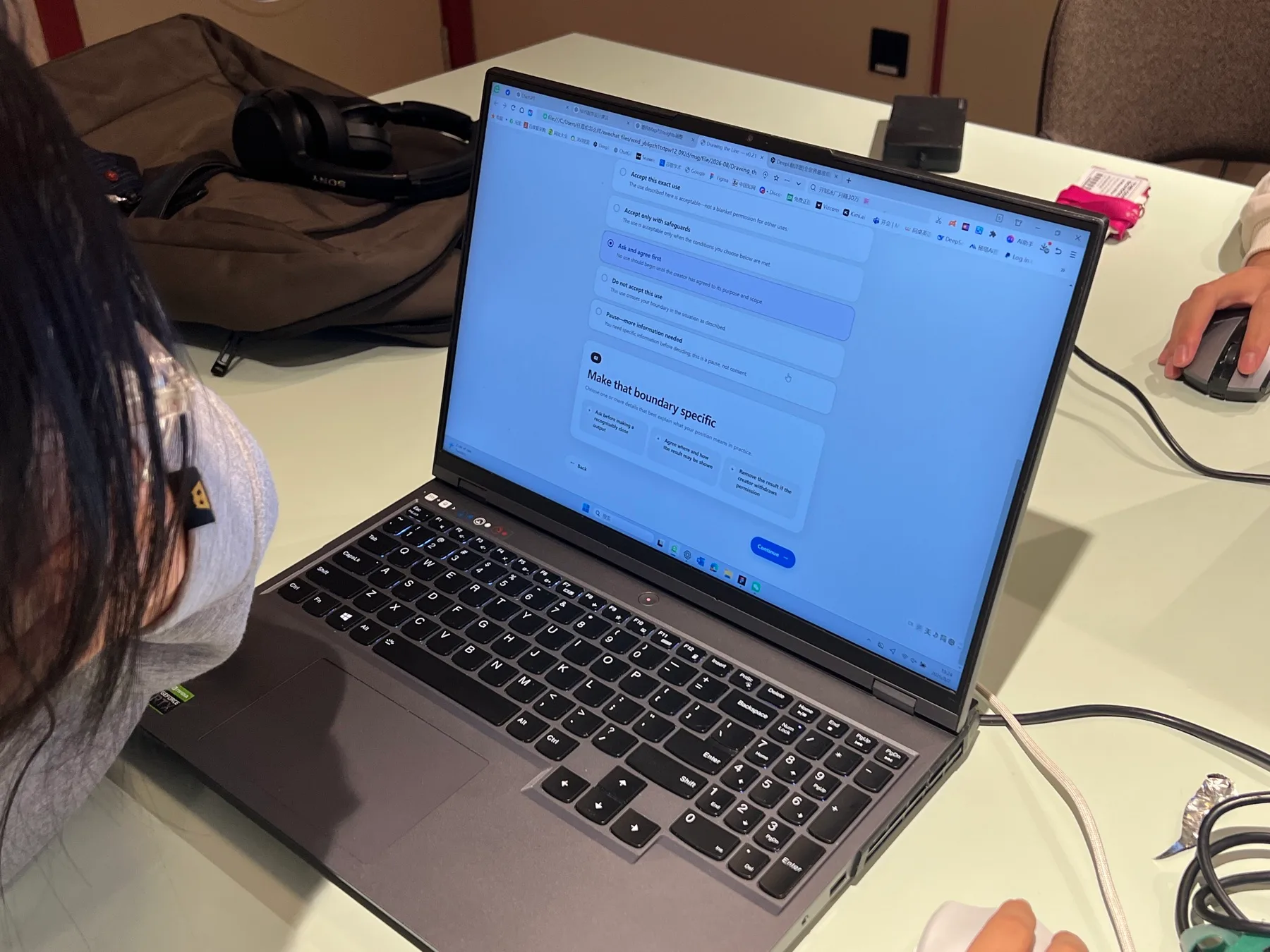
A participant testing My AI Practice Statement on a laptopAnother participant working through the statement prototype

The same lesson from the other tool. My AI Practice Statement v0.21 was tested with three students on 2 August. It recorded only how far someone accepted a use: a position without its conditions. So I added a layer to define the boundary. A position became useful only when its context could be seen too.

Collective

Not on
your own.

Individual control comes too late and is too weak. Where creators have had leverage, it came through collectives: Getty acting for its photographers, authors in a class action.

It can’t work like each individual author goes against these companies. You need some sort of collective action.Bartolomeo Meletti

So I retired the idea I started with, a personal switch at the moment of publishing. The tools became something to use together: they make a position visible enough to compare, and leave the conclusion to the people at the table.

Two outcomes:
a screen and a table.

After graduation I rebuilt the outcomes around the three findings. Where a card falls depends on the situation. Every card turns over. And the result is something to talk about with others.

Draw your line

Workshop Kit 2.0

The same question,
for a table.

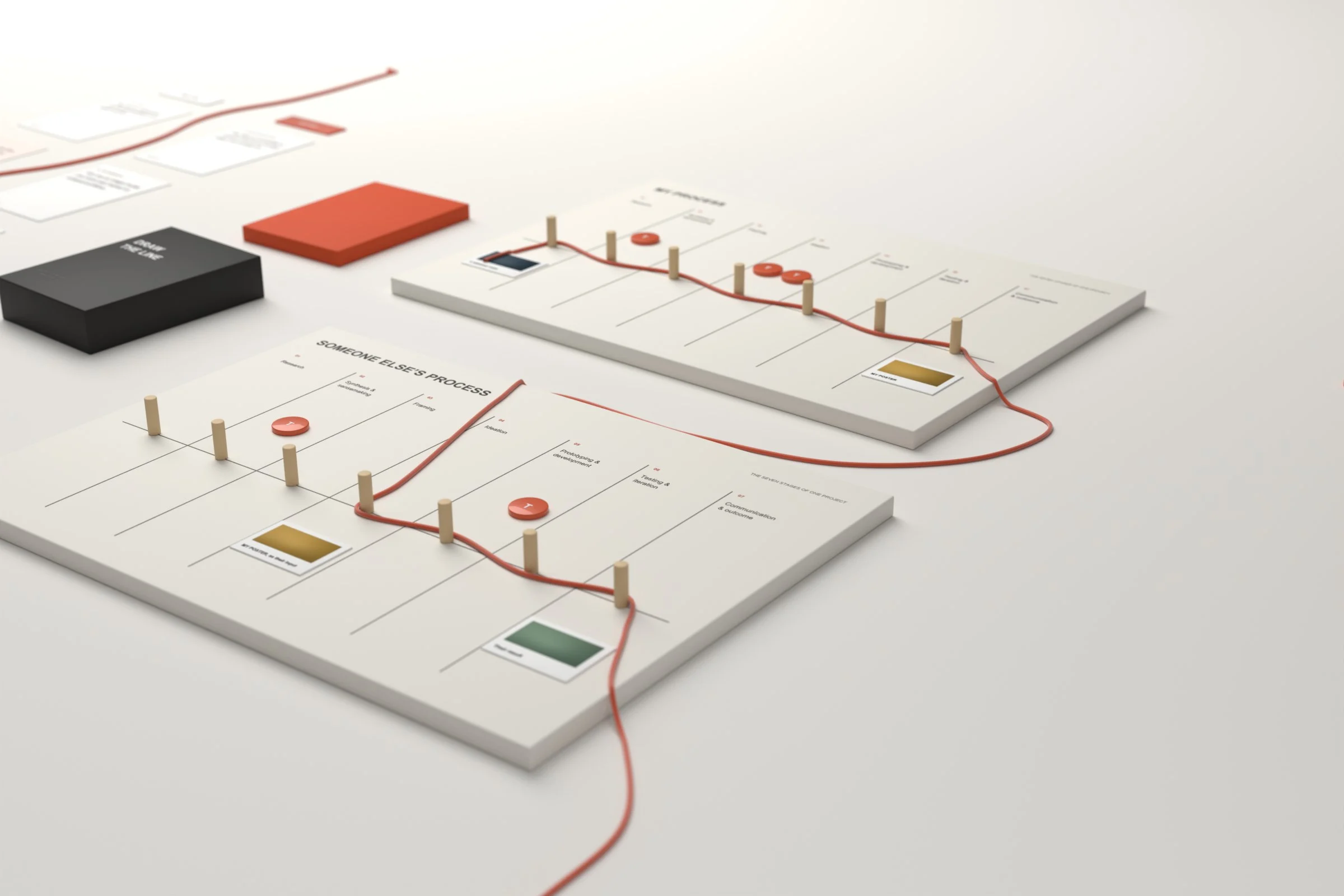
Six double-sided situation cards and an orange cord to lay between them. Two process boards with the seven stages from the original Sheet A: pegs, small work cards, and the same cord carrying one piece of work out of my process and into someone else’s.

Top view: six situation cards in two columns on a white table, an orange cord laid between them, Fine by me on the left and Not okay on the right, with the card tray and box beside them
The same table with every card turned over to its back, and two cards, The style and The voice, moved across the cord to the Not okay side
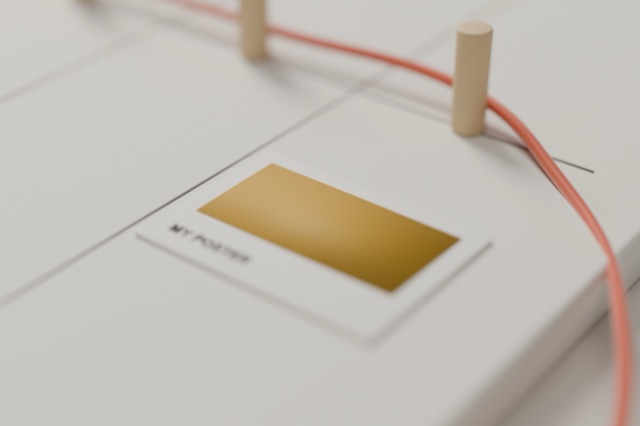
Two process boards, My process and Someone else’s process, each with seven stages and wooden pegs. The cord runs along my pegs, leaves my board beside a card labelled My poster, and enters the other board at ideation
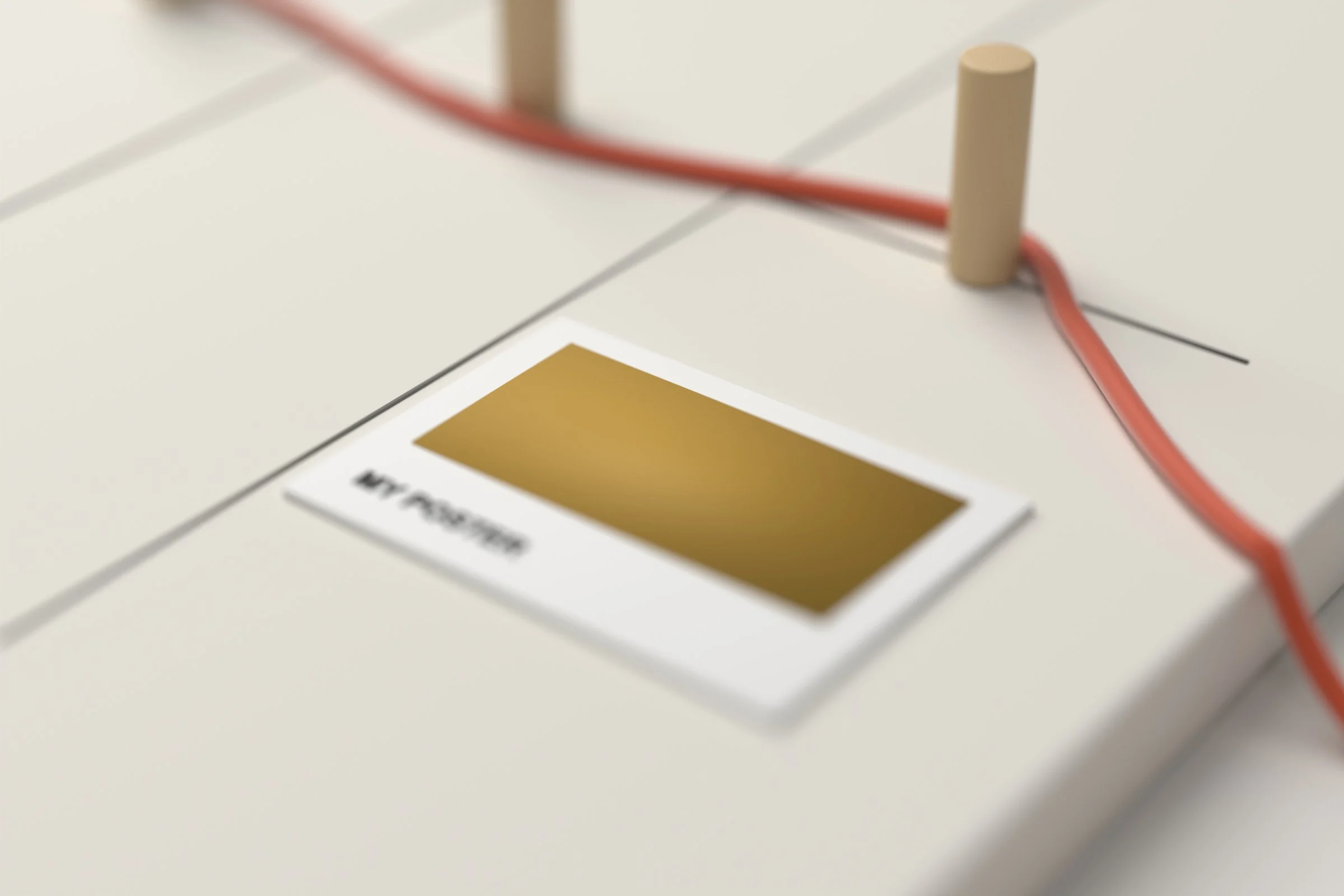
Close-up of the cord laced round a wooden peg and running off the board’s edge beside a card labelled My poster

6
double-sided situation cards, the same six as Draw your line
1
orange cord, laid between the cards or carried from peg to peg
2
A3 process boards, seven stages each, with a peg per stage
T
orange tokens from the original Sheet A, to mark where AI came in

Where it started · 2026 graduation outcomes

The original two tools.

Original reflective tools

Individual reflection

My AI
Practice Statement.

Consider the same studio situation twice: first as the creator of the source work, then as the person using AI.

The tool brings the two responses together in a personal statement to carry into future projects.

Read the example statement ↗
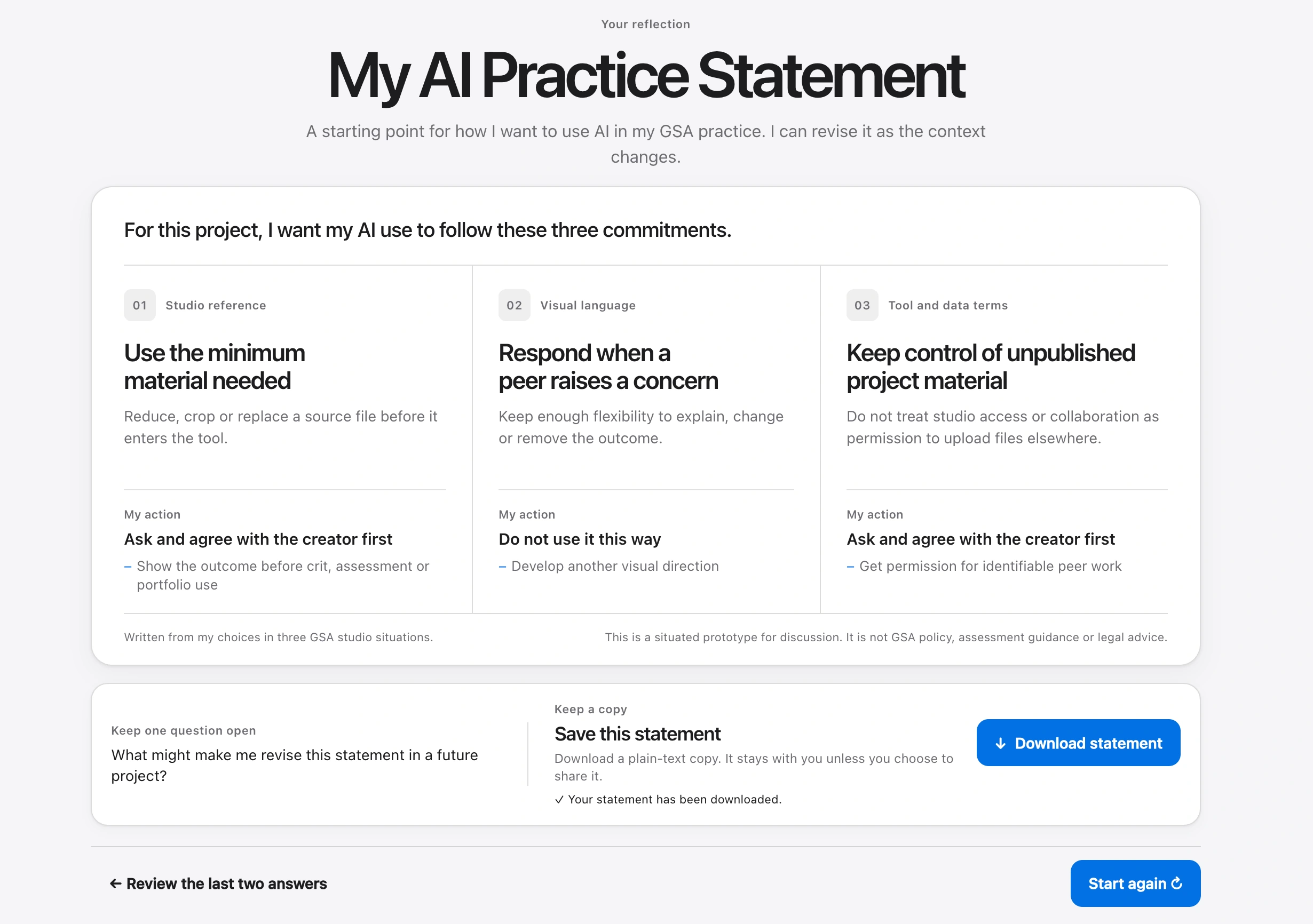
My AI Practice Statement example, with three commitments about references, peer concerns and unpublished project material
An example output from the reflection tool.
Trace the LineThree sheets. Two perspectives.
A small shift in perspective.

A shared, physical conversation

Trace the Line.

Put the question on the table.

A printable workshop turns a broad ethical question into things people can place, move and compare. Three sheets carry the conversation from one real project to two reciprocal roles.

ALocate the involvement.Place tokens where AI entered a real design process. The tokens mark perceived involvement, not a score.Read sheetClose sheet
Original Trace the Line Sheet A: Locate the involvement.
Original workshop material. Sheet A.
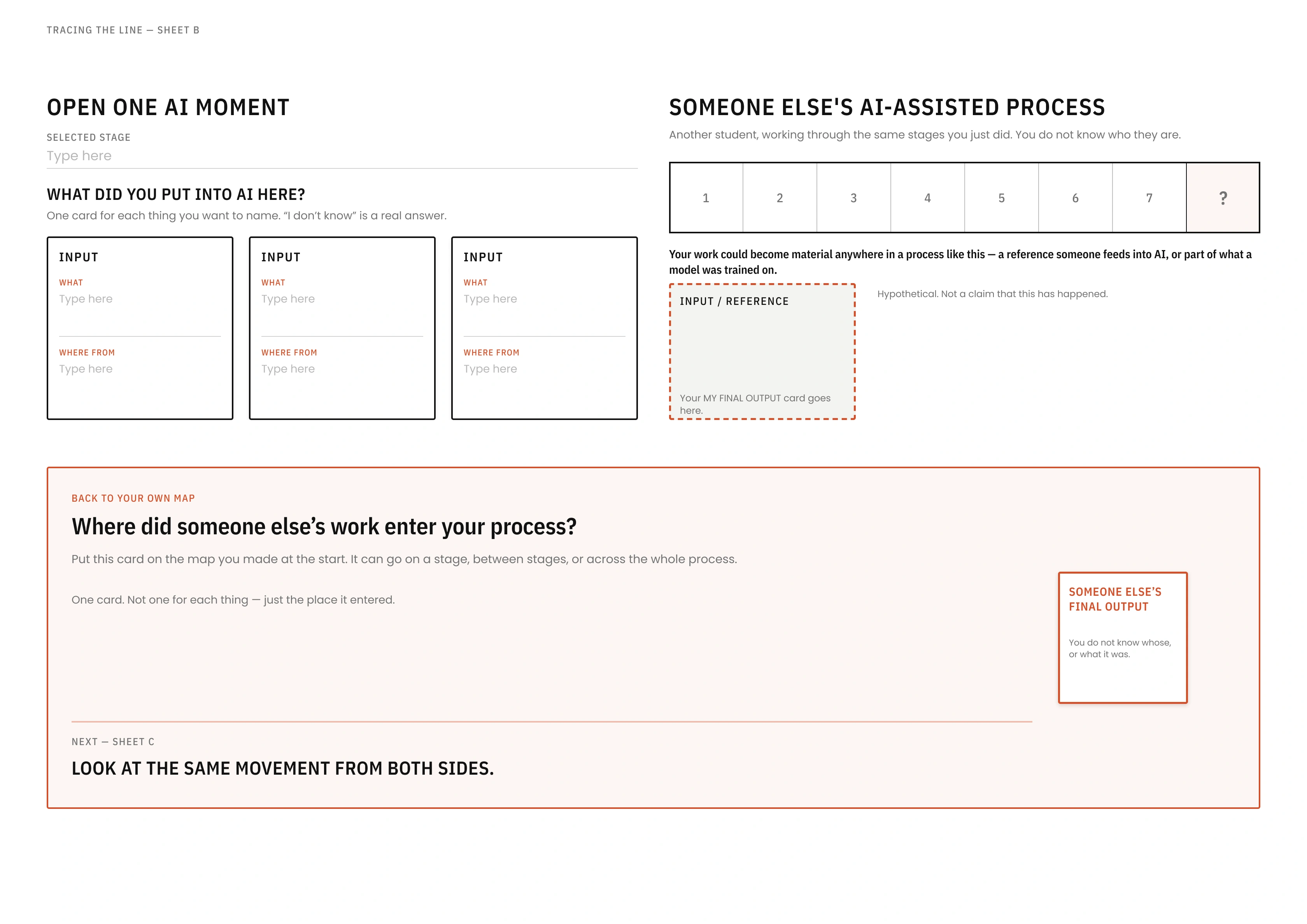
BFollow the exchange.Open one AI moment. Trace whose work entered your process, and where your own output could travel next.Read sheetClose sheet
Original Trace the Line Sheet B: Follow the exchange.
Original workshop material. Sheet B.
CLook from both sides.Compare the boundaries you ask for as a creator with the boundaries you respect as an AI user.Read sheetClose sheet
Original Trace the Line Sheet C: Look from both sides.
Original workshop material. Sheet C.

A token is a starting point.

A marker of perceived involvement. Not a count, percentage or score.

What I want
to test next.

The contribution is a way to work with disagreement, without pretending one rule will settle it.

It is not a consent mechanism, GSA policy or legal advice. What I want to test next: Draw your line with a studio group, and whether the kit can hold a conversation without me in the room.

The original GSA Showcase ↗
Back to selected workDraw the Line · 2026

Find your next question.

Back to selected work Objects, services & systems.

Trace the Line · Sheet A

Locate the involvement.

Place tokens where AI entered a real design process. The tokens mark perceived involvement, not a score.

Original Sheet A: Locate the involvement.

Where would you place it?

Drag a token, or choose a place below. Use all, some or none.

Try a placement. There is no correct answer, and this is not a score.

Reading this sheet

A real project anchors the conversation. Seven stages run from research to communication. Place tokens on or between stages to mark where AI felt involved, then choose the stage you thought longest about.

Open original image ↗ (opens in a new tab)