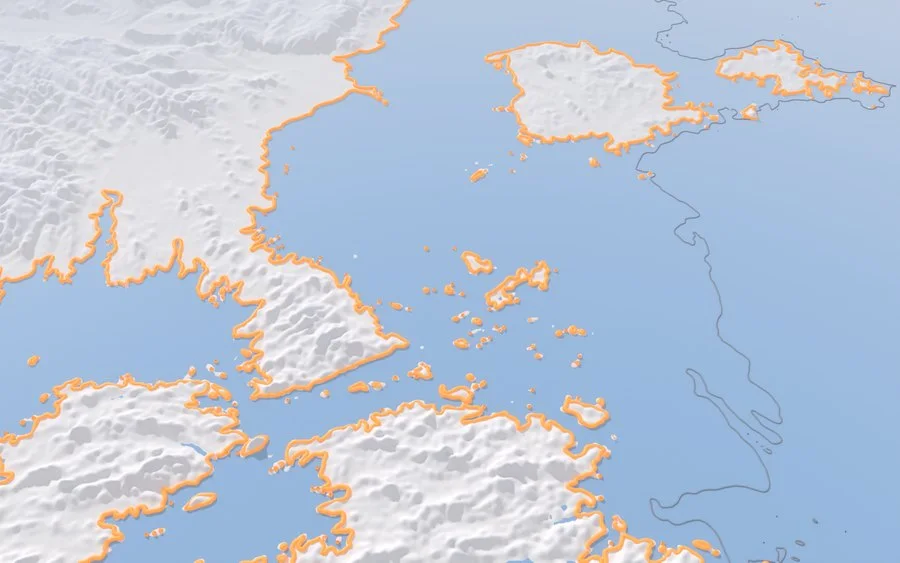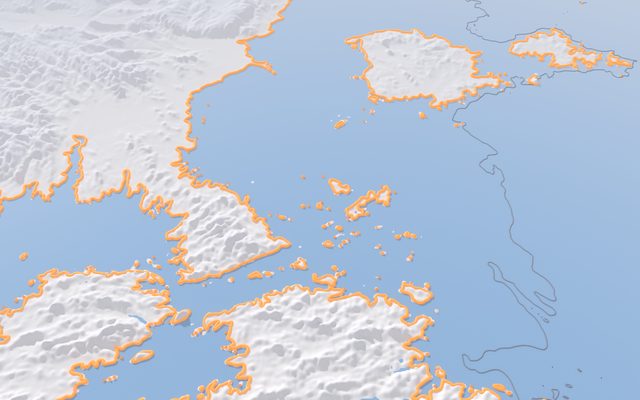
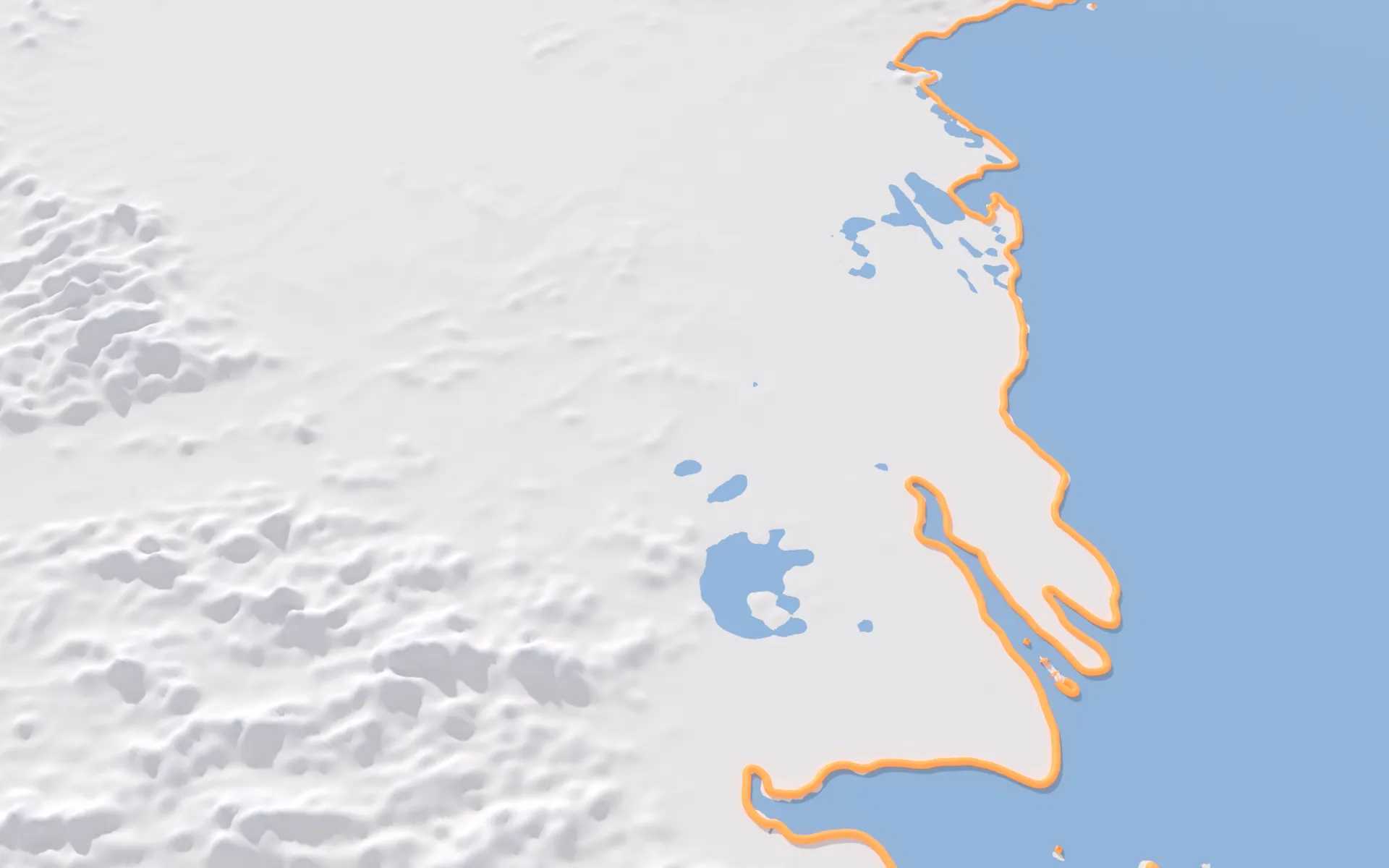
A white relief model of the Yangtze delta from above, with the sea in blue and today's coastline traced in orange

A learning service for climate-displaced students

Coast
line.

If the sea rose 70 metres, the coast would move inland.
What keeps a student learning when home moves with it?

My part
Scenario, research, service and interaction design; for 2.0, the station, the opening and the classroom interactive.
Context
Personal project, 2024–25. Rebuilt in 2026.
Status
A proposal. Not researched or tested with displaced students.
Skip to the case
Follow the coast

The Yangtze delta, as it is today.

The original project began with a thought experiment: by 2080, the sea 70 metres higher. Real elevation decides what goes under.

Grey is today’s coast. Orange is the new one. Shanghai and the plains of the lower Yangtze are under water.

Families move inland, up the river.

To the edge of Chengdu, 500 metres above the sea. Here the project begins.

Context

Personal project, October 2024 – March 2025. Rebuilt as 2.0 in 2026.

My work

Scenario, desk research, service and interaction design. For 2.0: the station model, the opening and the classroom interactive.

Outcome

A hybrid learning service for students aged 12–18: shared stations, a class in a headset, a tablet at home, mentors.

The original boards
All projects

A home can change.
Learning should not have to stop.

Once families have moved and found the basics, five problems are waiting for them on the edge of the city.

I worked on one: education. In the outskirts, schools are far fewer than in the centre, so learning would move online, and online learning has its own gaps.

  • Emotional cognition
  • Dietary culture
  • Education
  • Social identity
  • Dialect

Carried by this project

Still there, beyond its scope

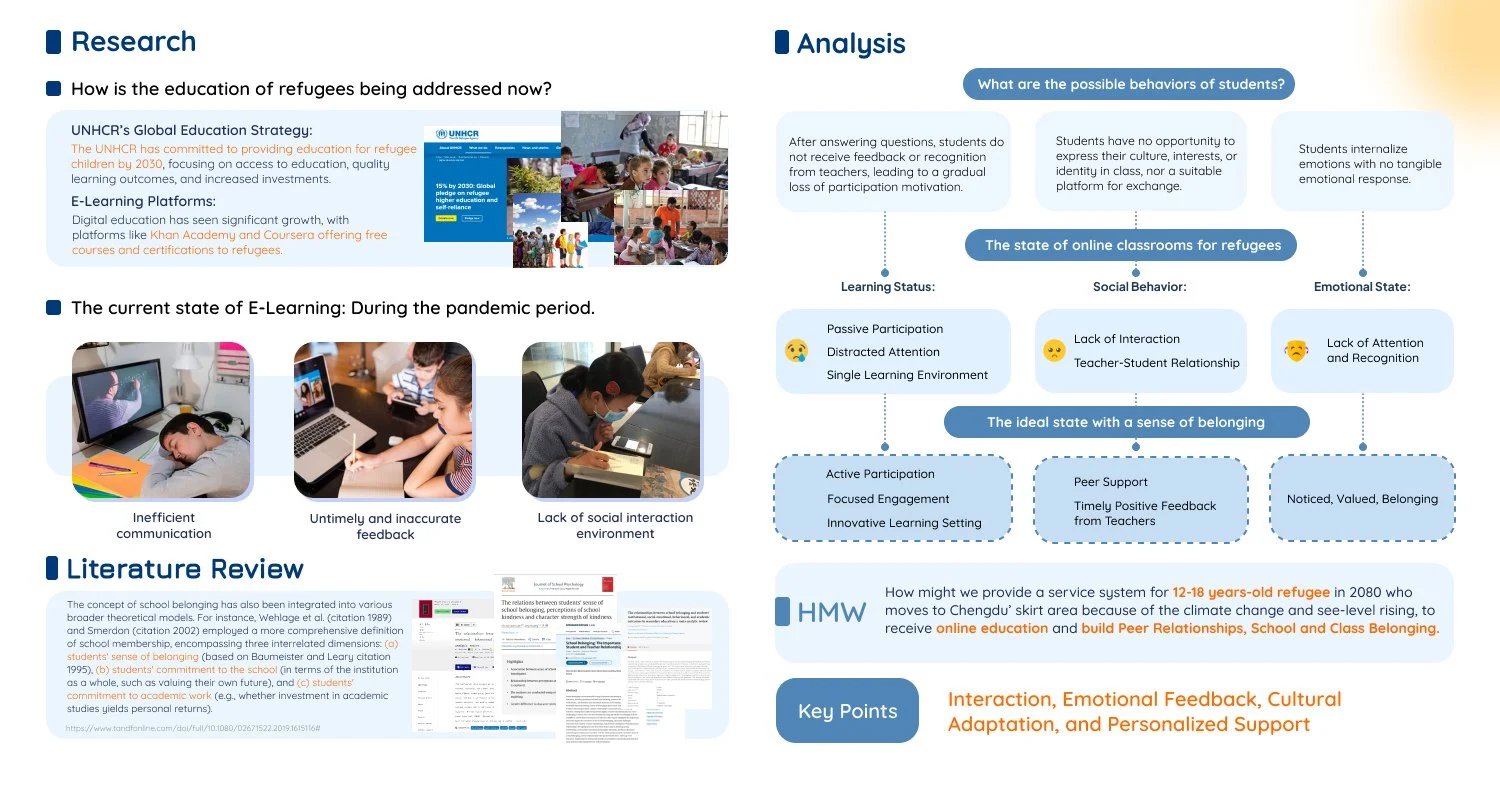
Online, a class can go quiet.

Digital education for refugees is growing; UNHCR’s 2030 strategy and free courses on Khan Academy and Coursera point that way.

But pandemic classrooms showed three gaps: slow communication, late feedback and no social life around the lesson. Research on school belonging links it to motivation, social-emotional outcomes and achievement.

Students in an online class, from my analysis

  1. Learning
    • Passive participation
    • Distracted attention
    • A single learning environment
    • Active participation
    • Focused engagement
    • An innovative learning setting
  2. Social
    • Little interaction
    • A distant teacher–student relationship
    • Peer support
    • Timely, positive feedback from teachers
  3. Emotional
    • No attention, no recognition
    • Noticed, valued, belonging

UNHCR, Refugee Education 2030 (2019) · Korpershoek et al., “The relationships between school belonging and students’ motivational, social-emotional, behavioural, and academic outcomes”, Research Papers in Education (2020). Method: literature and policy review, scenario building and analysis. The project did not involve participatory research with displaced students.

How might we give 12–18-year-olds who move to the edge of Chengdu in 2080 an education online, and the friends, school and class to belong to?

  1. 01InteractionA shared table and board
  2. 02Emotional feedbackA sticker comes back
  3. 03Cultural adaptationAsk one person, in your own words
  4. 04Personalised supportA mentor, two years ahead

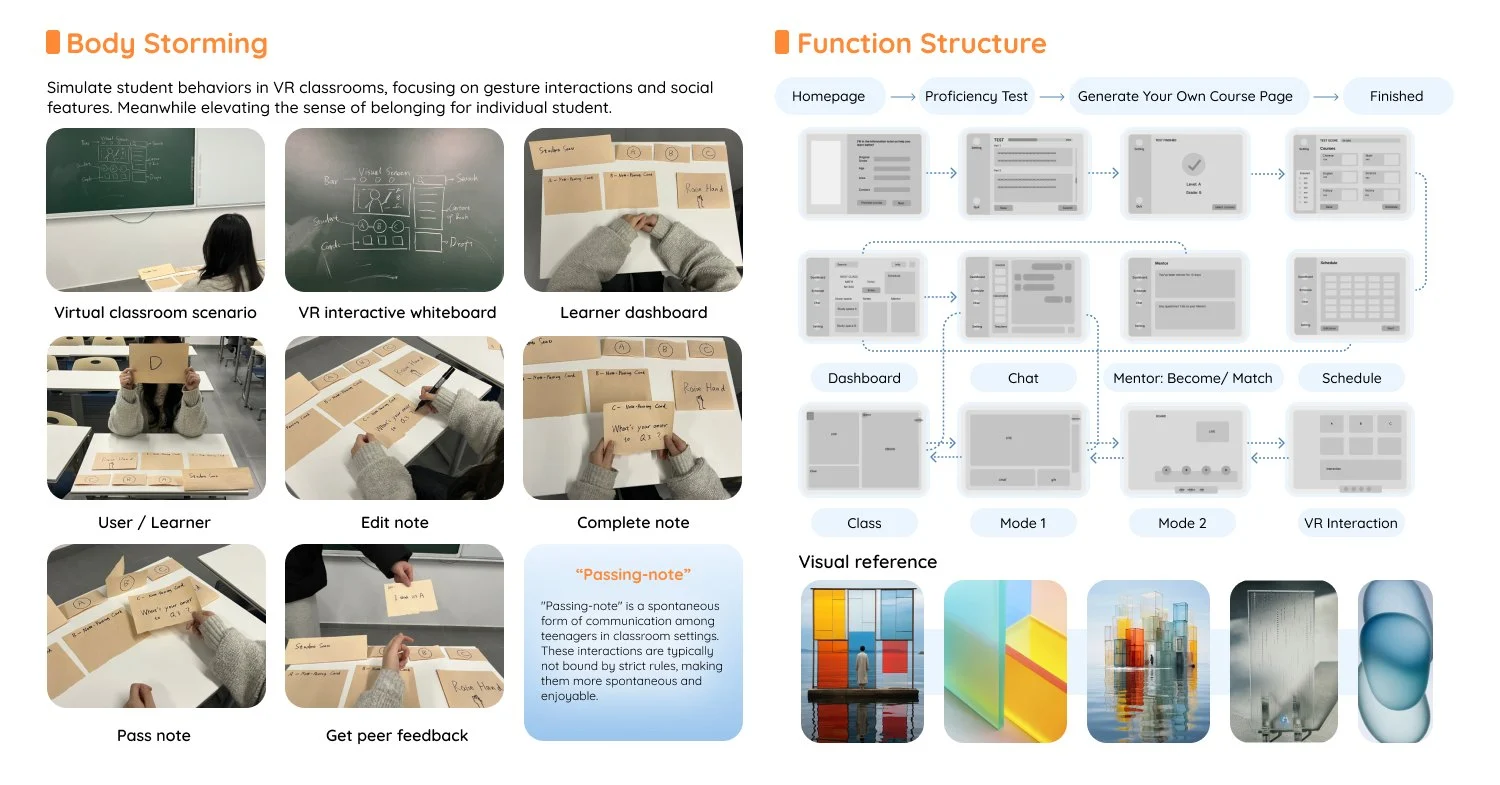
Paper first.

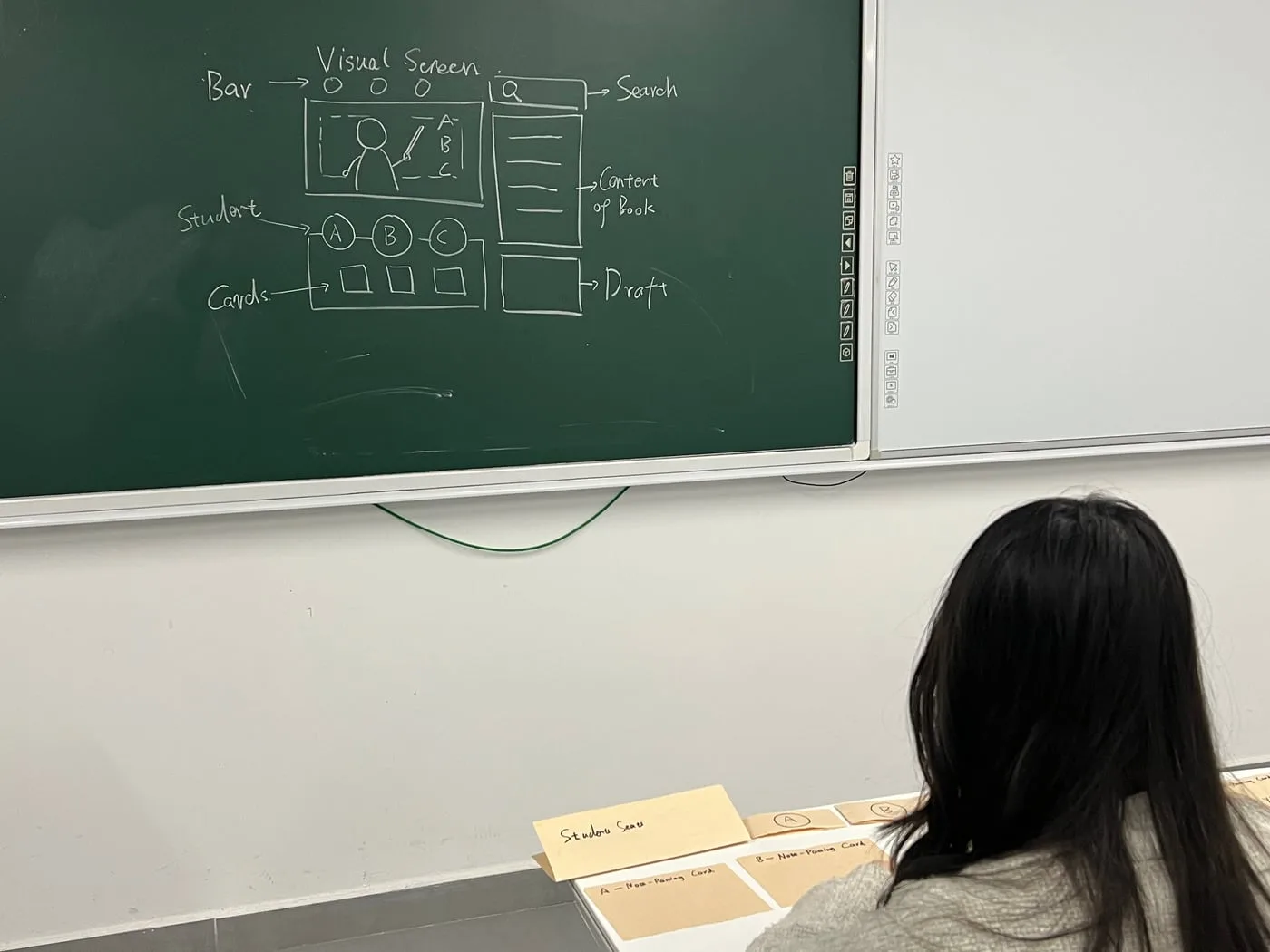
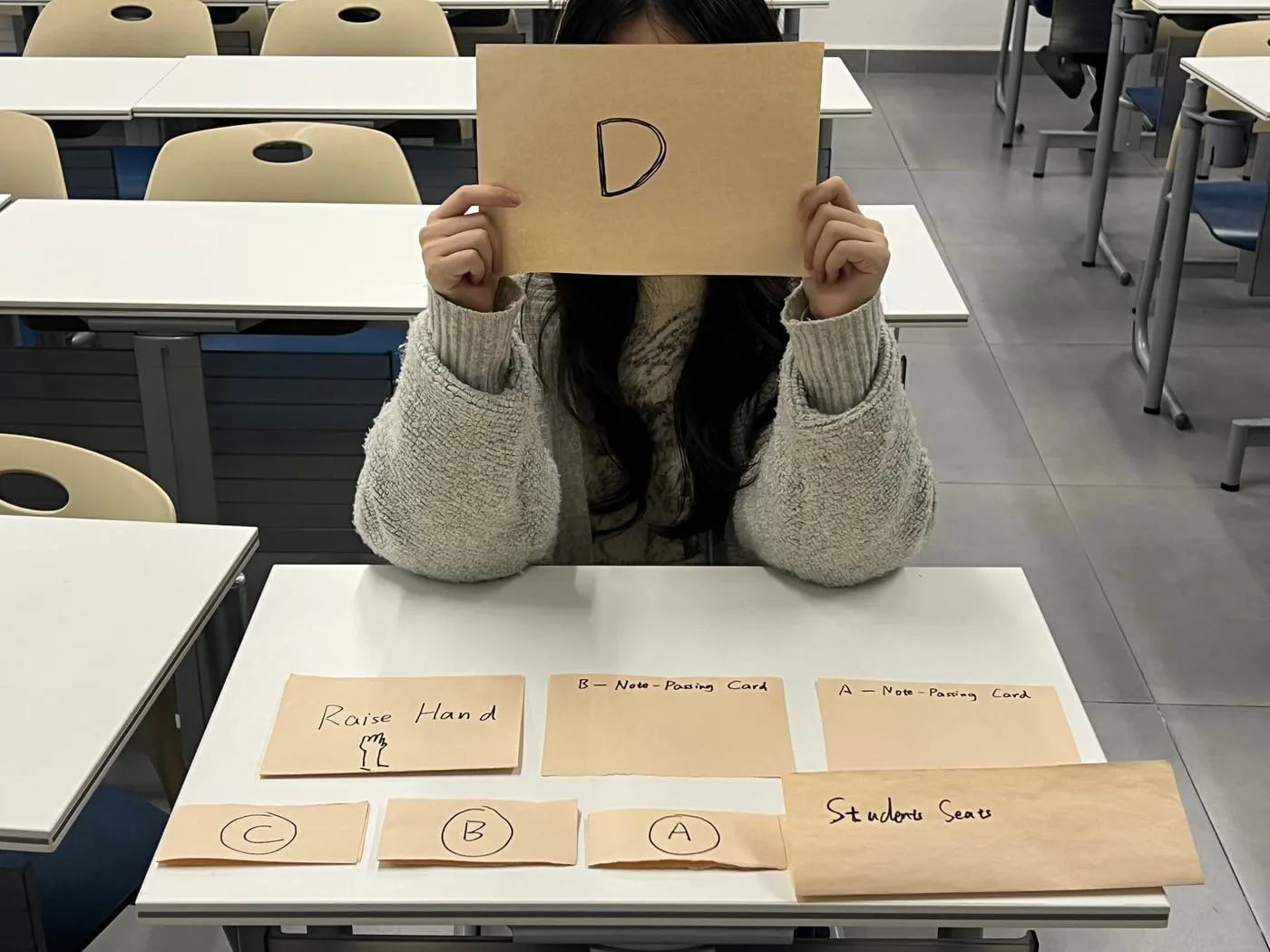
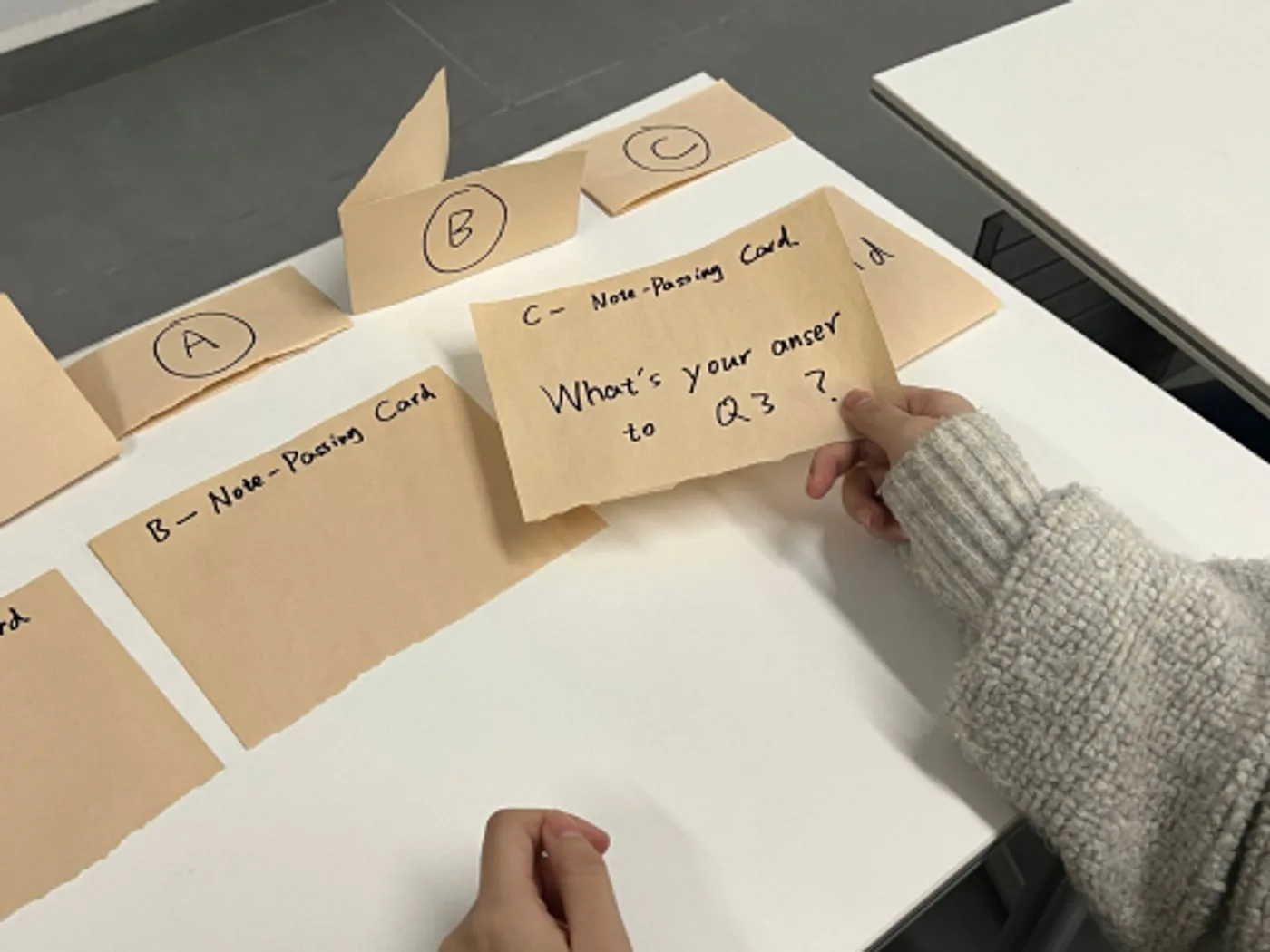
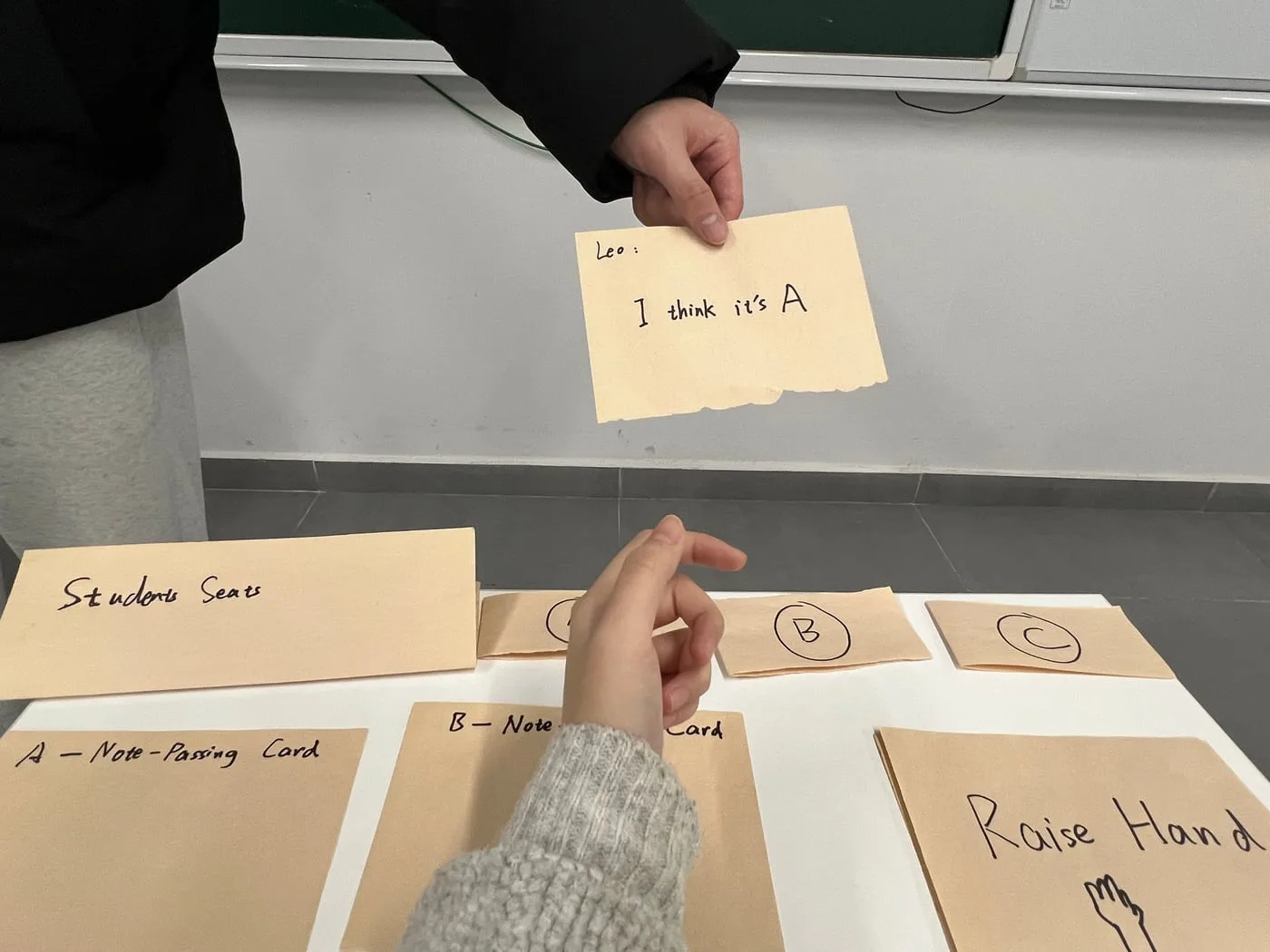
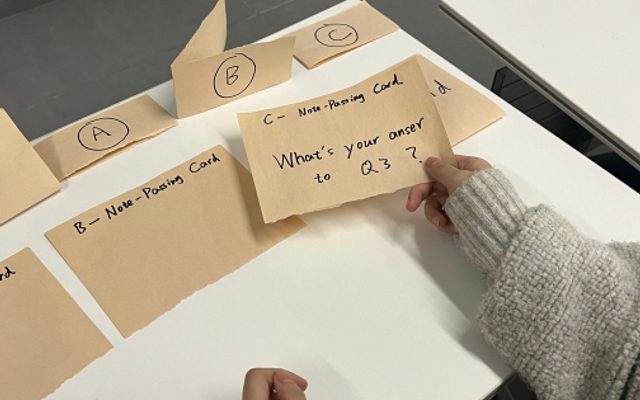
Before any screen, I acted out a VR classroom on a table: a board drawn in chalk, A–D answer cards, a raise-hand card and paper notes.

“Passing notes is a spontaneous form of communication among teenagers in classroom settings, not bound by strict rules.”

From the original bodystorming board
A student seated facing a chalkboard drawing of a virtual classroom screen, paper cards on the desk
The virtual classroom, on a chalkboard
A student holding up a card marked D in front of their face, paper props on the desk
Answering in front of everyone: card D
A hand sliding a paper note reading What's your answer to Q3 across the desk
Passing a note: “What’s your answer to Q3?”
A note held up in reply beside the raise-hand card on the desk
A reply comes back. The raise-hand card waits on the right.
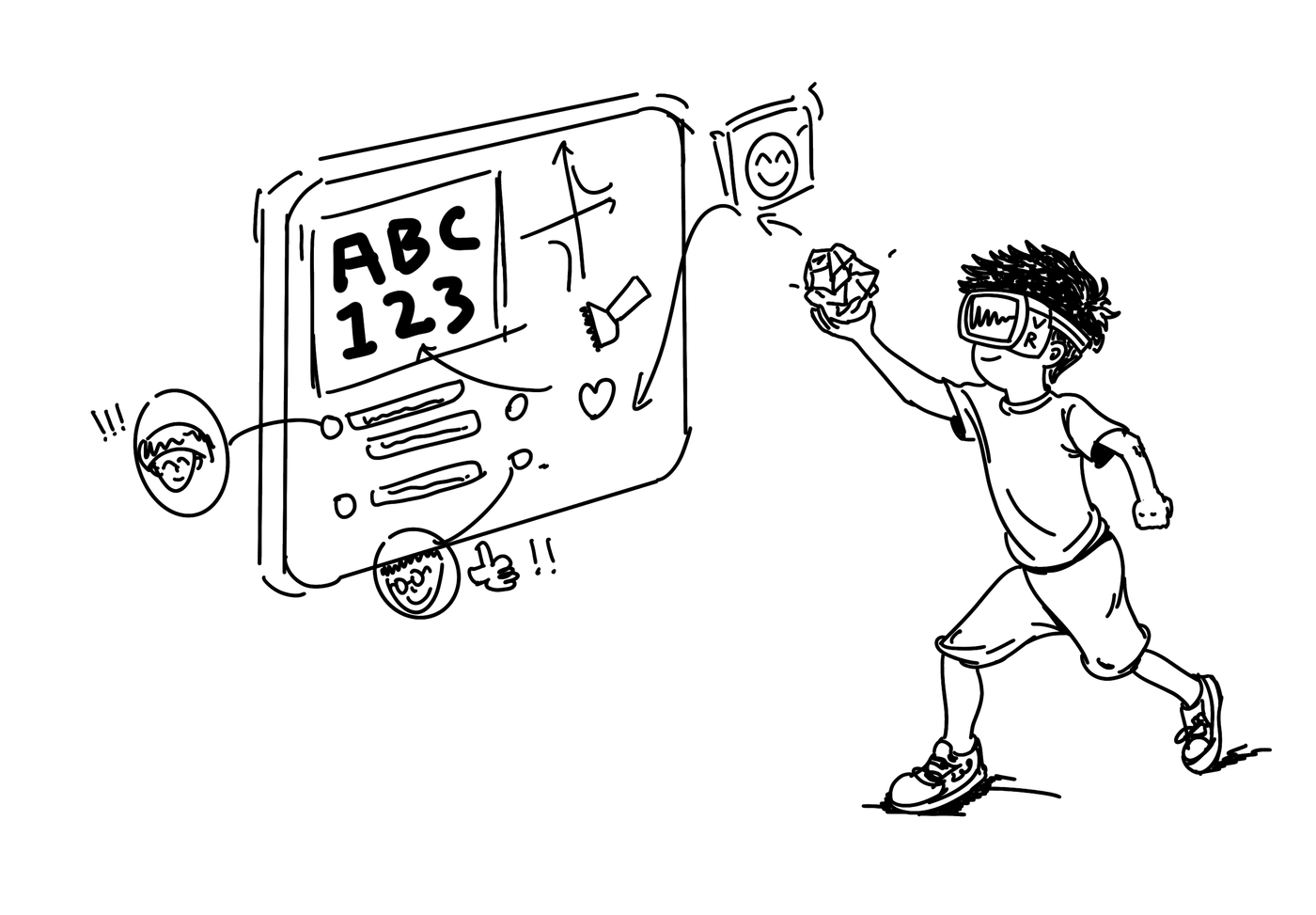
Pen sketch: a student in a headset at a virtual board, emoji reactions floating up, another student throwing a paper note
Original sketch: passing notes and emotional feedback in VR

What I took from itThe raise-hand card and the note did the same job in opposite ways. One asks in front of everyone, the other asks one person. For a student who has just arrived, with a different accent and no friends yet, that difference decides whether the question gets asked at all.

A place to learn,
on the edge of the city.

Coastline puts shared learning stations in resettlement neighbourhoods, next to schools and community services.

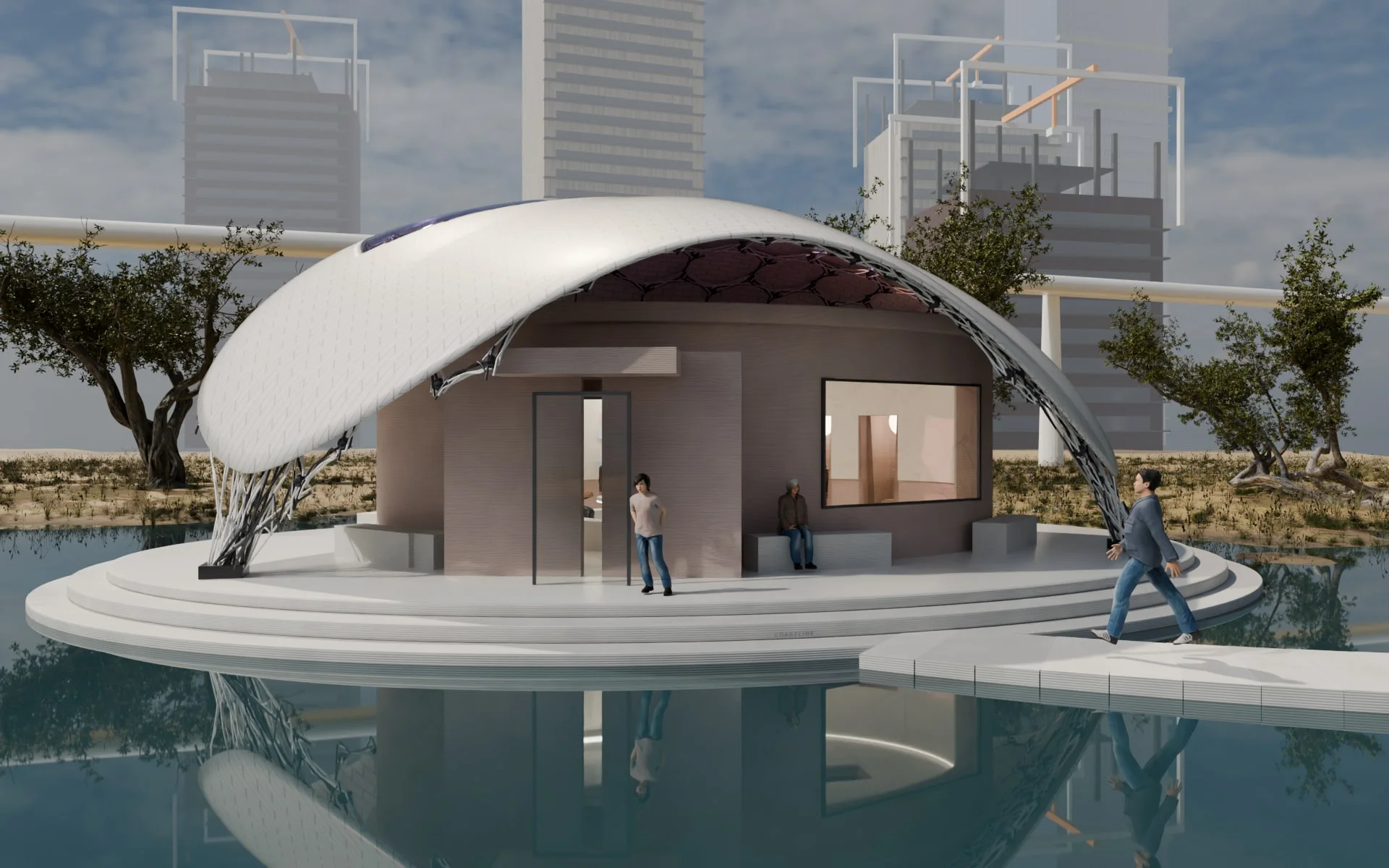
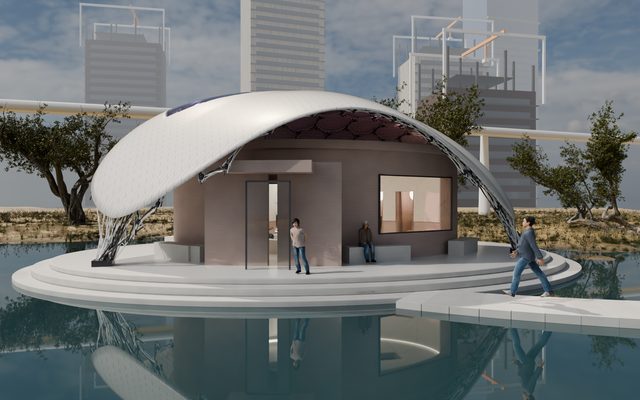
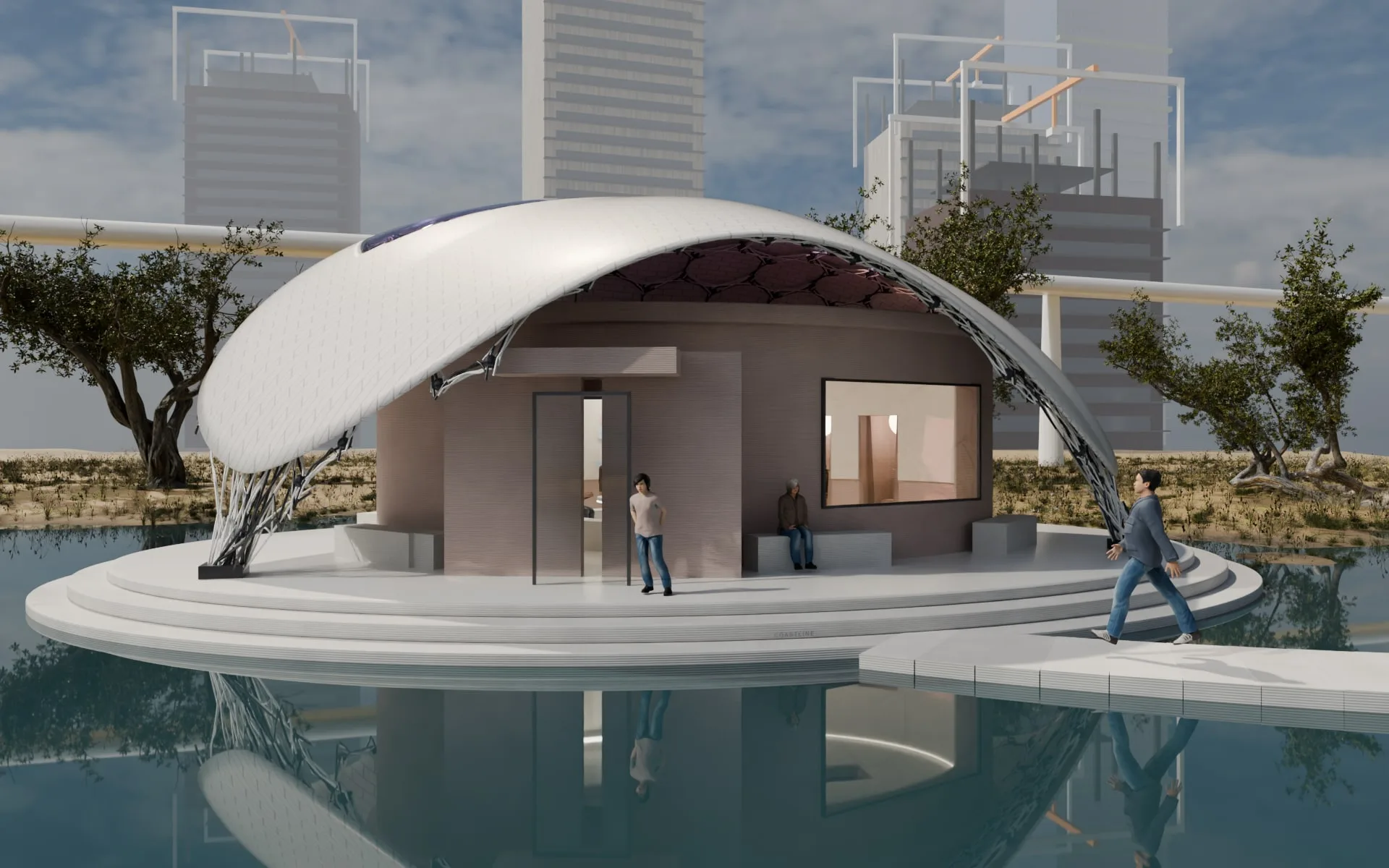
By 2080 the towers built in the 2020s are coming down, and the station is made in two layers. A shell wound by robots from glass and carbon fibre, covered in ceramic solar shingles, keeps off the rain and the sun and powers the headsets; one band of dichroic glass along the ridge lets in a slow, coloured light. Under it is a quiet classroom printed from the old towers’ concrete and the basin’s red earth: thick walls, a lobby that keeps the noise out, felt on every wall. Between the two, a shaded porch for whoever is waiting. Students come here for live classes in a headset, and go home with the same course on a tablet.

Rendering: a smooth pearl-white shell of solar shingles on three fibre feet, over a rose-coloured printed classroom with a lit window and a glazed lobby, on a pale printed base in a wetland; a student waits at the door, an older neighbour sits on the porch bench and a man walks in along the path; behind it 2020s towers, two of them being taken down by robot rigs
The station in 2080, on the edge of Chengdu. Modelled for 2.0. A shell for rain, sun and power over a room for quiet, as in Kéré’s Gando Primary School, where a raised roof shades the thick-walled classrooms below. The shell’s structure follows robot-wound fibre pavilions such as ICD/ITKE’s BUGA pavilion; the walls, buildings printed from site material such as TECLA. The original visual reference, coloured glass, stays as one band of light along the ridge.
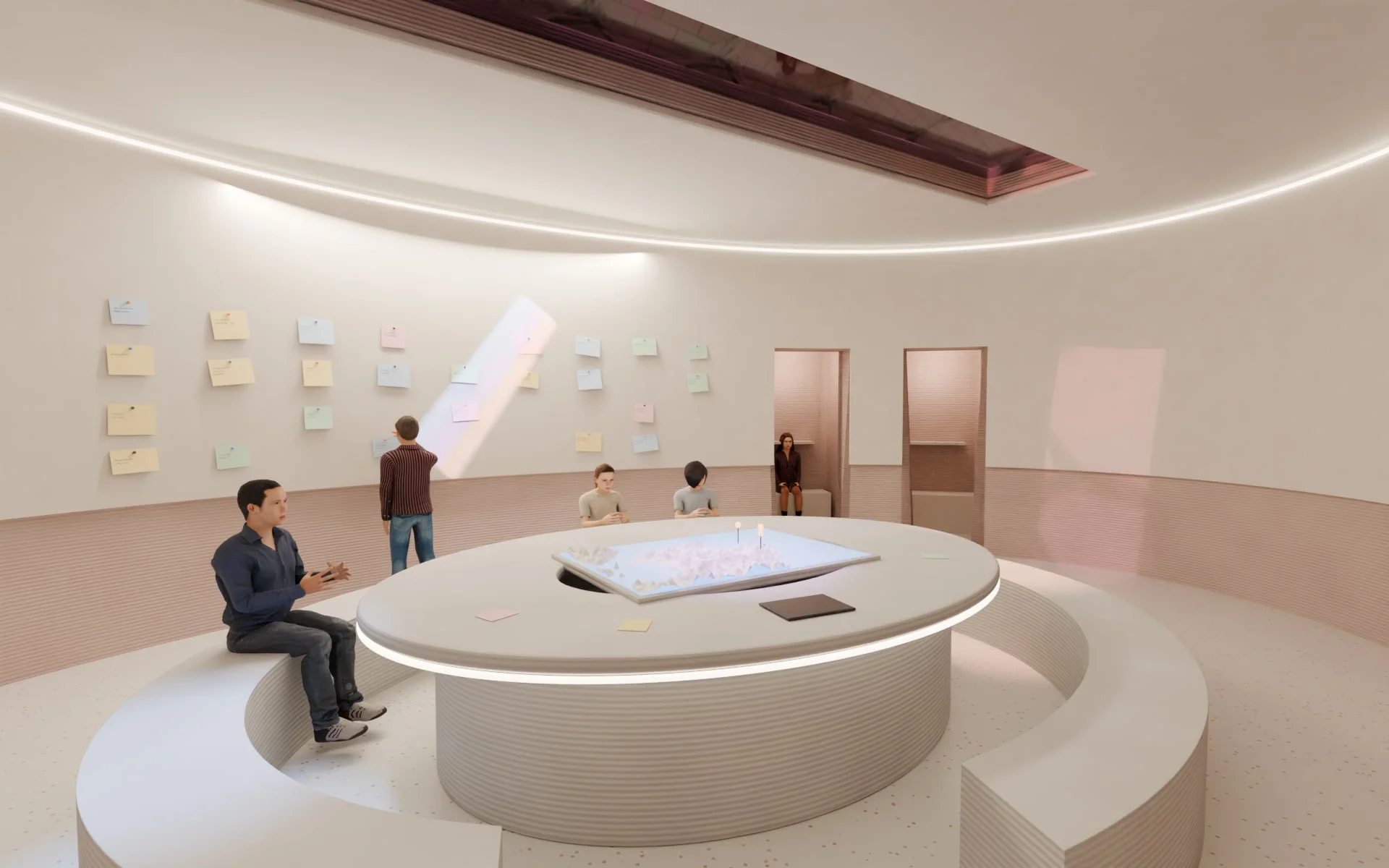
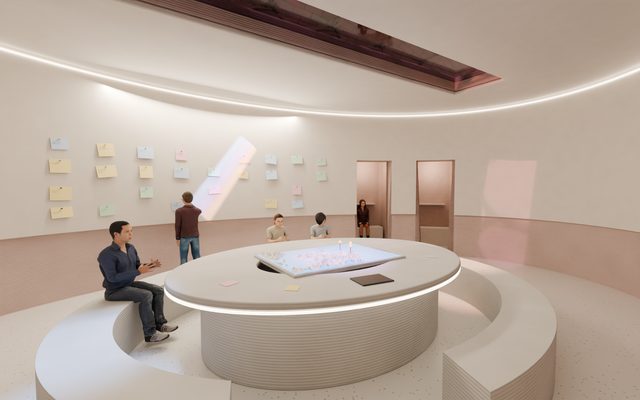
Rendering inside the classroom: students sit at a printed ring of table and bench around a small relief of the Yangtze delta, under a felt ceiling with a skylight slot and a ring of soft light; a slanted band of coloured light falls across the paper notes on the felt wall, where one student pins a new note; a mentor sits in one of two small booths at the back

Choose a point to look closer.

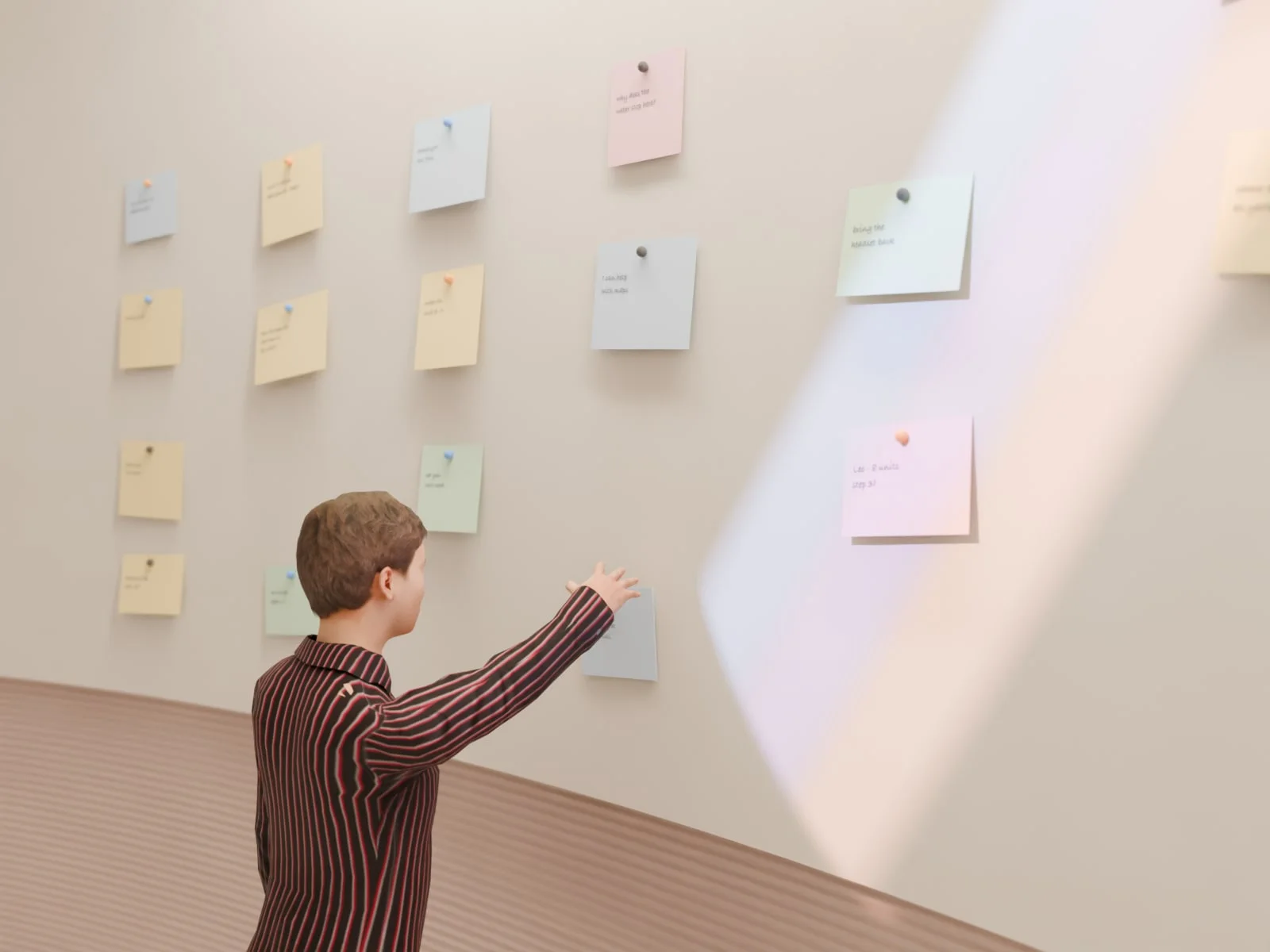
Close-up rendering: a student reaches up to pin a blue note to the felt wall among handwritten paper notes, a slanted band of blue, lavender and peach light from the skylight falling across them
The note wall

Raise your hand,
or pass a note?

Alex arrived from Shanghai three weeks ago. Today’s class at the station is The coast I came from: trace where the coast was. Alex is lost.

Two props from the paper classroom did the same job in opposite ways. Choose one.

A scenario: the class and timings are illustrative. In the service, the teacher also sees passed notes in the class summary, so asking a classmate never hides a question.

The note
comes home.

The same course lives on a tablet. The note from class is there, with Leo’s answer and the map it was about.

If Alex wants more, a mentor is one tap away: an older student on the same course, matched by the service. Mentors answer when they can; nothing here waits on an instant reply.

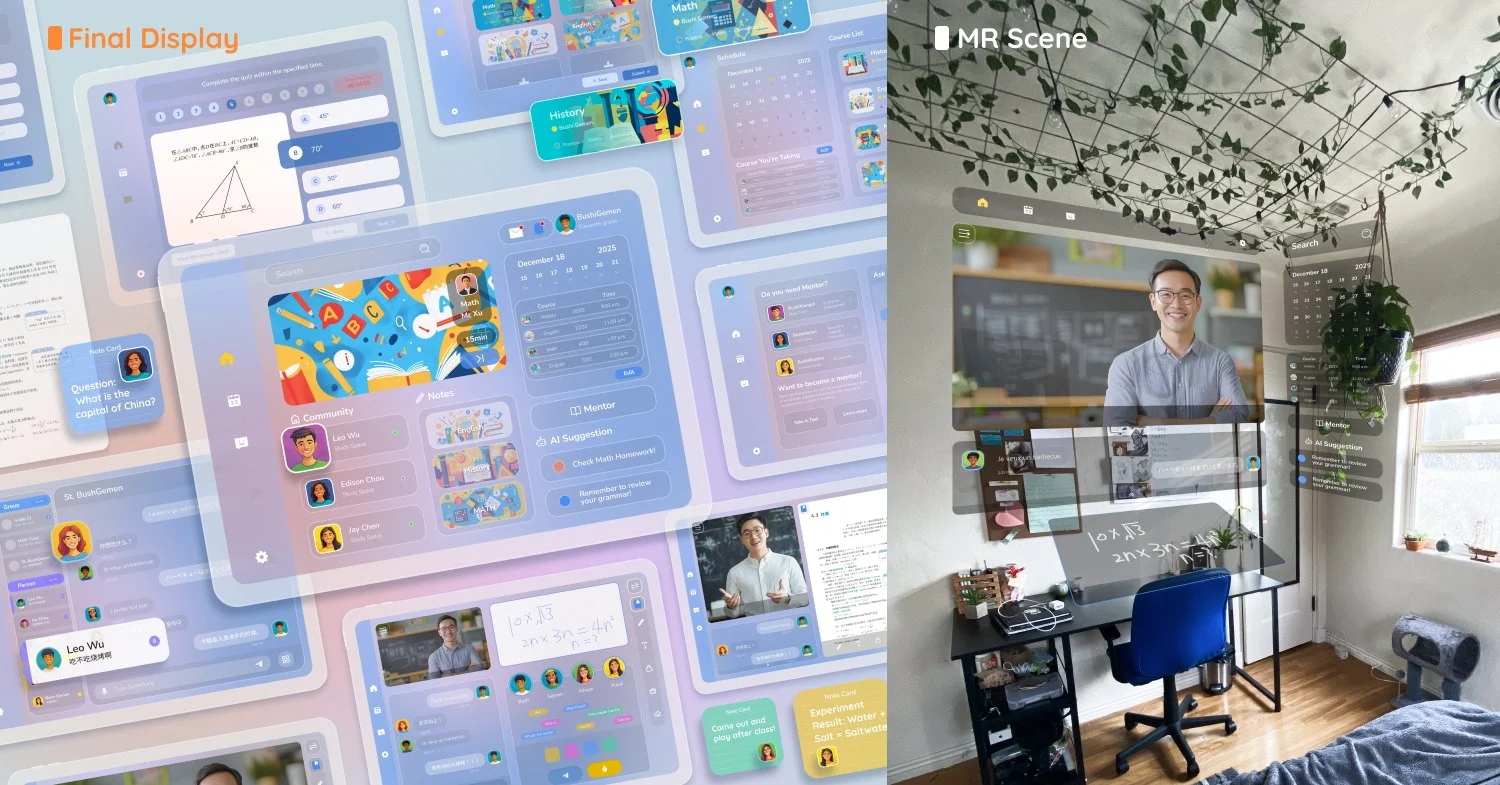
The workspace keeps the look of the original final display: blue, lavender and peach behind white glass.

Kept from class · Wed

Notes

Which line is today’s coast?Alex → Leo · Station class
Grey is today. Orange is 2080.Leo
Attached to the board map, The coast I came from. Also in the teacher’s class summary.

  • How do I book a headset for Friday?to the station host
  • Words my Chengdu classmates usemy own list
Matched for this course

Maya

Maya · Grade 12Passed the mentor test. Took this course two years ago.

  1. Which line is today’s coast?Note from Wednesday
  2. Trace the 0 m line first, then the 70 m one. The gap between them is the land that went under. Bring it on Wednesday?

A preset example. Mentors answer when they can; a note never needs an instant reply.

This week

Station and screen

  1. Mon
    OnlineMandarin reading
  2. Tue
    OnlineMaths · fractions
  3. Wed
    StationThe coast I came fromHeadset 3 booked
    NoteBring the traced mapfrom Maya
  4. Thu
    MentorCall with Maya19:00
  5. Fri
    StationOpen studyDrop in

Two years later,
Alex answers.

In the original concept, older students can take a test to become mentors. Belonging is also being needed.

Grade 11. A new arrival from the south coast sends Alex the kind of note Alex once sent.

Mei → Alex · new this weekWhere do I get a headset, and do I have to talk in class?
Alex → MeiStation desk, ask for Mr Zhou. And no. Pass me a note.
Coastline · Peer mentorAlex

Passed the mentor test. Mentoring at Chengdu East station.

Co-issued with the local school · proposed

How the service
fits together.

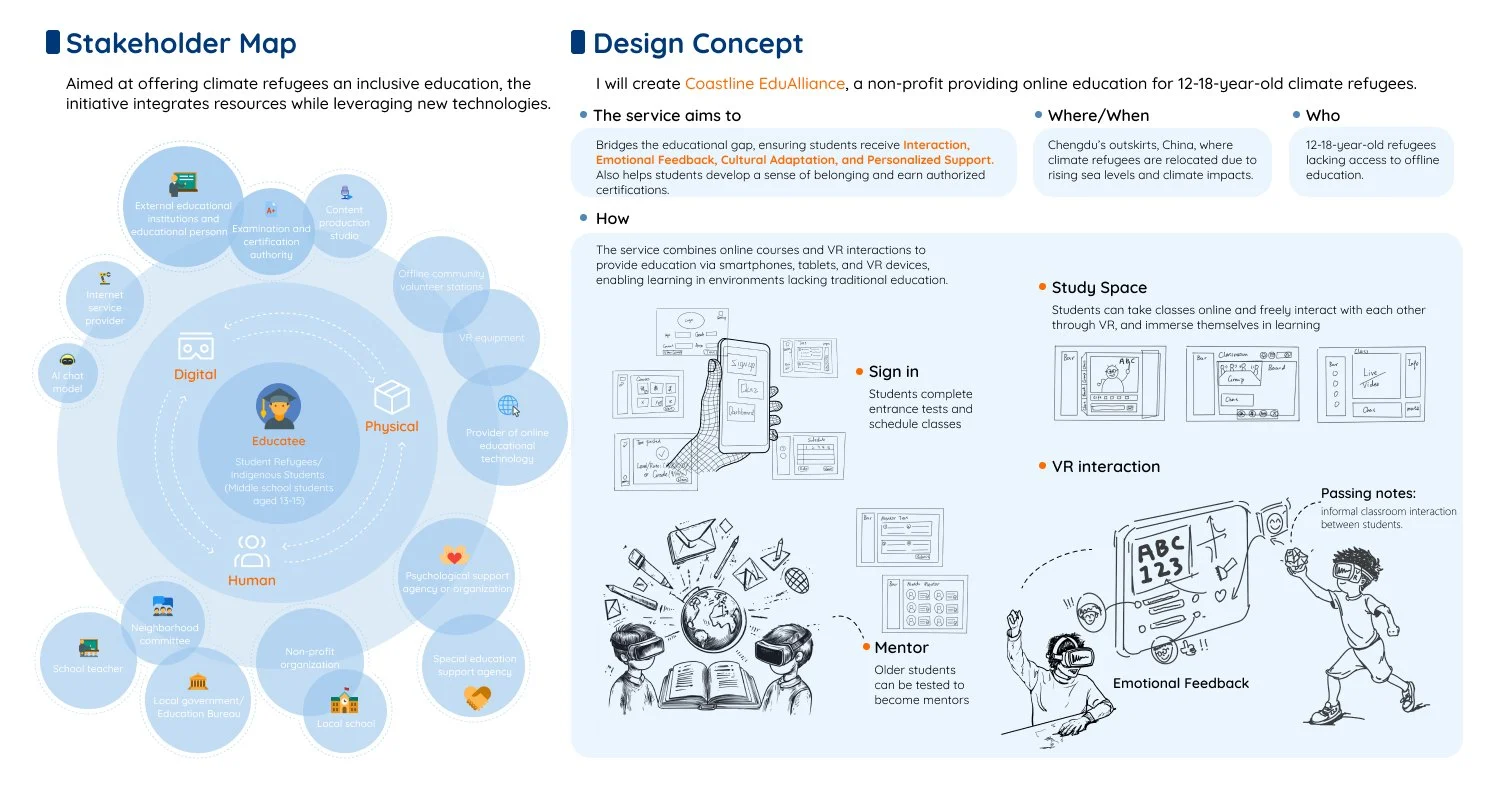
The original stakeholder map put the student at the centre of three rings. Follow the note, and each ring carries part of it.

Choose a ring to see which steps it carries.

  1. 01Book a headsetStation, Wednesday 16:00
  2. 02Class on the shared boardThe coast I came from
  3. 03Pass a noteAlex to Leo
  4. 04A sticker backand the answer
  5. 05Kept on the tabletand in the class summary
  6. 06A mentor answersMaya, Grade 12
  7. 07Becomes a mentorcertificate with the local school

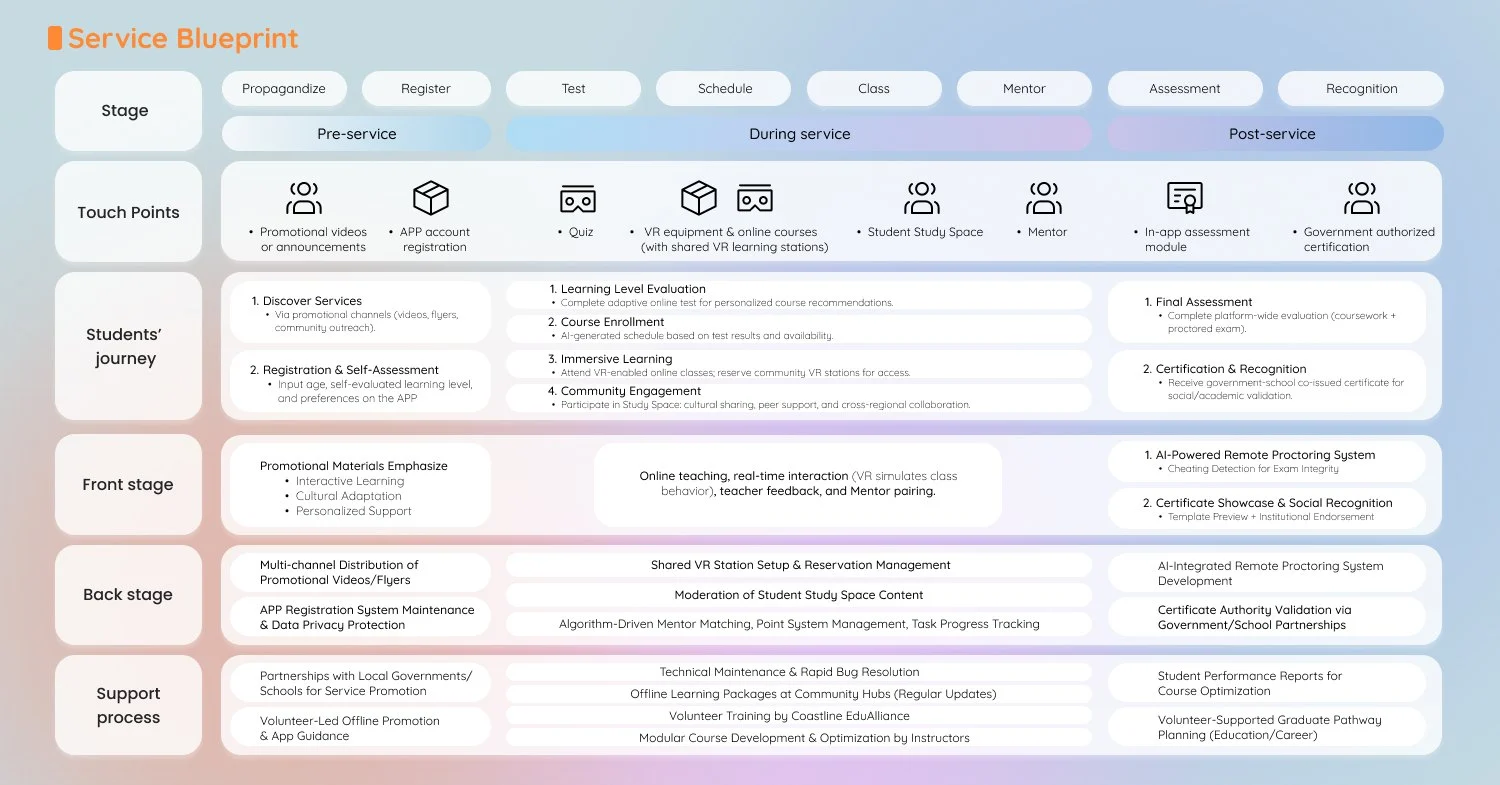
The service blueprint

Before, during and after the service, through every layer. Point at a phase to read it straight down.

Stage

  1. Propagandize
  2. Register
  3. Test
  4. Schedule
  5. Class
  6. Mentor
  7. Assessment
  8. Recognition
Pre-serviceDuring servicePost-service

Touch Points

  • Promotional videos or announcements
  • APP account registration
  • Quiz
  • VR equipment & online courses (with shared VR learning stations)
  • Student Study Space
  • Mentor
  • In-app assessment module
  • Government authorized certification

Students’ journey

  • 1. Discover ServicesVia promotional channels (videos, flyers, community outreach).
  • 2. Registration & Self-AssessmentInput age, self-evaluated learning level, and preferences on the APP
  • 1. Learning Level EvaluationComplete adaptive online test for personalized course recommendations.
  • 2. Course EnrollmentAI-generated schedule based on test results and availability.
  • 3. Immersive LearningAttend VR-enabled online classes; reserve community VR stations for access.
  • 4. Community EngagementParticipate in Study Space: cultural sharing, peer support, and cross-regional collaboration.
  • 1. Final AssessmentComplete platform-wide evaluation (coursework + proctored exam).
  • 2. Certification & RecognitionReceive government-school co-issued certificate for social/academic validation.

Front stage

  • Promotional Materials EmphasizeInteractive LearningCultural AdaptationPersonalized Support
  • Online teaching, real-time interaction (VR simulates class behavior), teacher feedback, and Mentor pairing.
  • 1. AI-Powered Remote Proctoring SystemCheating Detection for Exam Integrity
  • 2. Certificate Showcase & Social RecognitionTemplate Preview + Institutional Endorsement

Back stage

  • Multi-channel Distribution of Promotional Videos/Flyers
  • APP Registration System Maintenance & Data Privacy Protection
  • Shared VR Station Setup & Reservation Management
  • Moderation of Student Study Space Content
  • Algorithm-Driven Mentor Matching, Point System Management, Task Progress Tracking
  • AI-Integrated Remote Proctoring System Development
  • Certificate Authority Validation via Government/School Partnerships

Support process

  • Partnerships with Local Governments/Schools for Service Promotion
  • Volunteer-Led Offline Promotion & App Guidance
  • Technical Maintenance & Rapid Bug Resolution
  • Offline Learning Packages at Community Hubs (Regular Updates)
  • Volunteer Training by Coastline EduAlliance
  • Modular Course Development & Optimization by Instructors
  • Student Performance Reports for Course Optimization
  • Volunteer-Supported Graduate Pathway Planning (Education/Career)

The original blueprint (CR-6), its text unchanged. Partnerships, proctoring and certification are proposed, not built.
A proposal,
still untested.

Coastline connects a future scenario to research, a service and the moment a student is most likely to drop out of class: when a question goes unasked.

It is a proposition. There was no research with displaced students, the headset class is not built software, and certification would need real partners. What I would test next: the raise-hand or pass-a-note moment, with a mixed class of teenagers, some of them new.
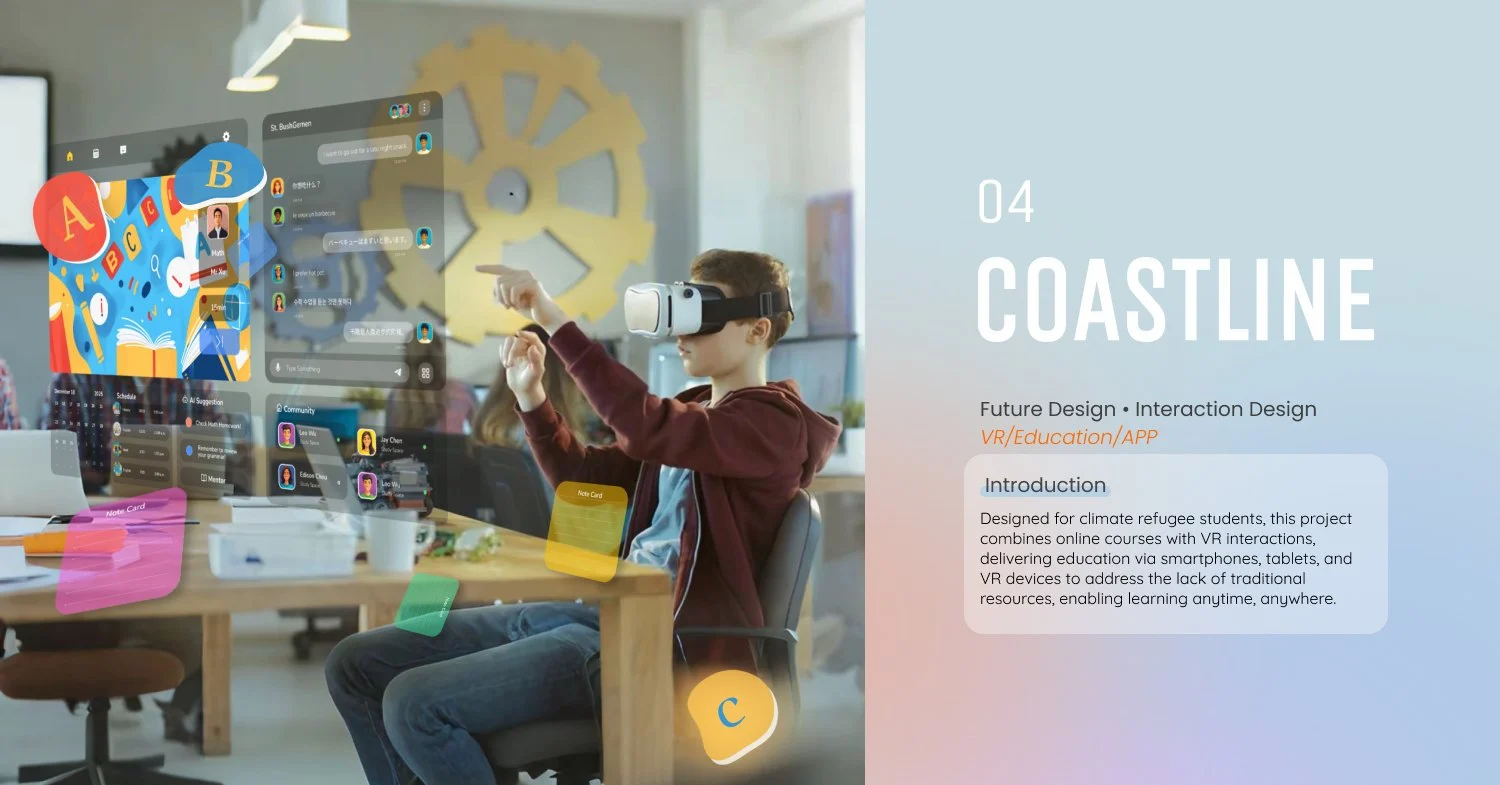
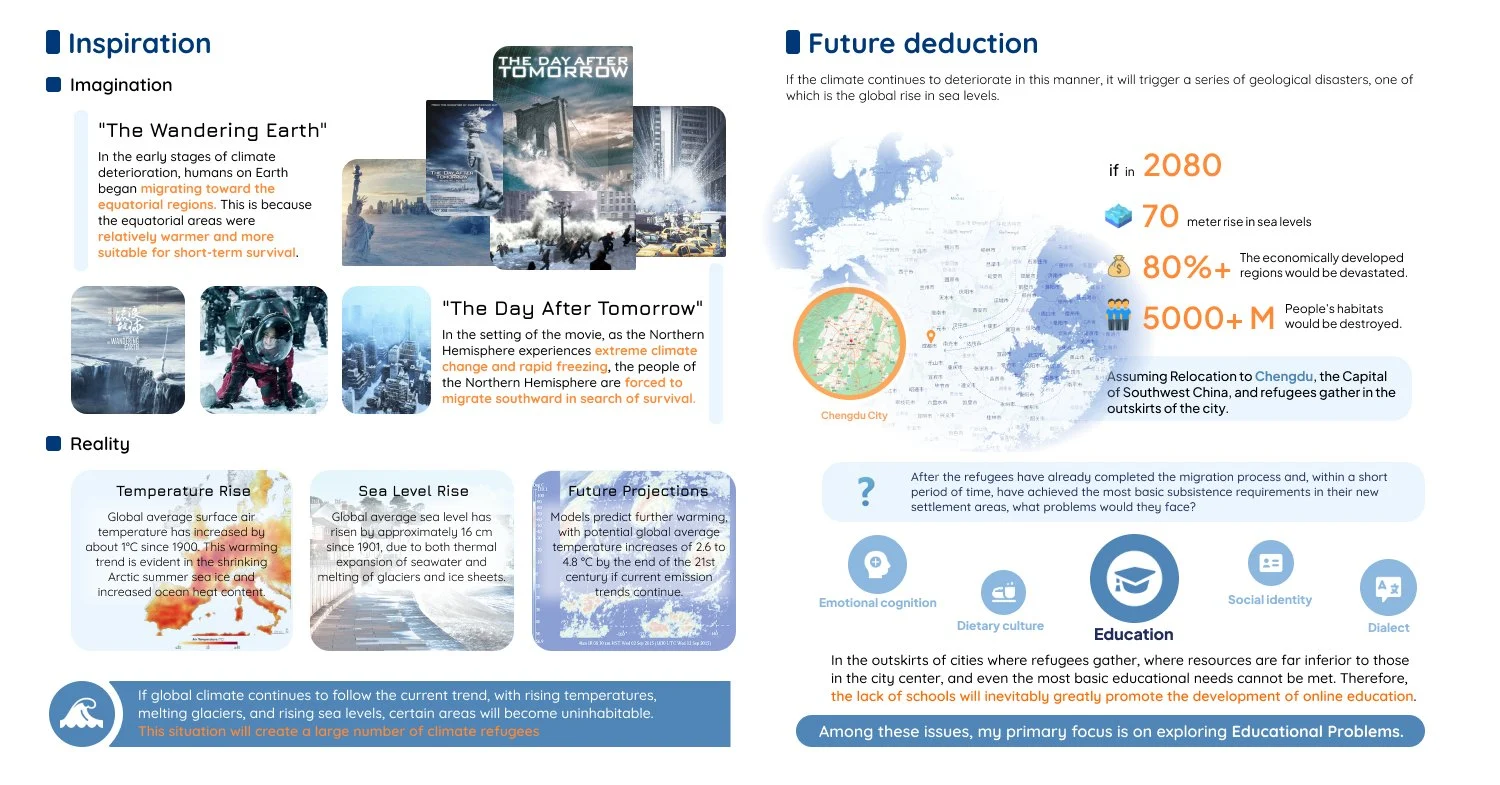
The original boards, 2025.

  1. CR-0CoverOriginal board CR-0: Cover
  2. CR-1Inspiration and future deductionOriginal board CR-1: Inspiration and future deduction
  3. CR-2Research and analysisOriginal board CR-2: Research and analysis
  4. CR-3Stakeholder map and design conceptOriginal board CR-3: Stakeholder map and design concept
  5. CR-4Bodystorming and function structureOriginal board CR-4: Bodystorming and function structure
  6. CR-5Final display and MR sceneOriginal board CR-5: Final display and MR scene
  7. CR-6Service blueprintOriginal board CR-6: Service blueprint

Between the original and 2.0, I developed a working browser prototype of the spatial lesson and the tablet workspace (2026). See the 2026 prototype →

Back to selected workCoastline · 2025 / 2026

Find your next question.

Back to selected work Objects, services & systems.

Trace the Line · Sheet A

Locate the involvement.

Place tokens where AI entered a real design process. The tokens mark perceived involvement, not a score.

Original Sheet A: Locate the involvement.

Where would you place it?

Drag a token, or choose a place below. Use all, some or none.

Try a placement. There is no correct answer, and this is not a score.

Reading this sheet

A real project anchors the conversation. Seven stages run from research to communication. Place tokens on or between stages to mark where AI felt involved, then choose the stage you thought longest about.

Open original image ↗ (opens in a new tab)