Touch, colour & music

Resonance.

A shared instrument with wooden keys
for resource-limited classrooms.

Independent BA graduation project · Feb–May 2025
Material experiments, product design & a working touch-and-sound prototype.
Named on a related patent application accepted by CNIPA.
2026 extension: product model & classroom concept.

Try the five notes
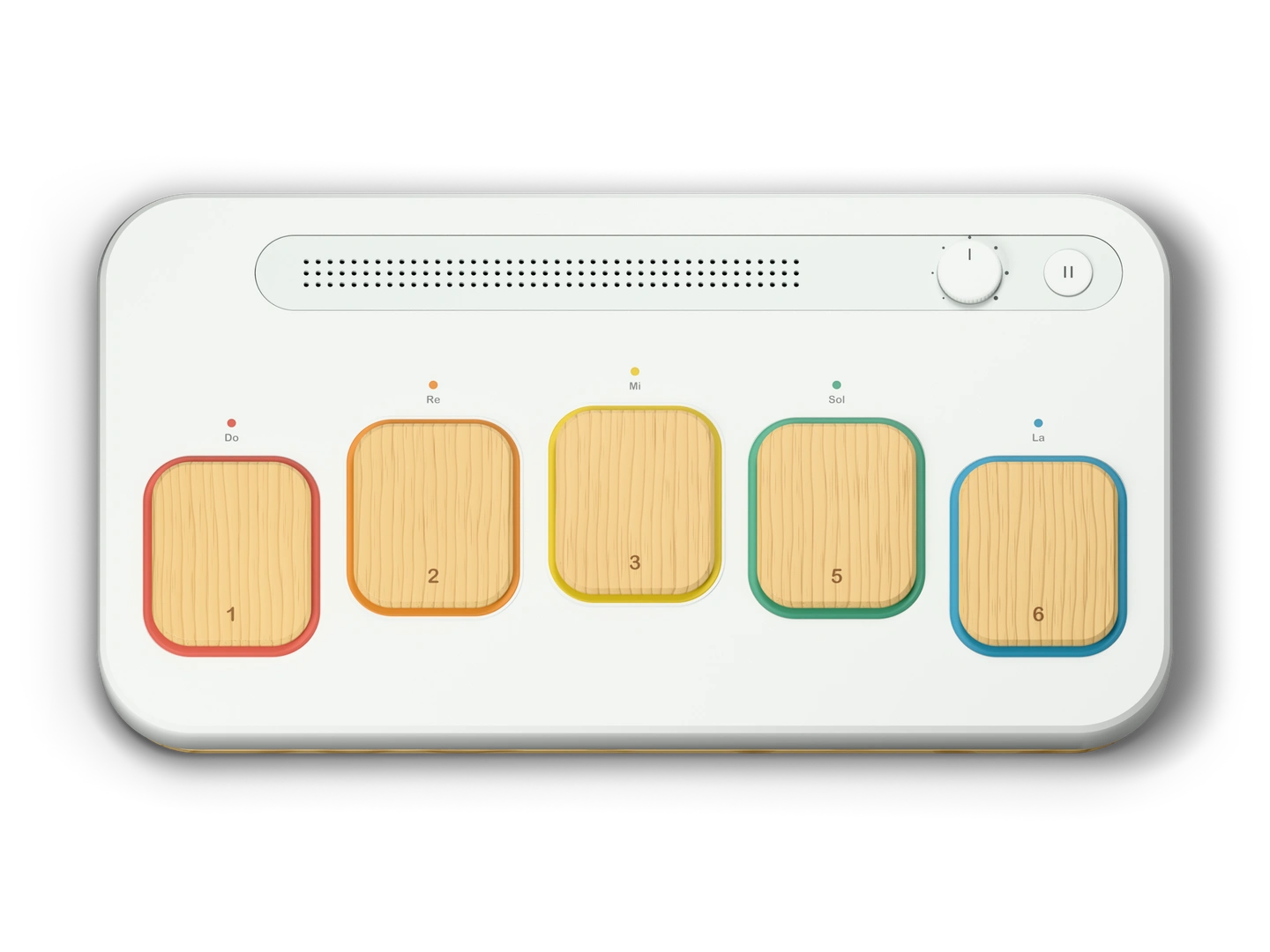
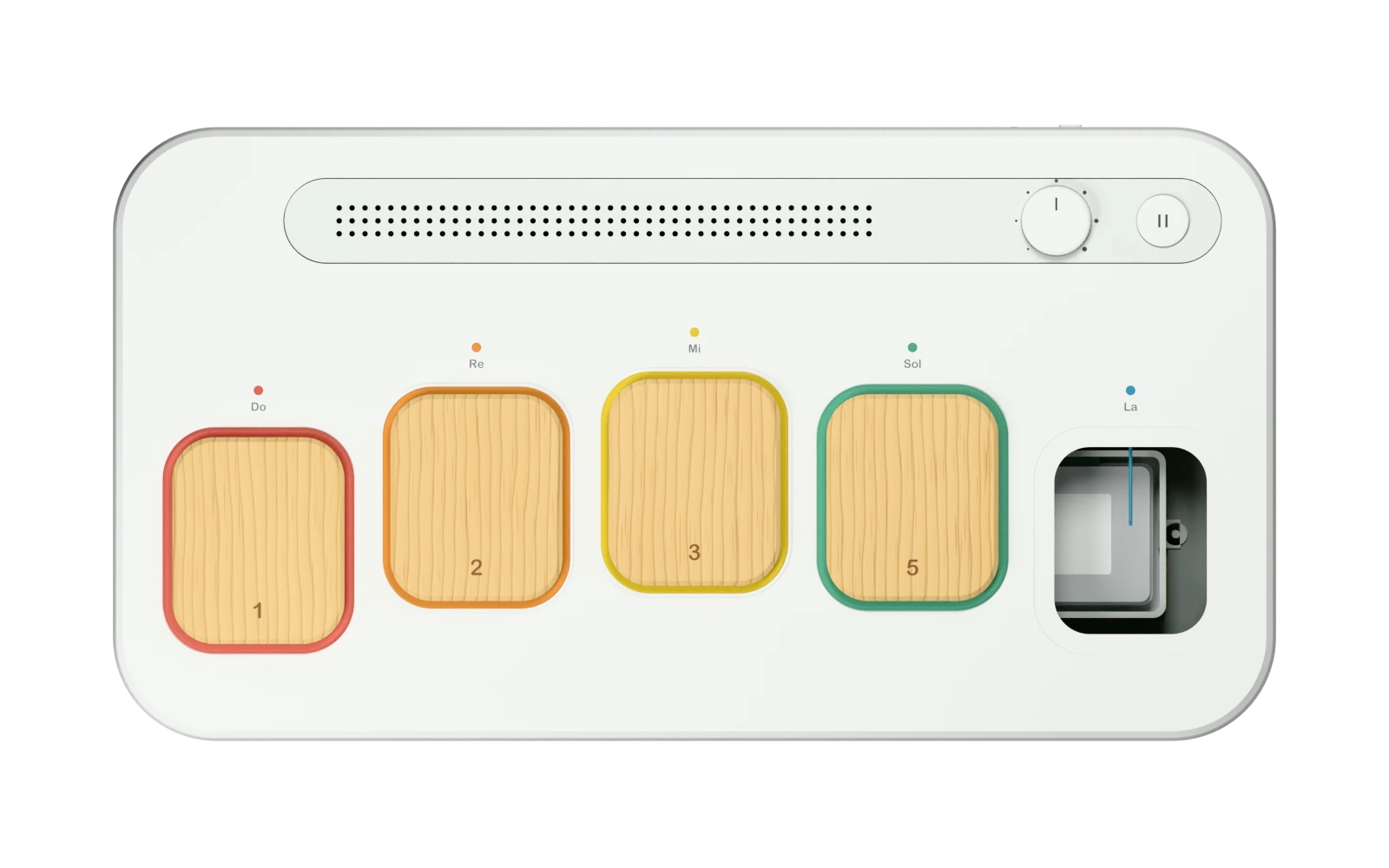
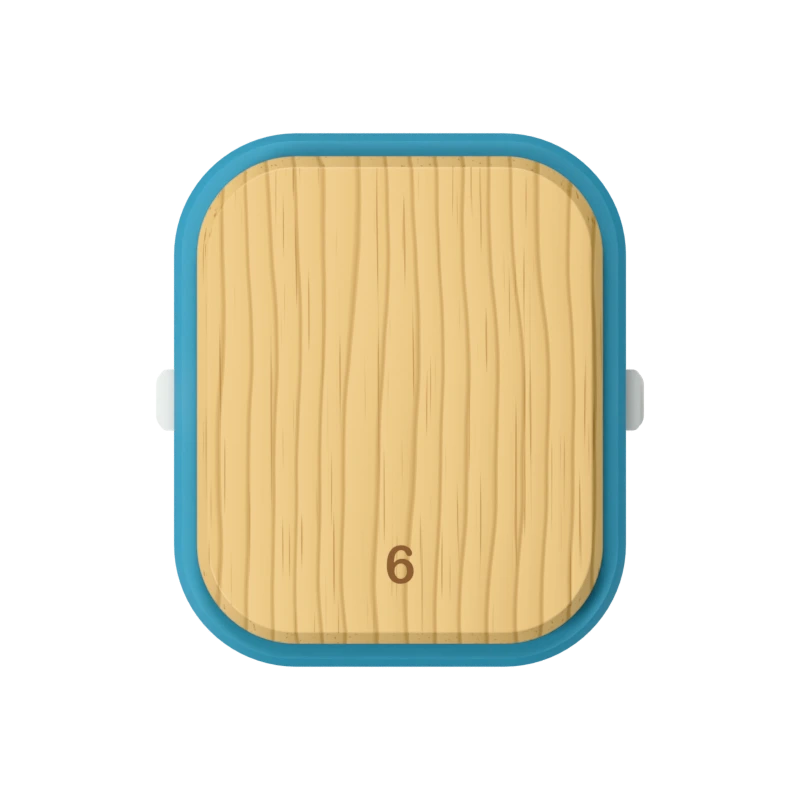
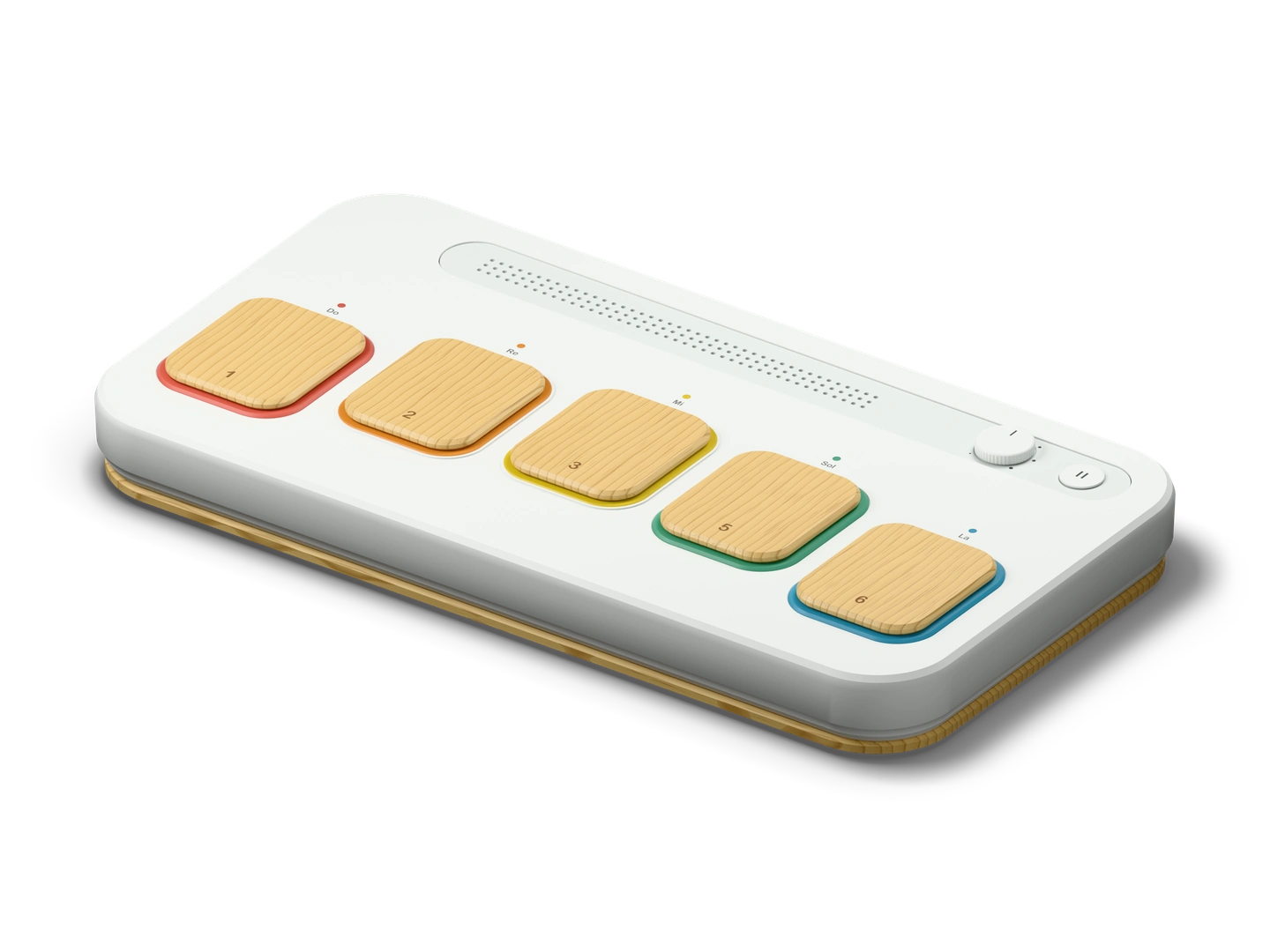
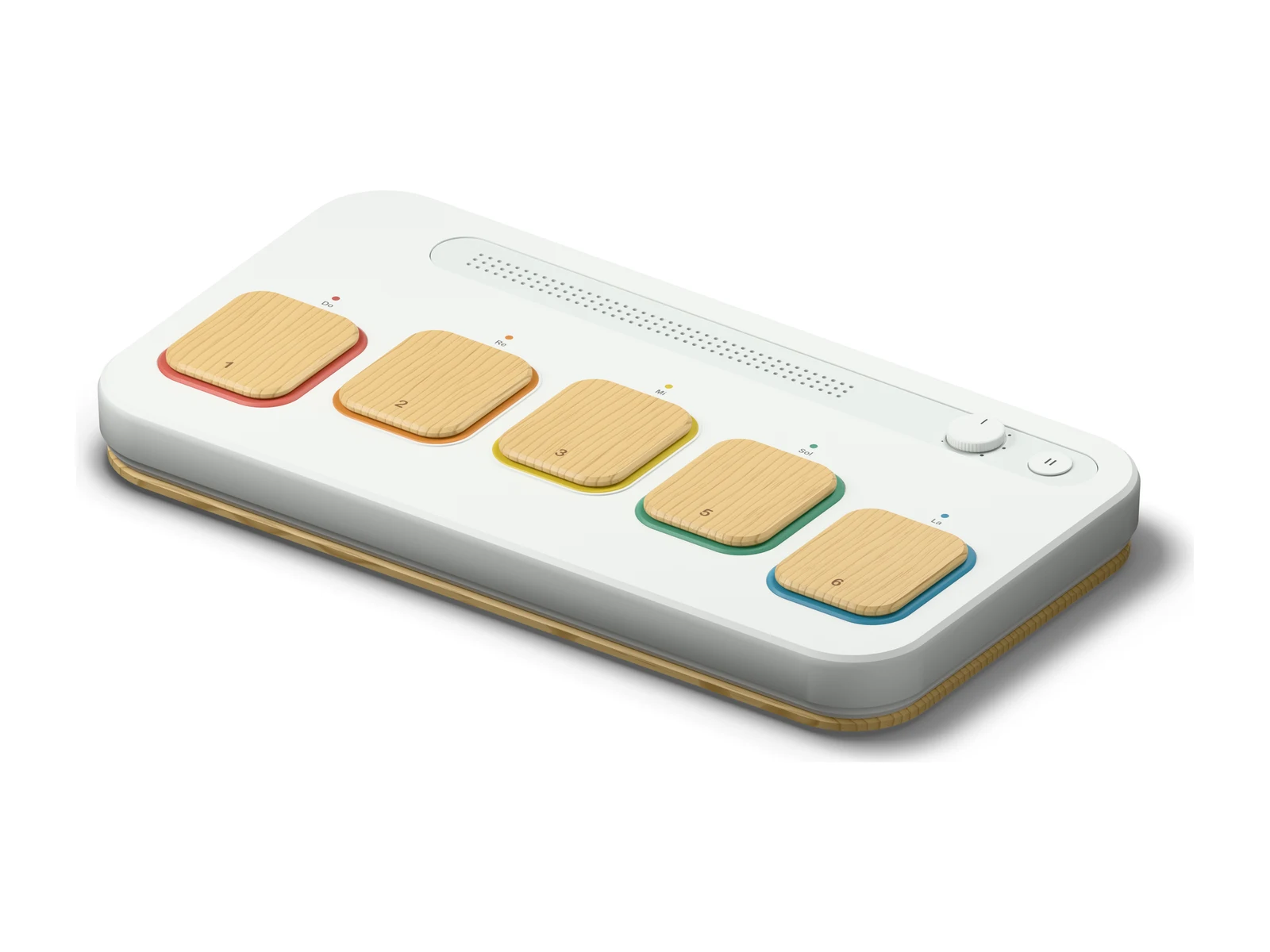
Five wooden touch surfaces on the shared Resonance instrument

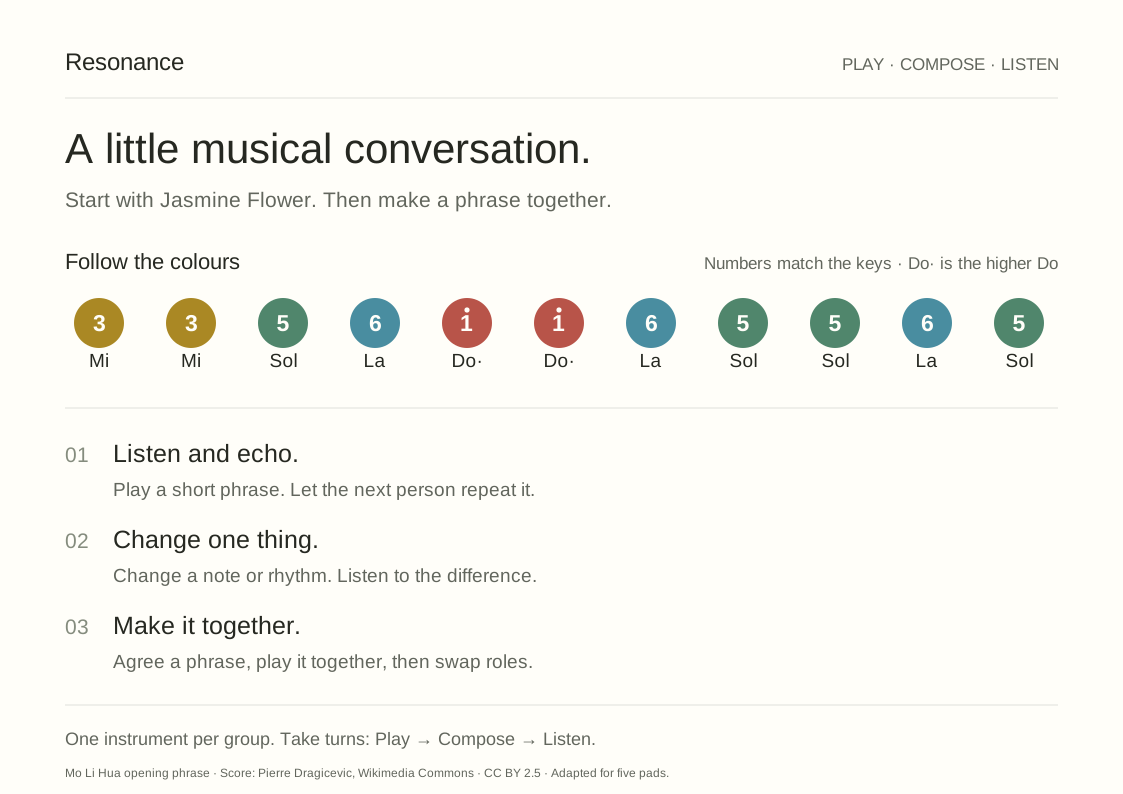
Follow a little melody.

好一朵美丽的茉莉花

Touch the key that lights up.

Play at your own pace. Look inside

Made for
a shared lesson.

The instrument starts with touch.
The project starts with access.

Why this instrument?

Wood, colour and sound in one shared instrument.

Music belongs
in the classroom.

How can children in rural China take part in music with fewer specialist teachers and classroom resources?

Fewer than a third of rural primary schools had enough music teachers.

In 2019, 30.0% of rural primary-school heads said their music-teacher numbers met teaching needs, up from 14.5% in 2016. In city schools it was 70.1%.

So the instrument is shared. One instrument for a group, five notes on one controller and one sound output.

Figure 14 · primary-school heads

Many Grade 4 music lessons are taught by non-specialists.

In 2019, 41.7% of Grade 4 music teachers taught music full-time. Nearly a third, 31.7%, taught it part-time without related training.

So it has to be easy to start. Colour and number instead of notation, and a one-page activity for the teacher.

Table 4 · Grade 4 music teachers, national

Provided is not the same as used.

Student instruments had the widest gap in Grade 4: a provision rate of 78.2%, while only 40.6% of music teachers in equipped schools used them often.

So it has to stay in use. Quick to set out, sturdy to share, and repairable: a wooden face lifts out, the parts are reached through the base.

Table 2 · usage = arts teachers in equipped schools who use it often

Primary-school heads saying music-teacher numbers met teaching needs (%)
Place20162019
City54.970.1
County town3842.8
Township26.138.7
Rural14.530
Music teachers in 2019 (%): full-time, part-time trained, part-time without related training
GradeFull-timePart-time, trainedPart-time, untrained
Grade 441.726.631.7
Grade 87812.69.3
Music resources in 2019, provision rate and usage rate (%)
ResourceGrade 4 providedGrade 4 usedGrade 8 providedGrade 8 used
Music classroom82.464.190.571.1
Teaching aids90.959.295.969.7
Student instruments78.240.678.336.5
Sound system89.57391.782.4

Two people to design for.

The 2025 personas named three needs each. Choose one to see where the instrument answers it.

The child

The teacher

Each need maps to one part of the instrument.

Sources and definitions

All three figures come from the 2019 National Compulsory Education Quality Monitoring, arts results, published by the Ministry of Education in 2020: Figure 14, Table 4 and Table 2 ↗. Figure 14 reports what primary-school heads said about music-teacher numbers. Table 4 covers Grade 4 and Grade 8 music teachers nationally. The usage rate is the share of arts teachers in schools with the resource who use it often. The report's rural arts-teacher statistics exclude schools with fewer than 100 pupils.

The needs come from the two personas in the 2025 graduation project. They are design inputs, not test results.

The wood is part
of the interaction.

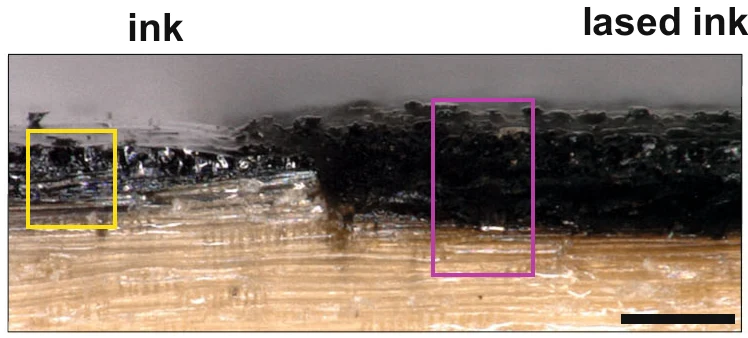
A wooden touch surface, grown out of a material experiment.

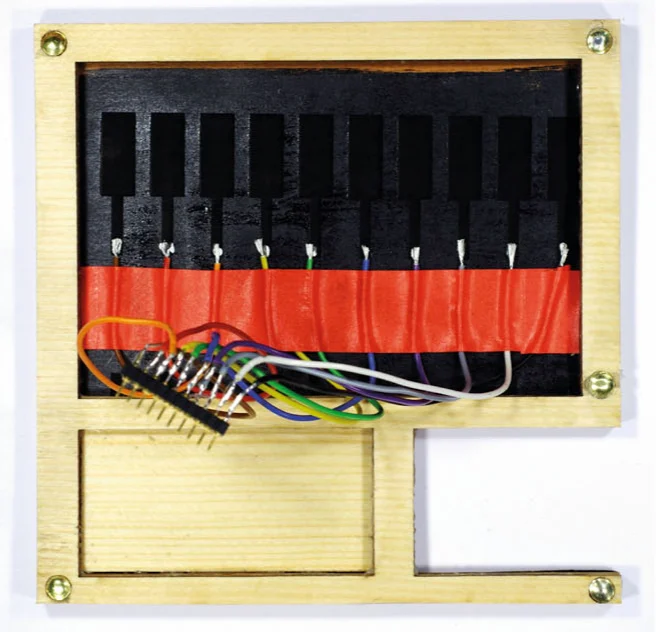
Overhead detail of Resonance, showing its right-hand wooden notes and controls

A natural face to touch.
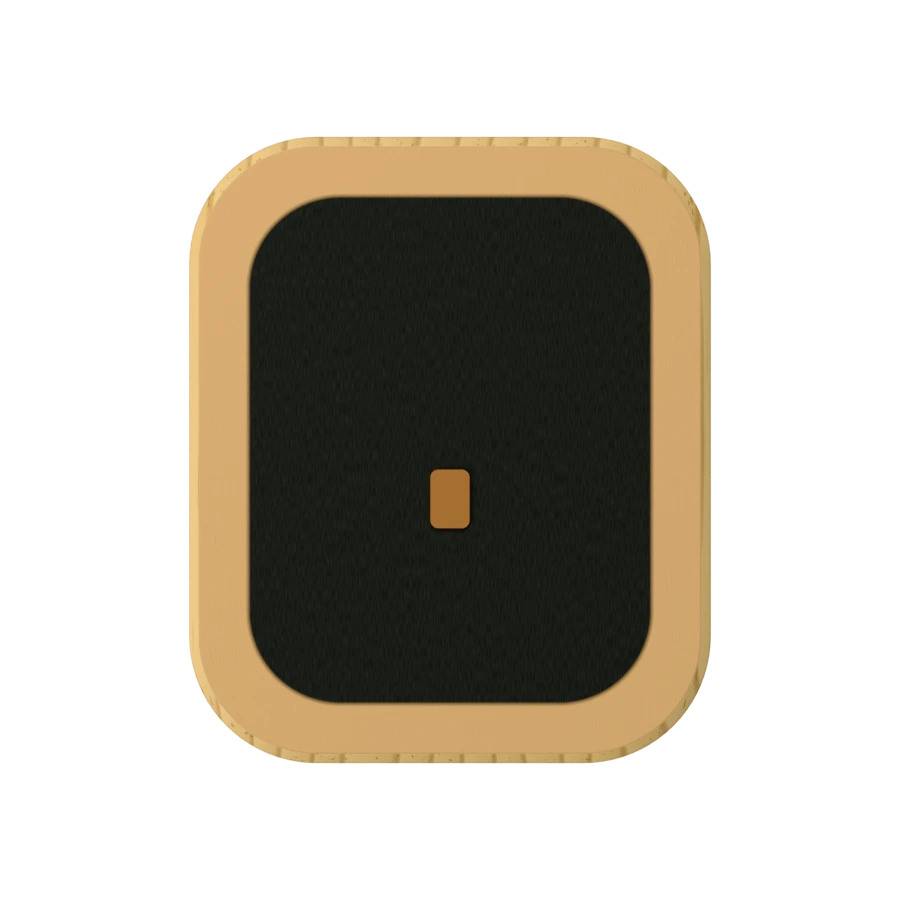
A dark, processed face underneath.

Wood, made to
sense touch.

A natural face to touch. A treated and laser-processed surface underneath.

Flat view of the wooden note's dark processed face, natural wood border and small contact

Treat. Test. Refine.

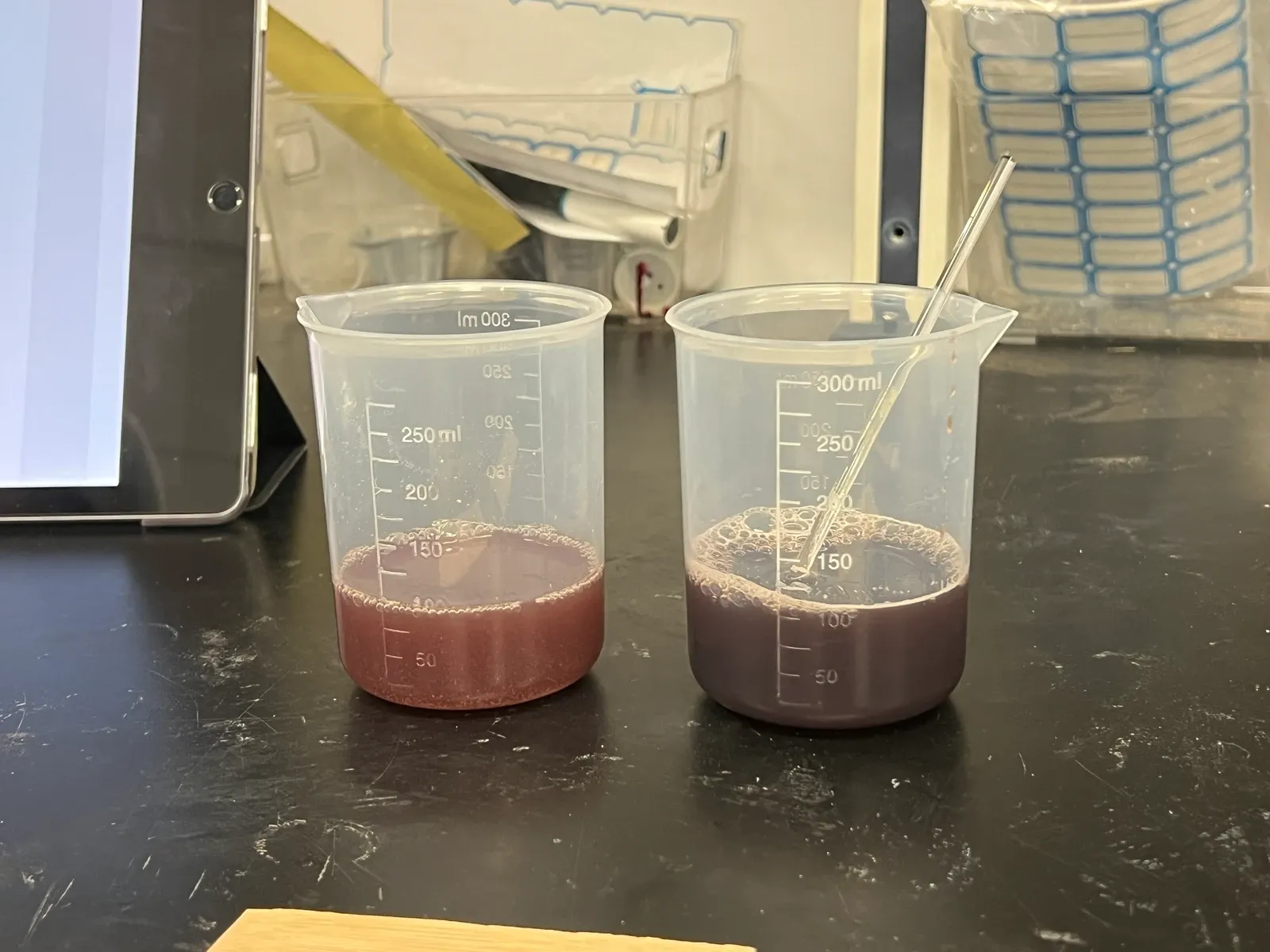
Original persimmon lacquer and green vitriol treatment beakers

Recipe · 2025 report, fig. 3-17

50 ml water + 50 ml persimmon lacquer

150 ml water + 1 g green vitriol

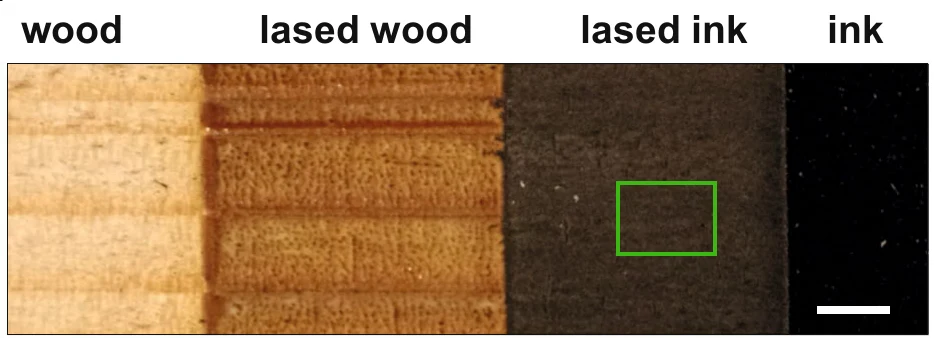
Tannins bind iron into a dark iron–tannin complex, the chemistry of iron-gall ink. The reference study used tannic acid, iron citrate, gum arabic and glycerol.

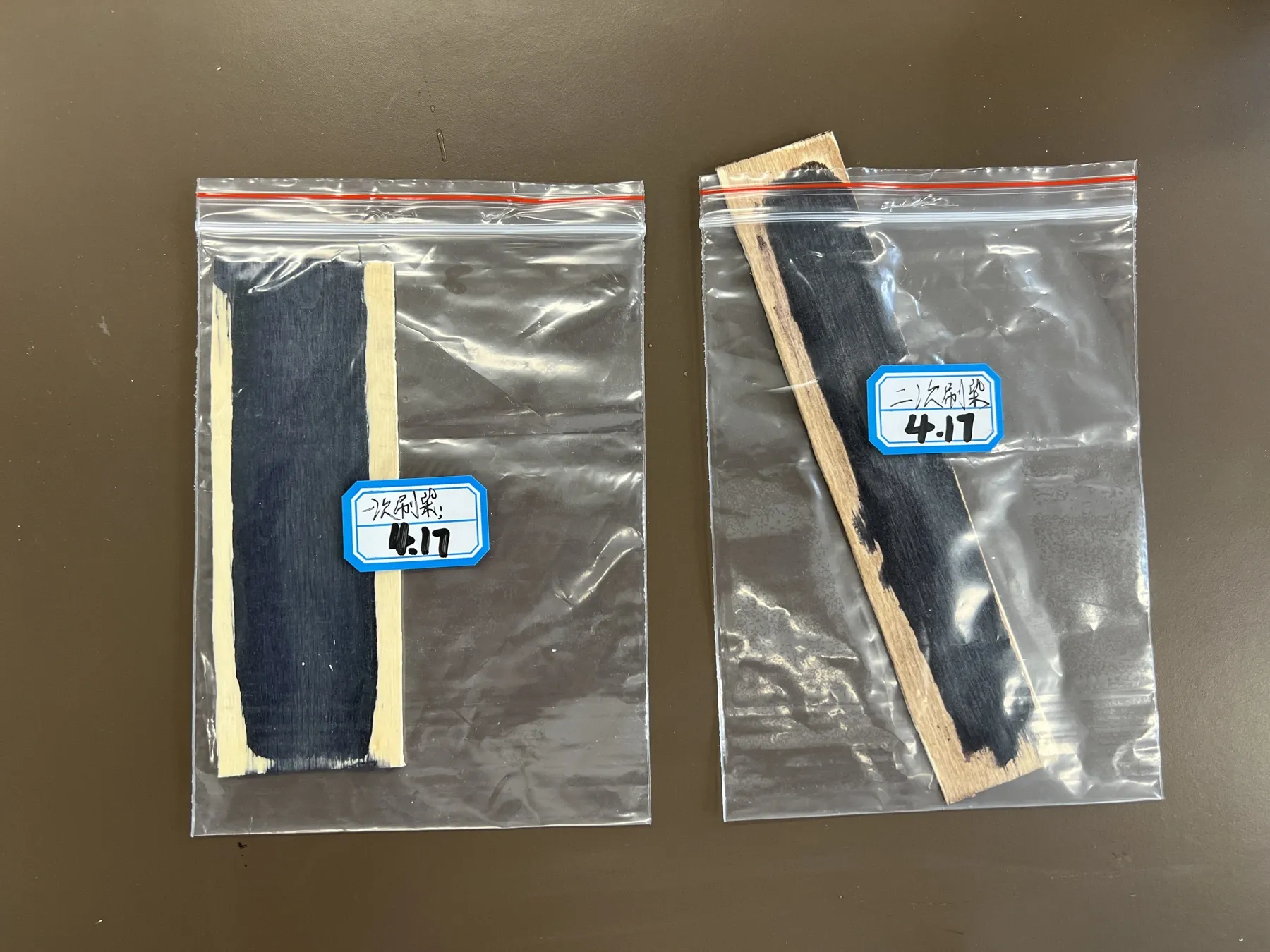
01 · TreatPersimmon lacquer + green vitriol. Brush or soak the wood.
Original first conductivity test setup

First test · not conductive

Treated wood, no laser yet

Wood does not conduct on its own, and the dark colouring is not yet carbon. In the reference study, ink without laser showed no graphite-like signal.

02 · TestTreatment alone did not produce a conductive surface.
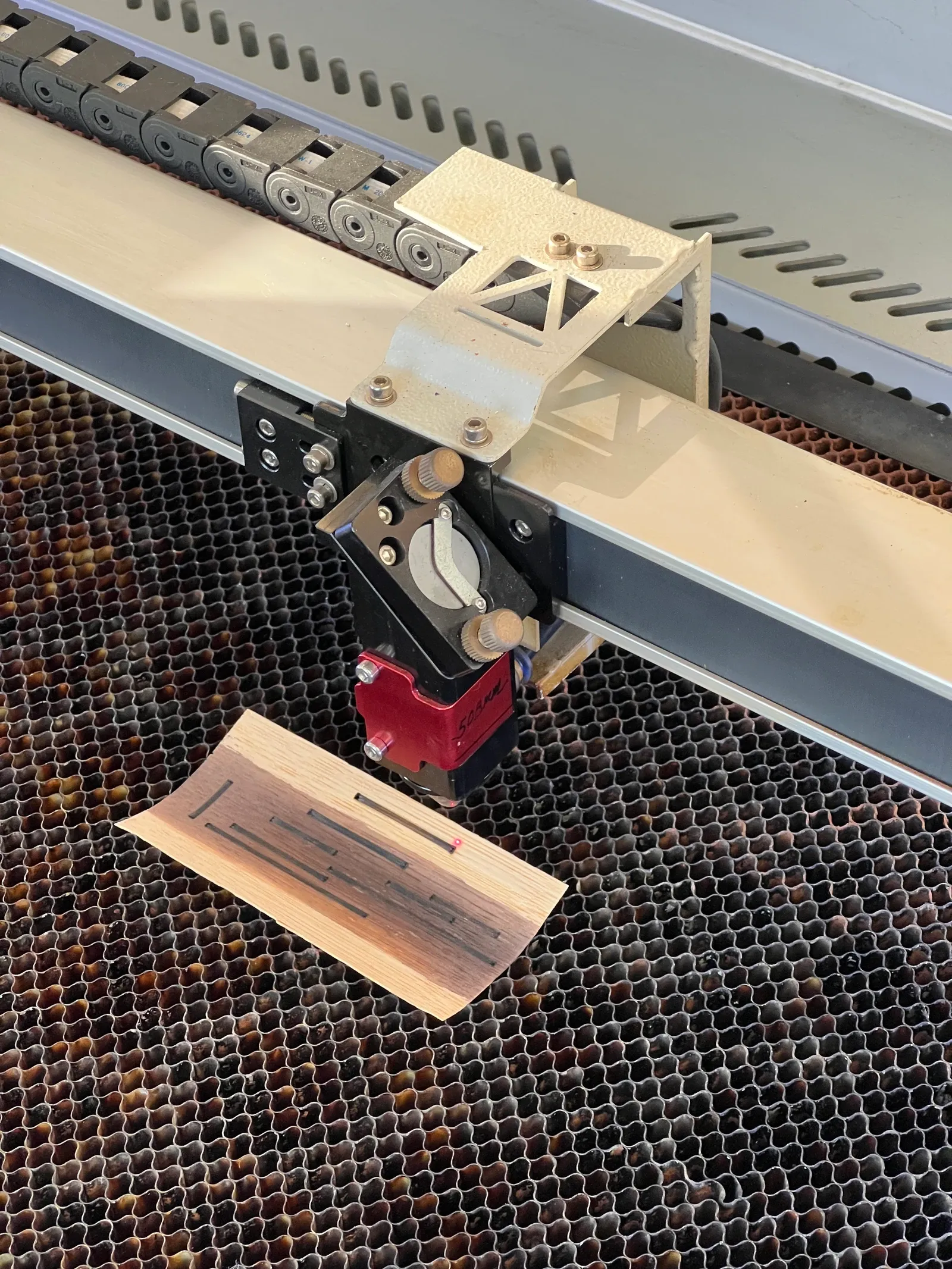
Original wood sample during laser processing

Laser settings

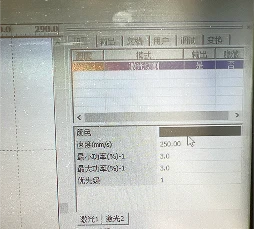
Photo of the laser software screen from the 2025 trial, speed field set to 250.00

2025 trial: 250 mm/s

Reference: ~13 W at 200 mm/s, or ~12 W at 270 mm/s

The reference study used a 10.6 µm CO₂ laser (60 W maximum) in one pass, in ordinary air.

03 · Laser-processProcess the treated surface, then test again.
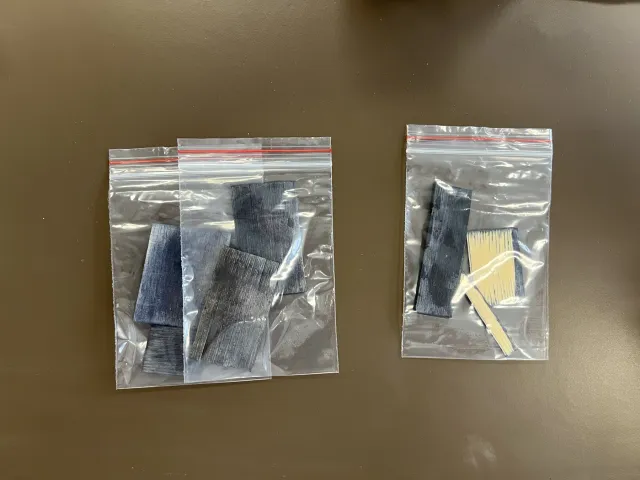
Original dark processed wooden samples in labelled bags

What changed

Thicker boards

Adjusted ratio

Thin boards and bamboo strips gave unstable results, so the ratio was adjusted and thicker boards were tried. Durability is still to be tested.

04 · RefineA successful follow-up test, then further material trials.
Material research and experiment credits

The reference study used iron–tannic-acid ink to promote laser-induced graphitisation. My trials explored persimmon lacquer and green vitriol. Dreimol et al., 2022 ↗

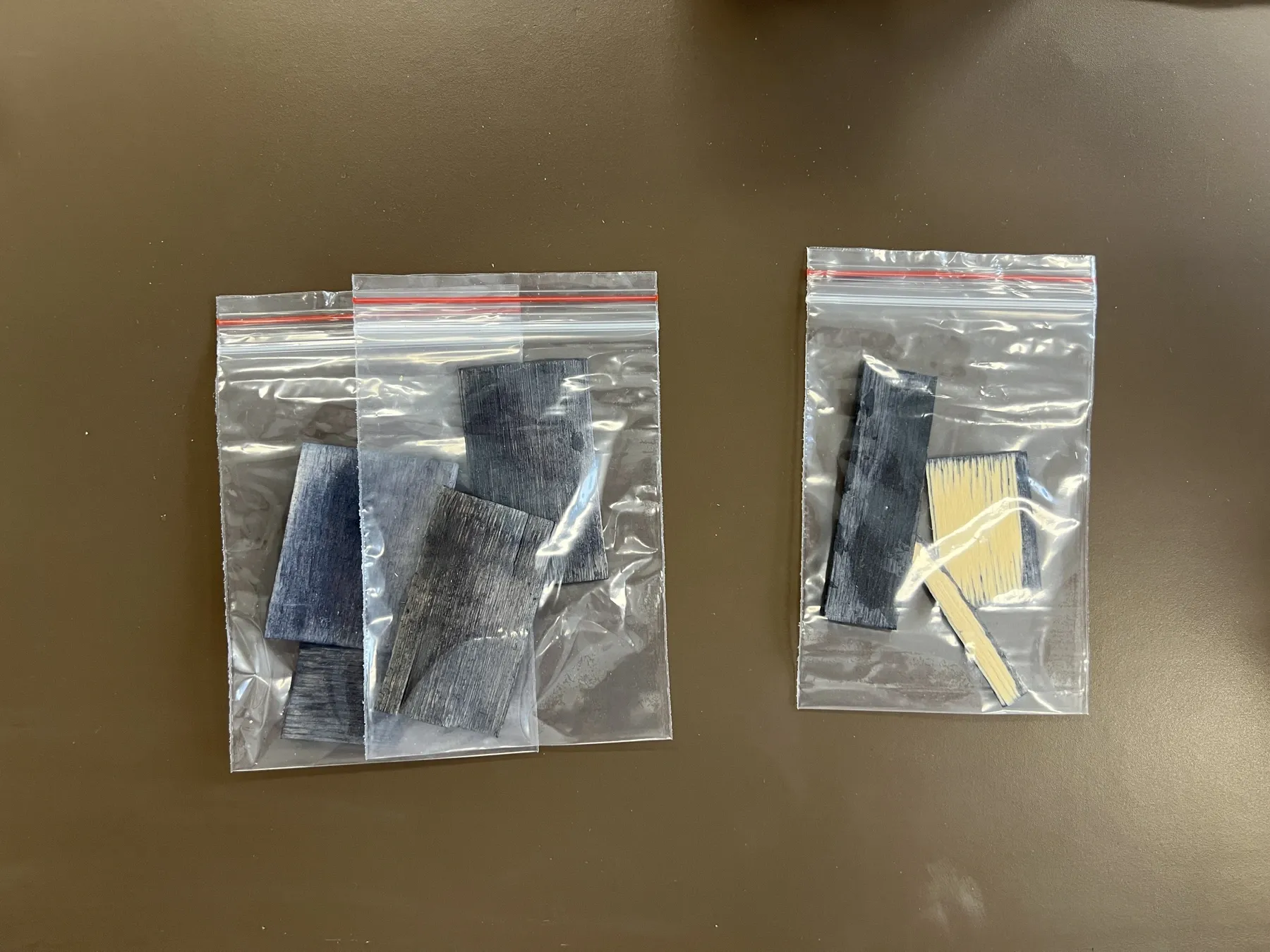
Later 2025 sample groups stored in bags after treatment and processing trials
Further sample trials, 2025.

Material experiments were supported by Wei Sentao. Original photographs and trial sequence: 2025 graduation report, figures 3-17 to 3-24.

A touch becomes
a sound.

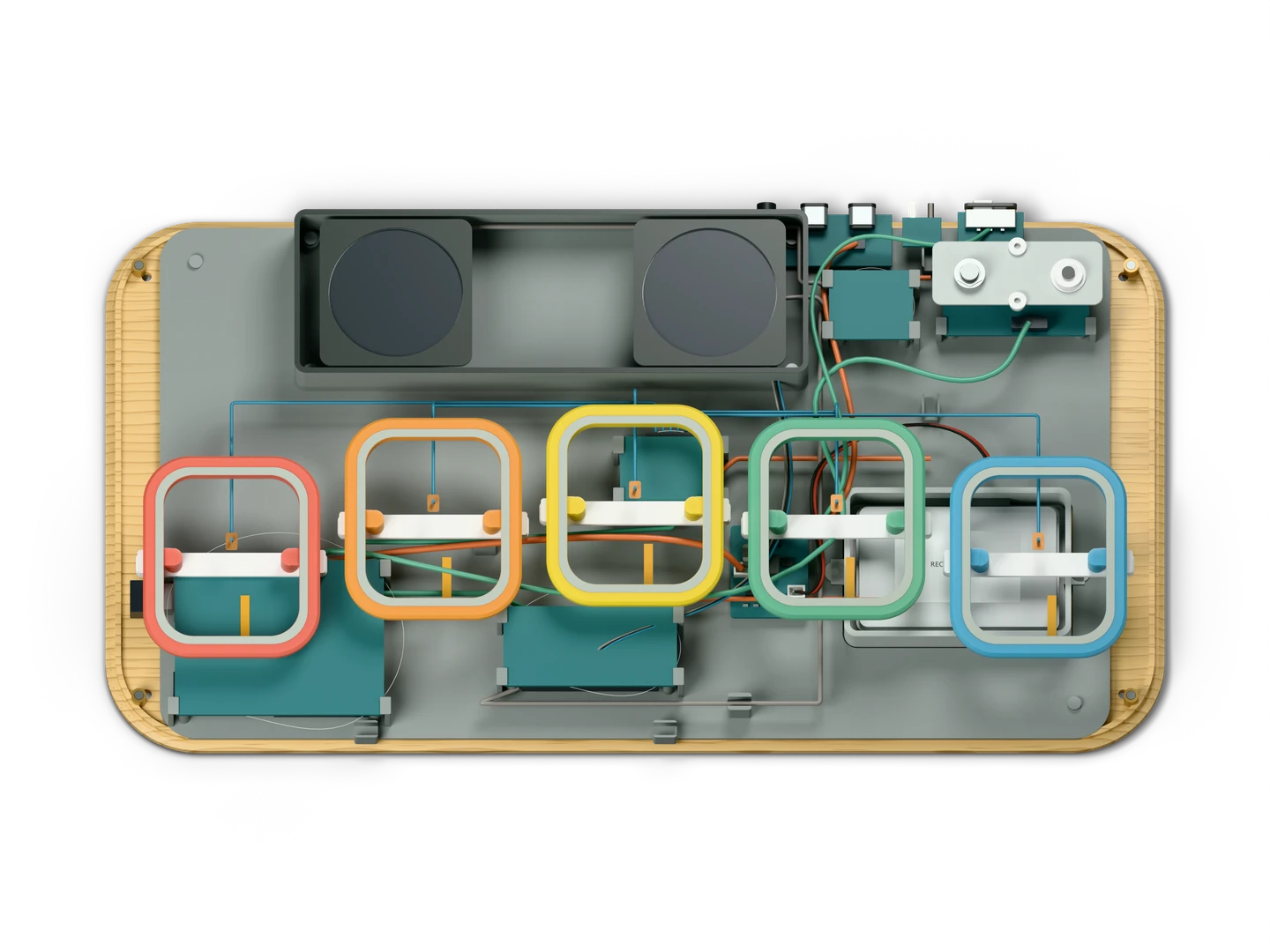
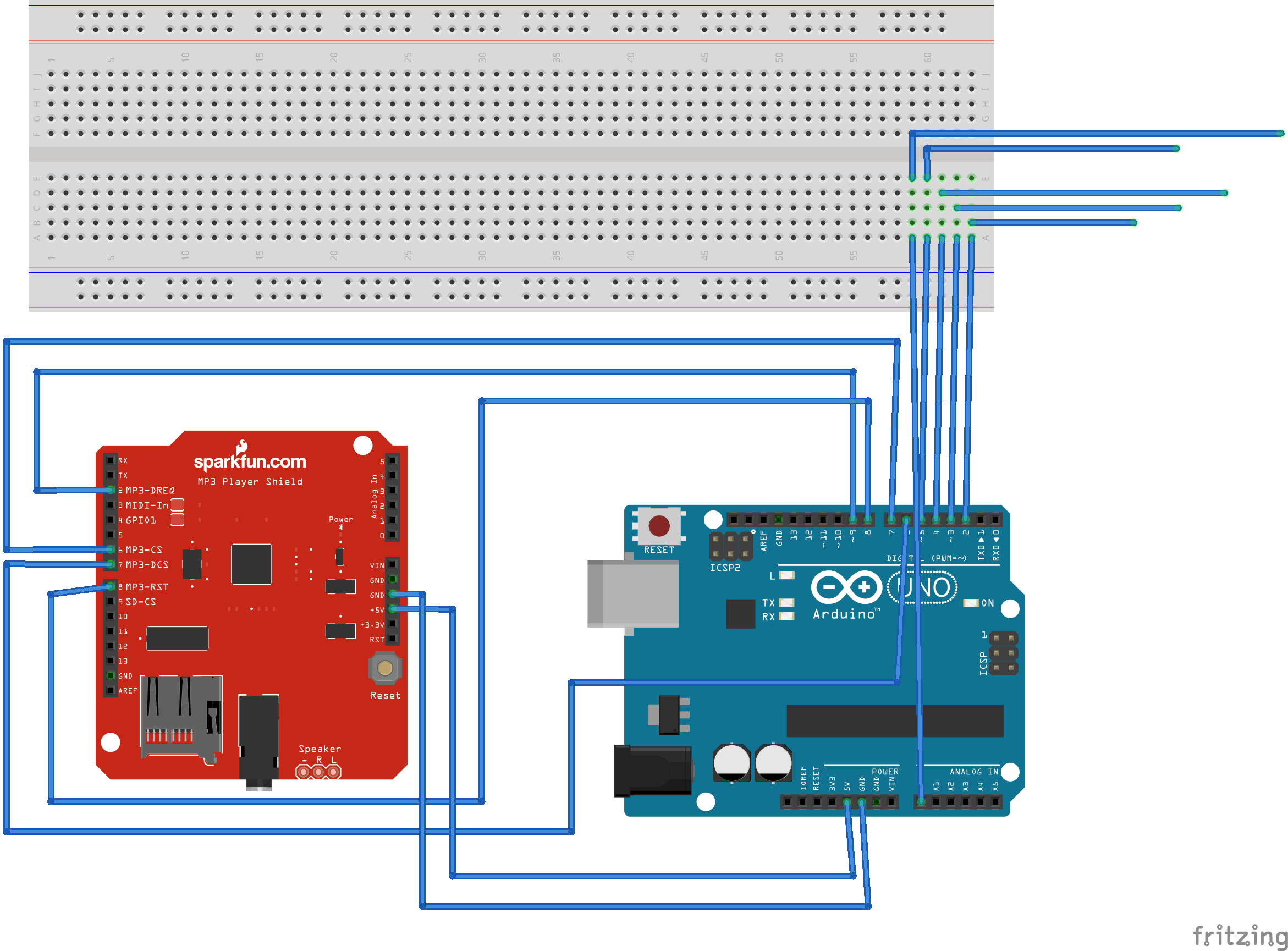
The 2025 prototype linked the processed wood to an Arduino UNO, an MPR121 touch sensor and a VS1053 audio board. The 2026 model keeps that chain inside one shell. Move the lens to look inside, then touch a key.

Resonance from above with its five wooden keys The same view with the shell and keys lifted off: coloured key frames over the service tray, the Arduino UNO, VS1053 and MPR121 boards, an amplifier and two speakers, joined by thin leads
  1. Touch the woodThe processed underside of the key meets a small contact. A lead runs to the touch connector.key 3 · Mi
  2. Read the touchThe MPR121 reports which of its five inputs changed, over I²C.if (touched & (1 << 2))
  3. Choose the noteThe UNO looks up the note for that key.noteValues[] = {60, 62, 64, 67, 69}
  4. Hear itThe VS1053 plays it as a MIDI note. In the 2026 model an amplifier drives two speakers.audio.midiNoteOn(0, 64, 127);

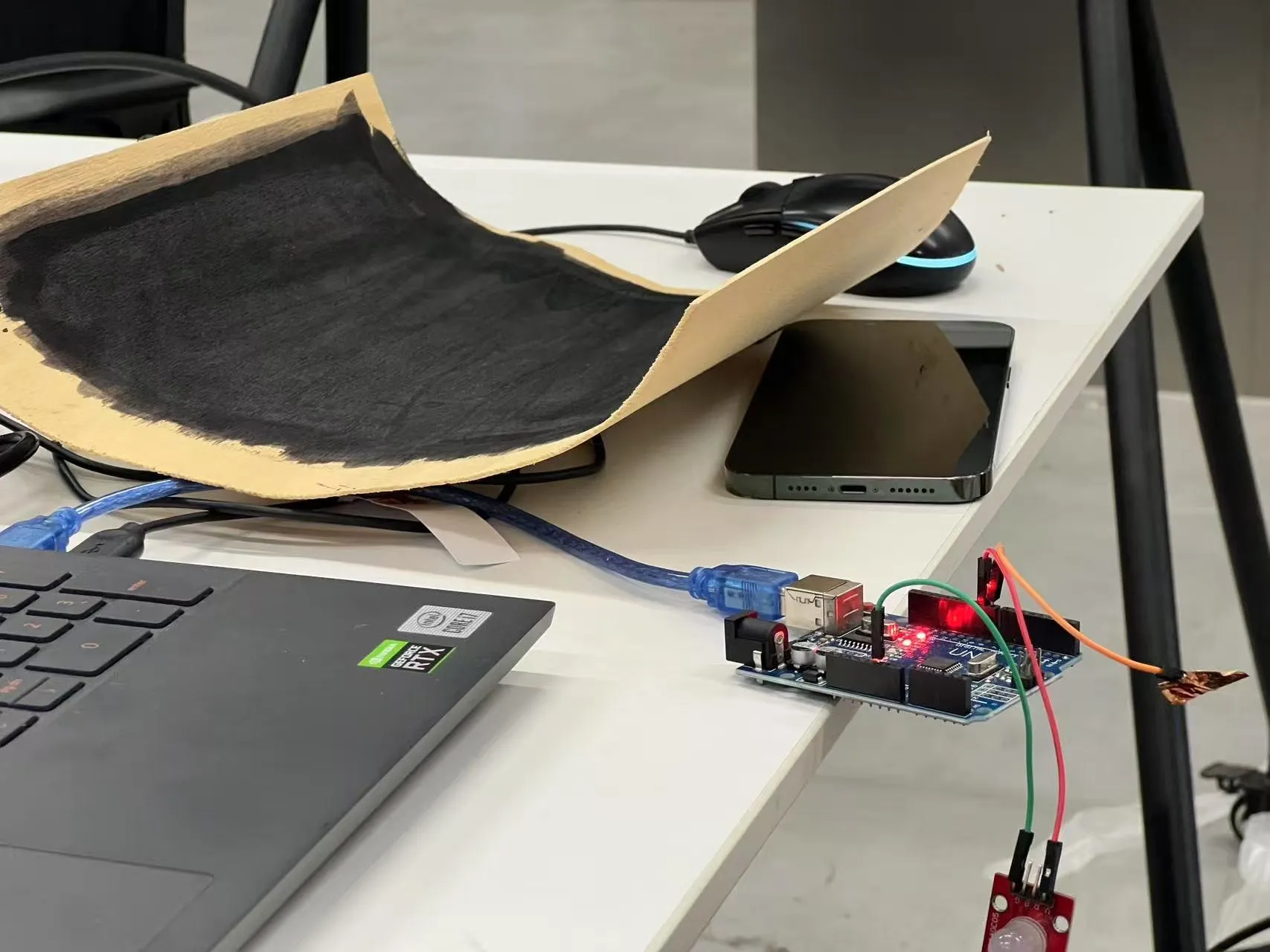
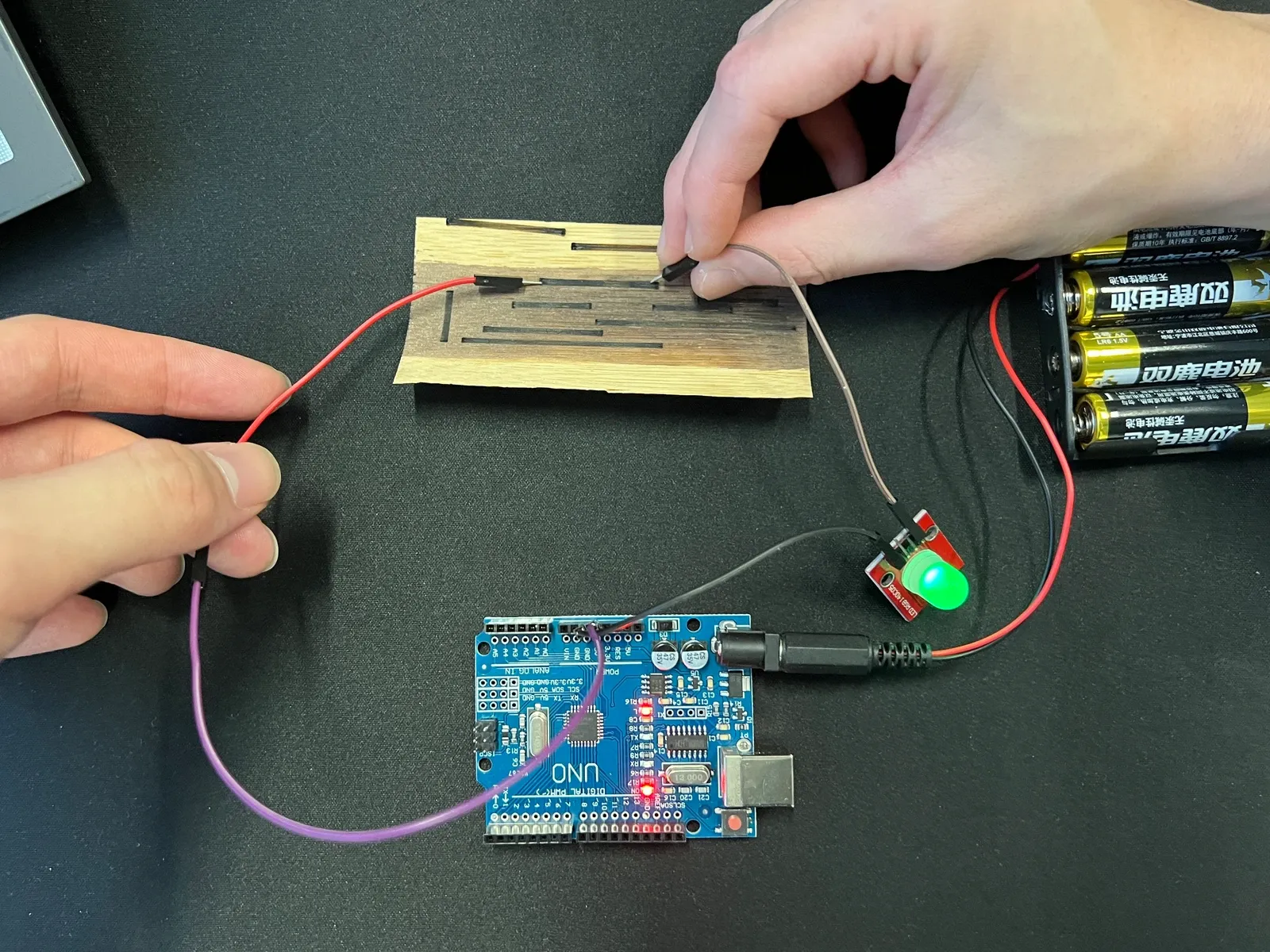
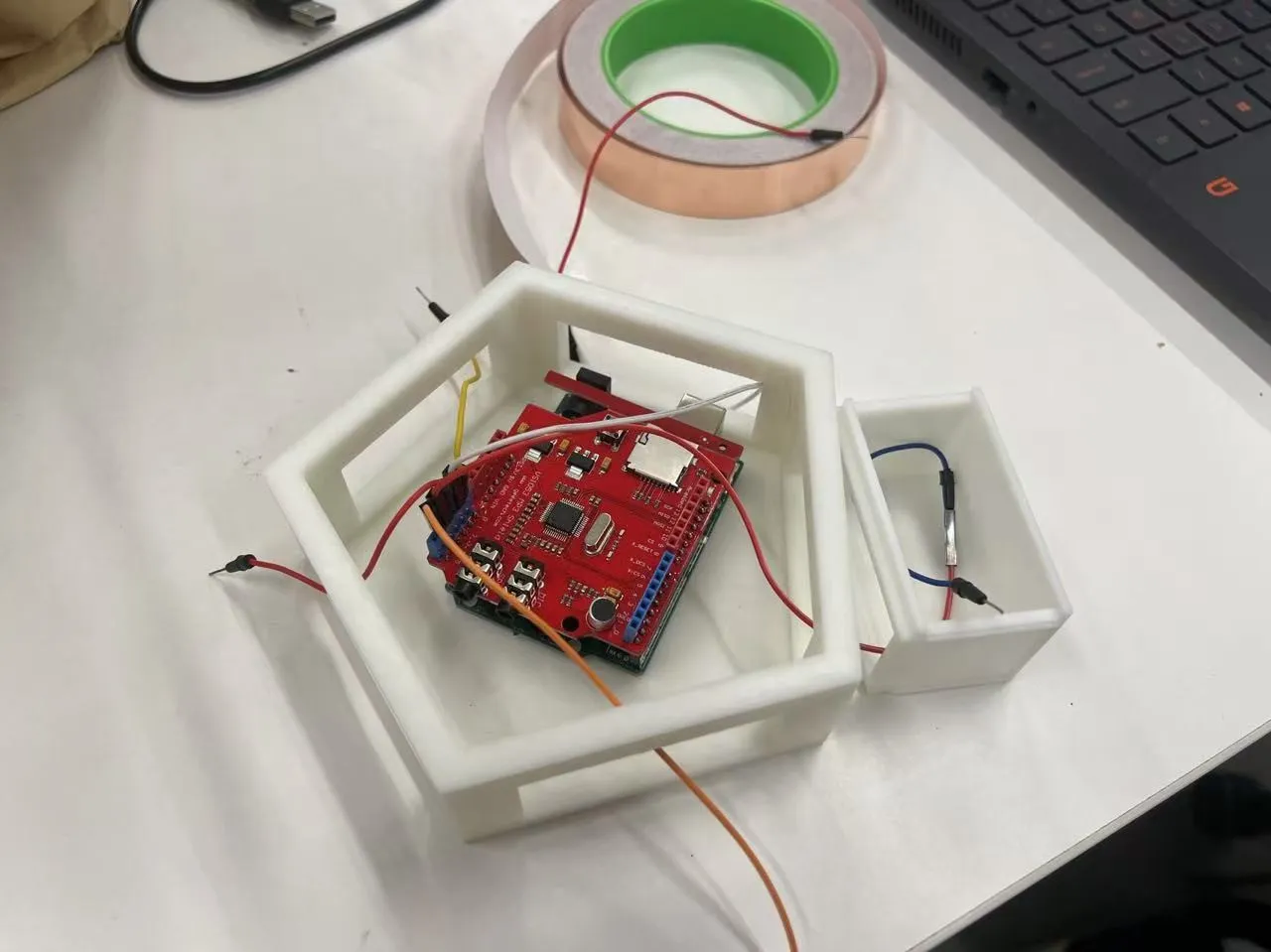
The 2025 prototype

A large sheet of processed, darkened wood wired to an Arduino on a desk beside a laptop
A processed wood sheet wired up for a touch test.
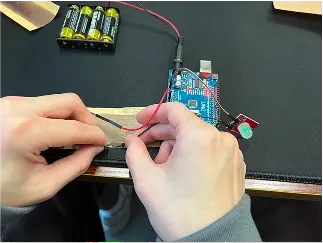
Hands touching a processed wood sample connected to an Arduino and an LED
The wood switches an LED, before sound was added.
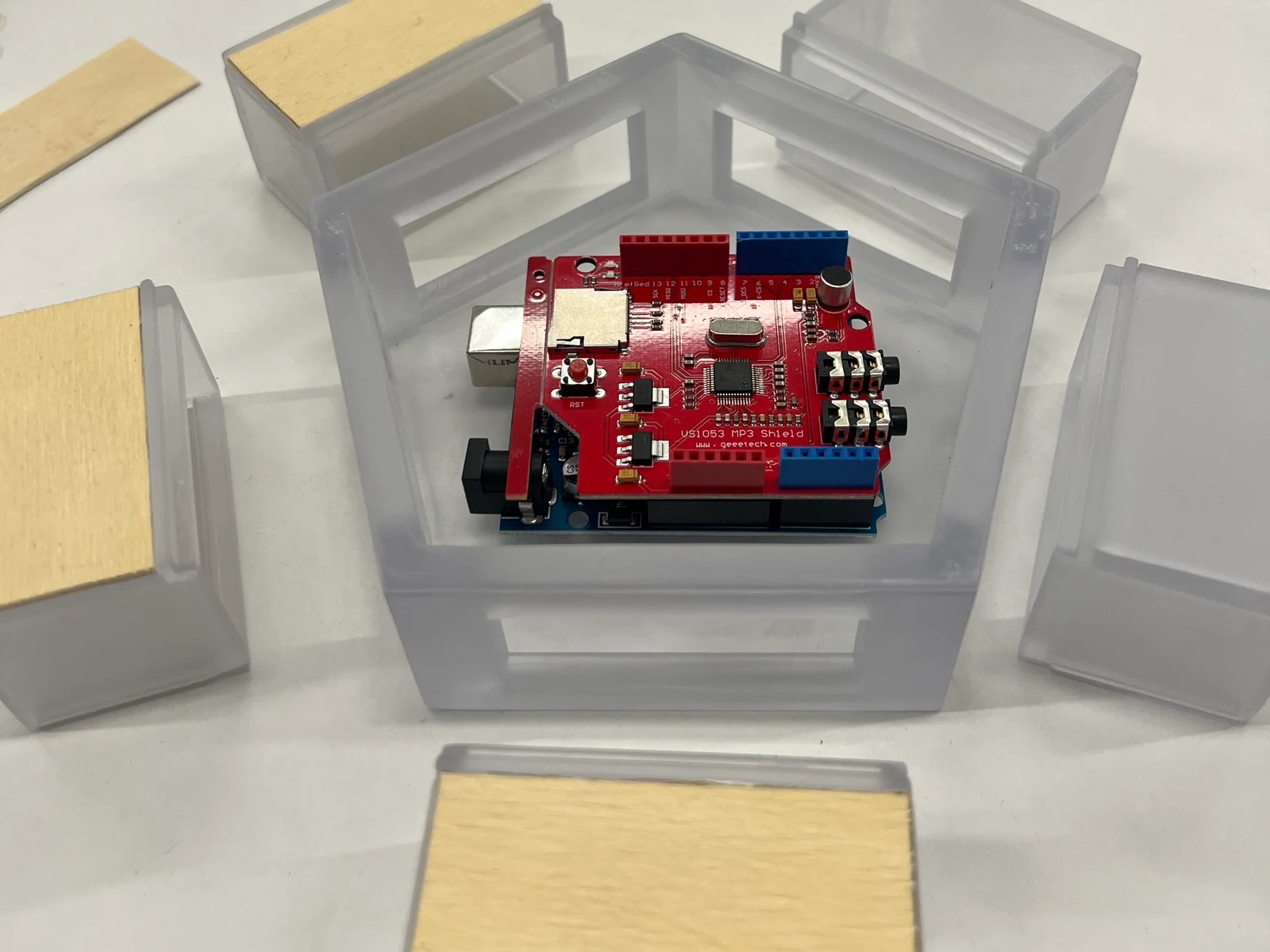
A 3D-printed white pentagon shell with a red shield board on an Arduino inside and leads running to one module
UNO and shield inside the printed pentagon shell.
Breadboard diagram: an Arduino UNO and a red audio shield with five touch leads
Original wiring diagram.
Original firmware lines
// 516.ino · MPR121 five-point test (I²C address 0x5A)
uint16_t touched = cap.touched();
for (uint8_t i = 0; i < 5; i++) {
  if (touched & (1 << i)) { /* input i touched */ }
}

// touch-11.ino · VS1053 in MIDI mode
int noteValues[] = {60, 62, 64, 67, 69};   // C D E G A
audio.useMIDI();
audio.midiNoteOn(0, midiNote, 127);

Excerpts from the two test sketches in the 2025 project files. The final prototype combined MPR121 sensing with VS1053 sound on an Arduino UNO R3.

From five modules
to one instrument.

From a pentagon of five modules in 2025 to one shared instrument in 2026. Scroll, or drag the lens along the track.

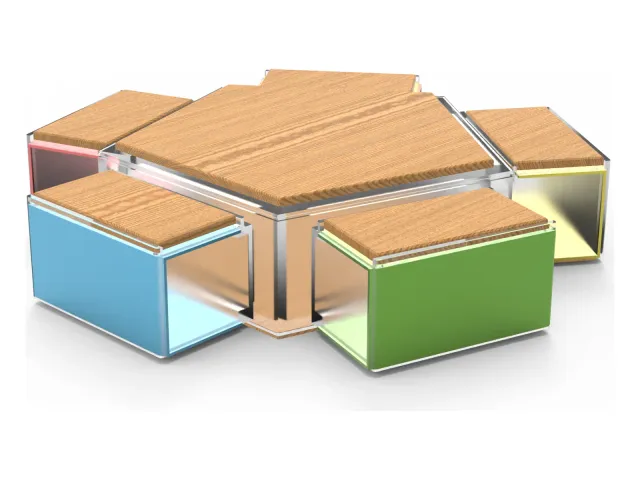
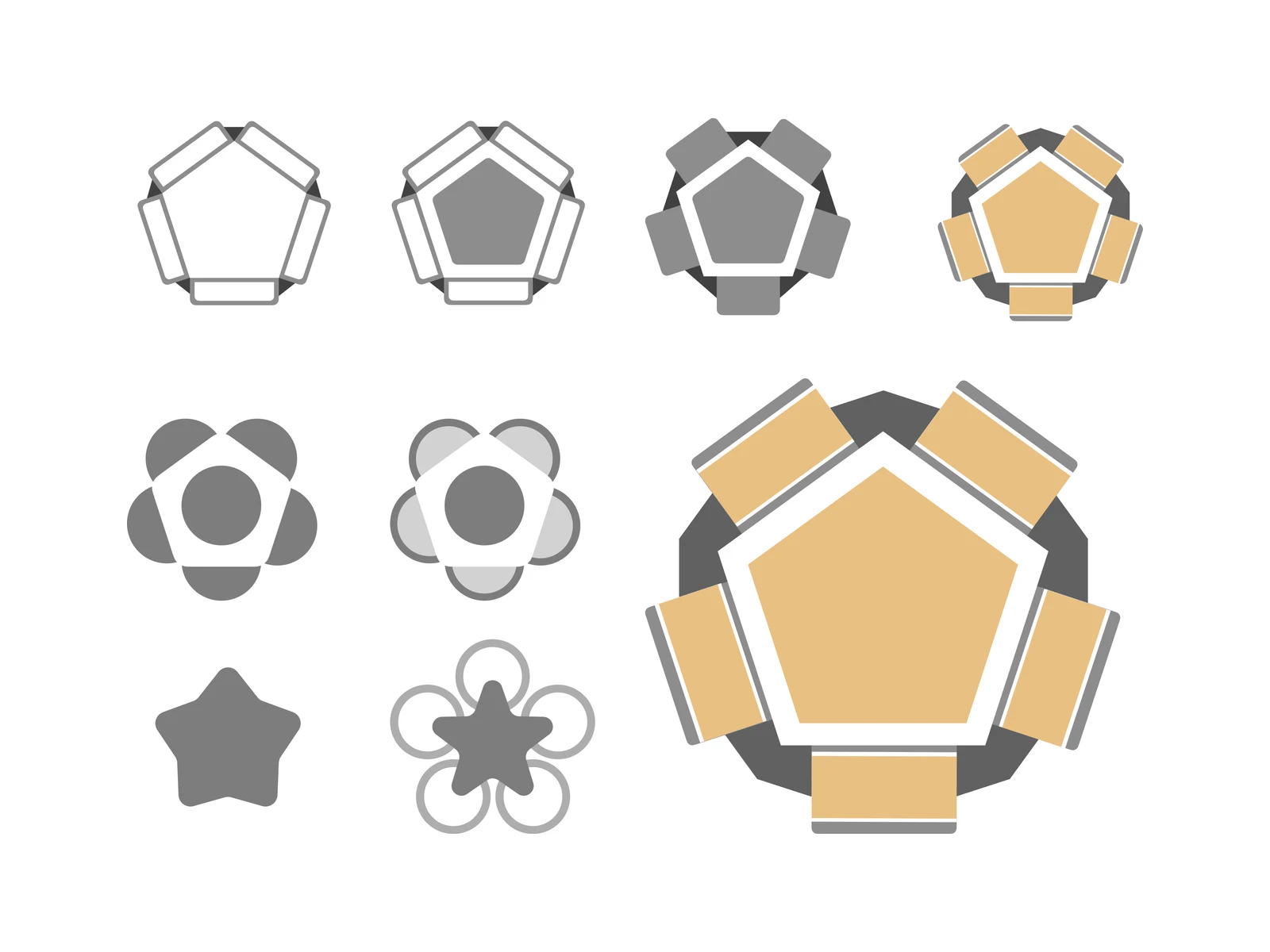
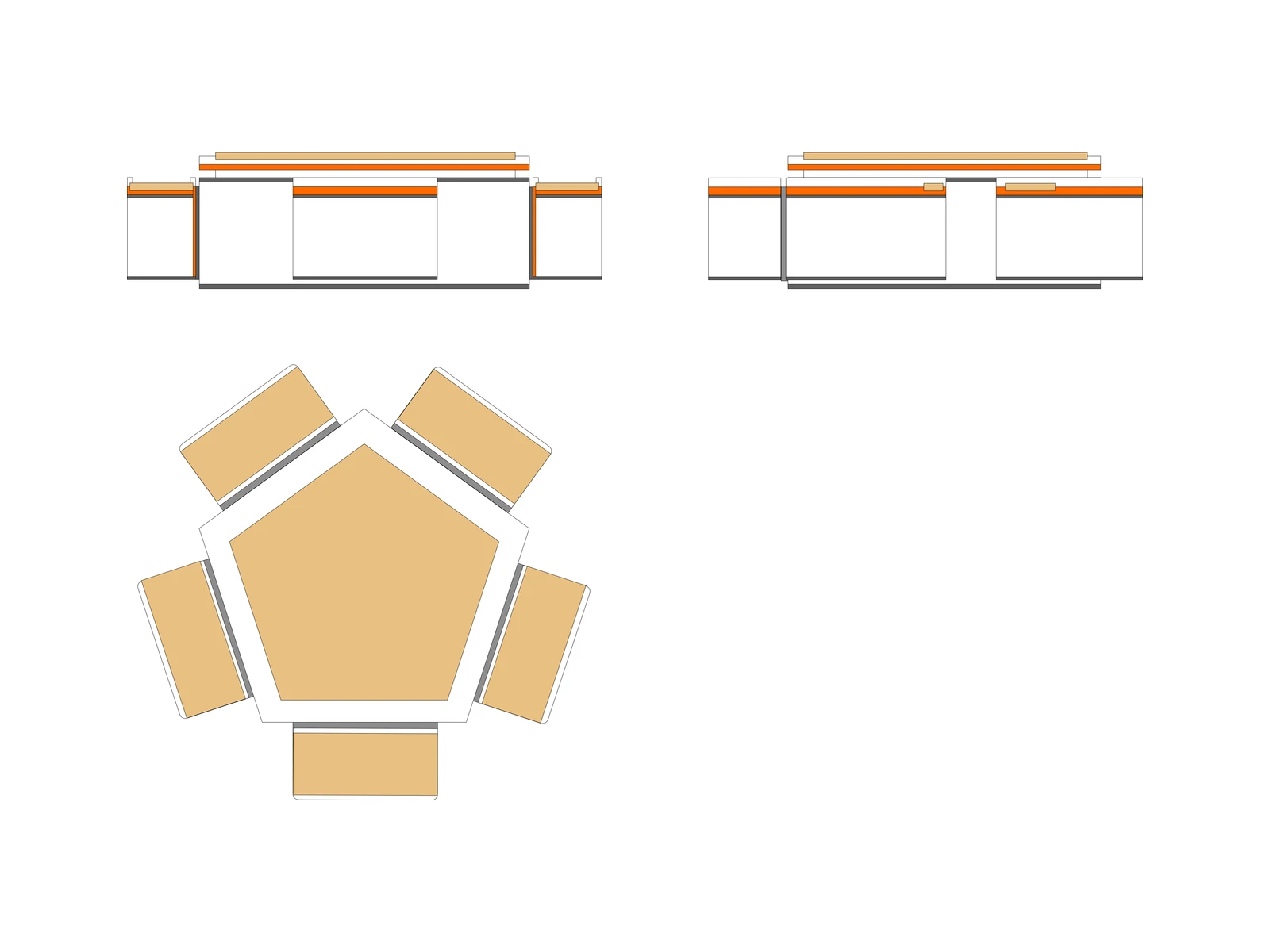
Form studies in grey and wood colour: pentagons, flower and star shapes, and five rectangular modules around a pentagon centrePlan and elevation drawings of the pentagon instrument with five rectangular modules and wooden topsKeyShot render of the 2025 concept: five coloured modules with wooden tops around a pentagon centre3D-printed translucent modules with wooden tops around an Arduino with a red shield in the pentagon centreThe 2026 Resonance model: one white shell with five wooden keys in a row in coloured frames

2025 · Form

Five notes, five sides.

Form studies settled on a pentagon. Each side would carry one sound channel, around a shared centre.

2025 · Drawings

Drawn to fit the electronics.

The Rhino model and its drawings fixed the module sizes. Renders checked there was room for the Arduino and the touch sensor.

2025 · Render

One colour per note.

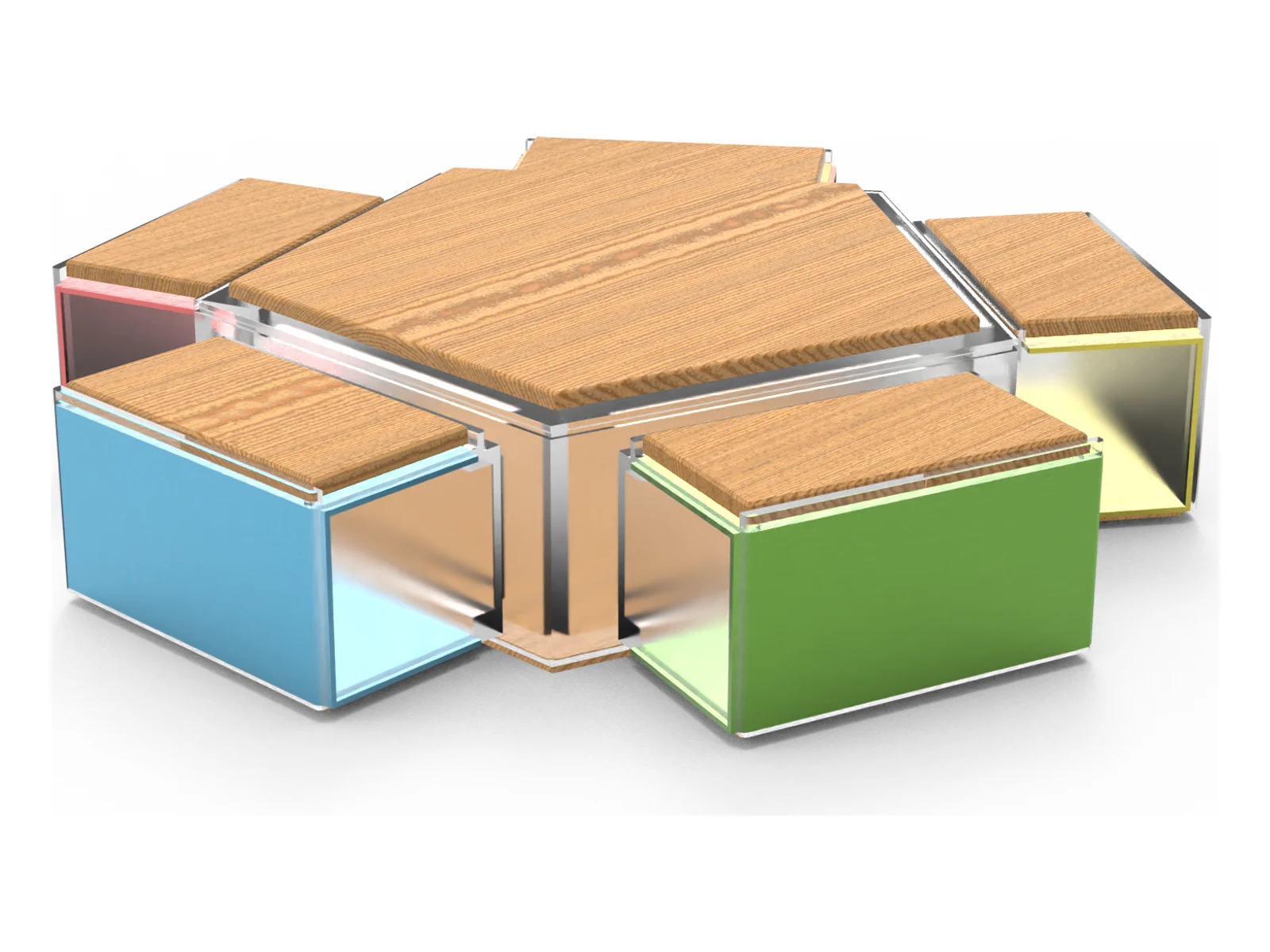
Colour joined the wood: each module took the colour of its note, with a wooden top to touch.

2025 · Prototype

Printed and wired.

Shells were SLA-printed in white and translucent resin. The UNO and its shield sat in the centre, with leads out to each module.

2026 · Instrument

One shell, one row.

The five notes now sit in a single row on one shell, easier to share across a table. The electronics have one home, the wooden faces lift out, and the parts are reached through the base.

Original product development 2025 · modules, construction and prototype

The graduation project explored separate modules around a centre plate. These original boards show the starting point for the later shared enclosure.

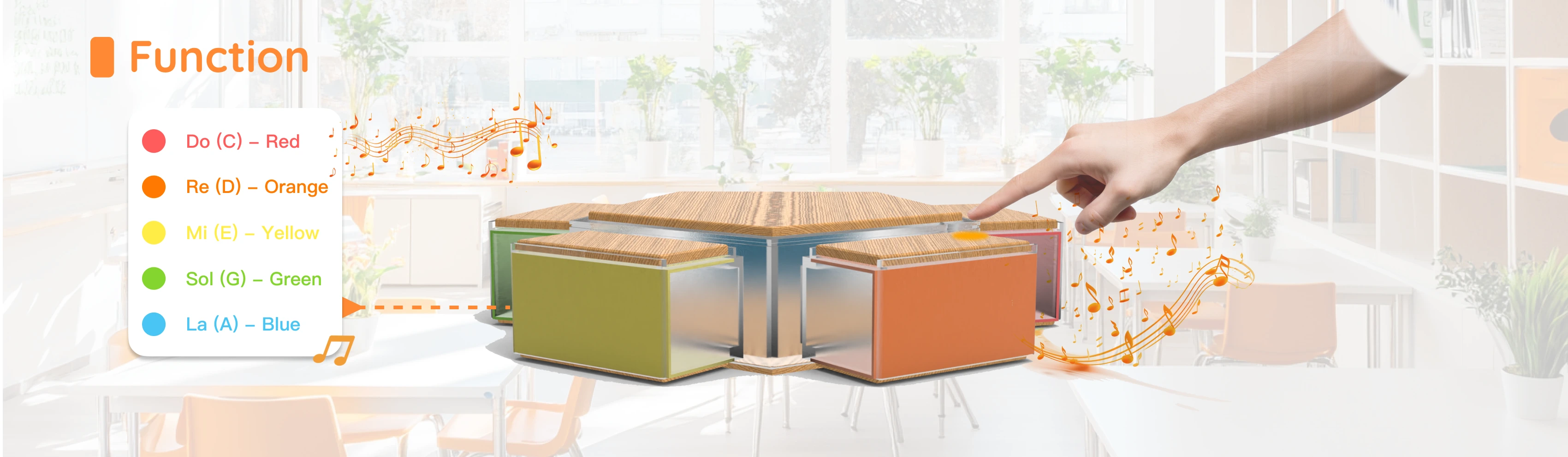
Five colour-coded Resonance modules arranged around a wooden centre plate in a bright classroom, with a hand touching one of them, beside a legend mapping Do to red, Re to orange, Mi to yellow, Sol to green and La to blue
Original module design · 2025. Five notes, five colours, one shared surface. Do (C) red, Re (D) orange, Mi (E) yellow, Sol (G) green, La (A) blue. Five notes rather than a full scale, arranged so a group can reach them at the same time.
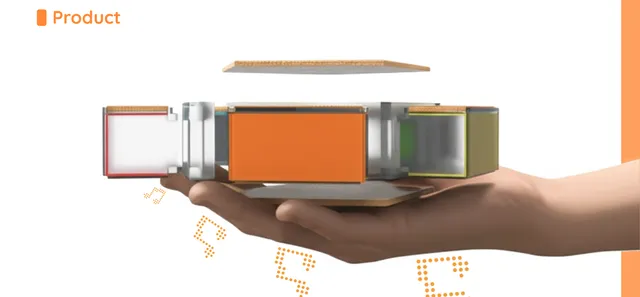
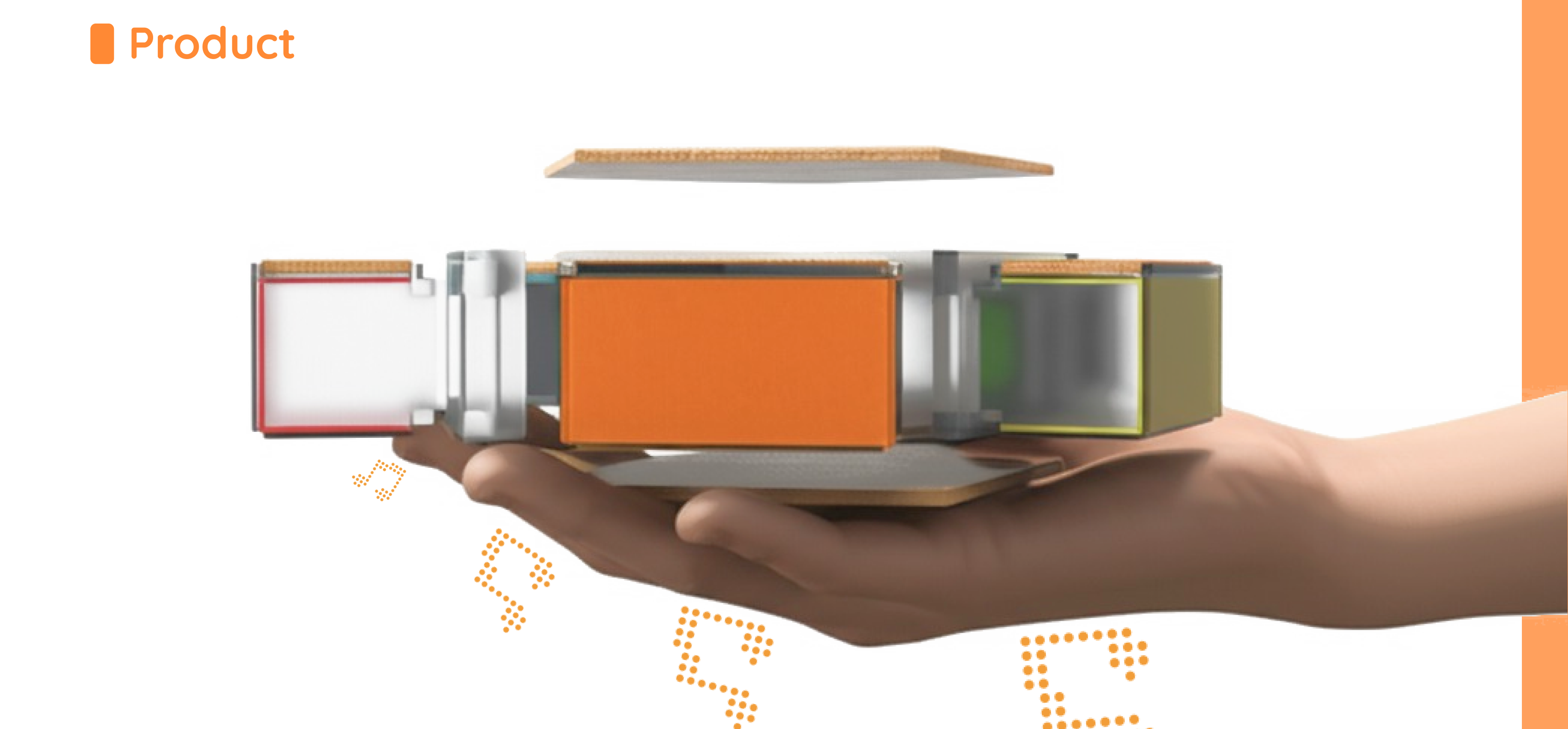
Exploded render of the Resonance module resting on an open hand: a wooden top plate, the coloured outer shells in red, orange and olive, the inner touch layers and the base tray separated in a row Opens the full-resolution board in a new tab
Original module concept · 2025. One module, taken apart. A wooden top plate, a coloured shell, the touch layer underneath and a shared base. The wood is not decoration; it is the surface a child actually touches, which is why the material experiments mattered as much as the circuit.
Process documentation: a white massing model of five modules around a central plate, a rendered assembly view, orthographic construction drawings, and bench photographs of the electronics being tested inside a printed shell Opens the full-resolution board in a new tab
From massing model to construction drawing to a working shell. The five-around-one arrangement was settled in white foam long before it had a colour or a sound.
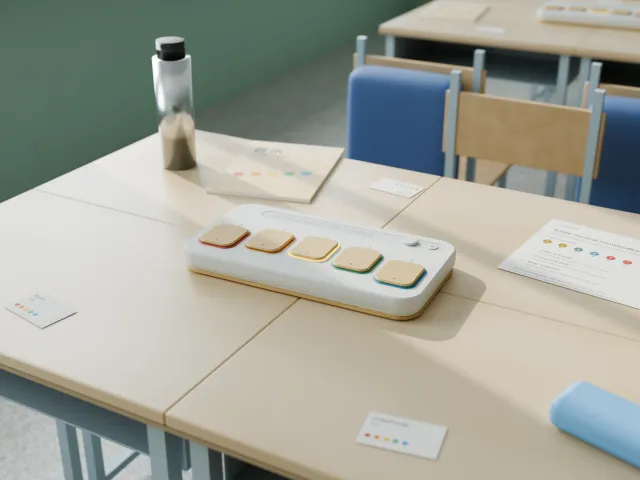
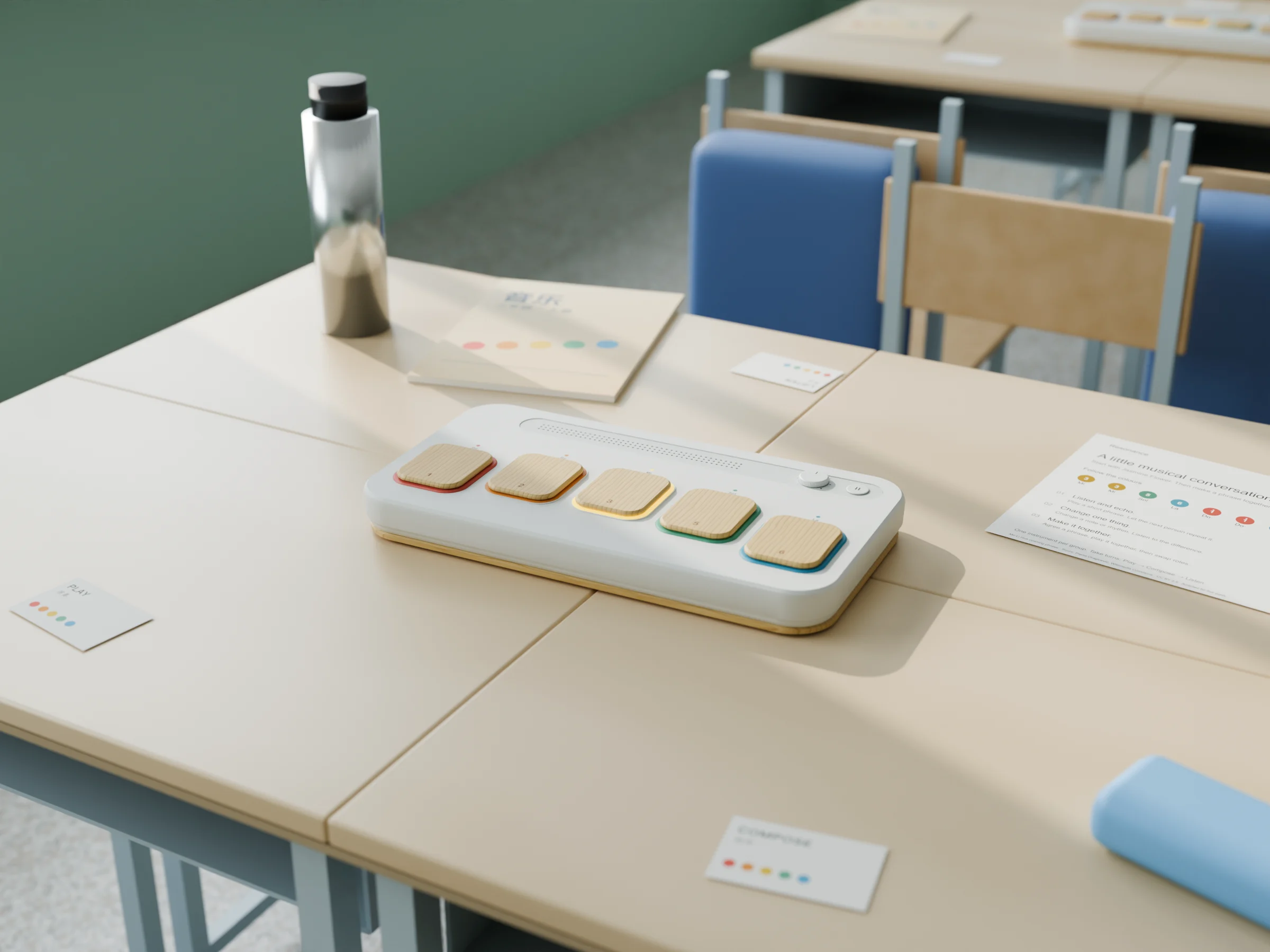
Classroom concept: one Resonance instrument on a group of school desks, with the Jasmine Flower activity sheet, three role cards, a music textbook and children's things
One instrument. Three roles. A place to begin. · Concept visualisation

Give the teacher
a place to start.

One instrument on each group table, an activity sheet and three role cards: a short guided activity the teacher can begin with.

Taking turns
round the table.

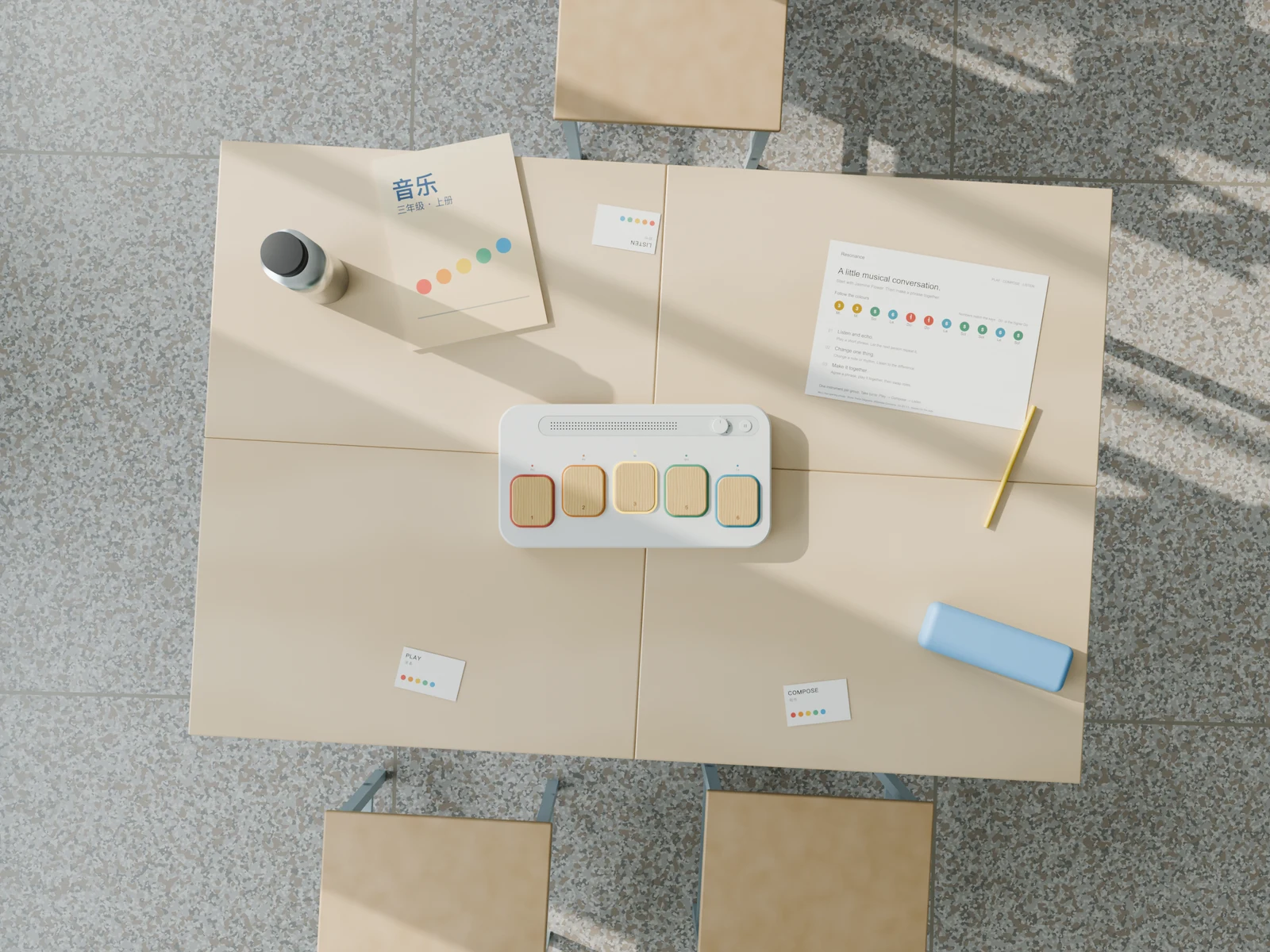
Three children share one instrument and one activity sheet. After each short phrase, the roles move one seat round the table.

Plan view of one group table: the instrument in the middle, the activity sheet, three role cards, a pencil case, a music book and a water bottle, with chairs at the front and back PlayComposeListen Concept visualisation · one group table, seen from above

Listen and echo.

Play a short phrase. The next person repeats it.
Phrase3 3 5 6 → 3 3 5 6

Change one thing.

Choose a different note or rhythm. Hear the difference.
Phrase3 3 5 6 → 3 3 5 1

Make it together.

Agree a phrase, play it together, then swap roles.

Phrase3 3 5 6 i i 6 5

Try the guided melody

A small start for the teacher.

Place one instrument and the activity sheet on each group table. Demonstrate a short phrase, then let the children take turns.

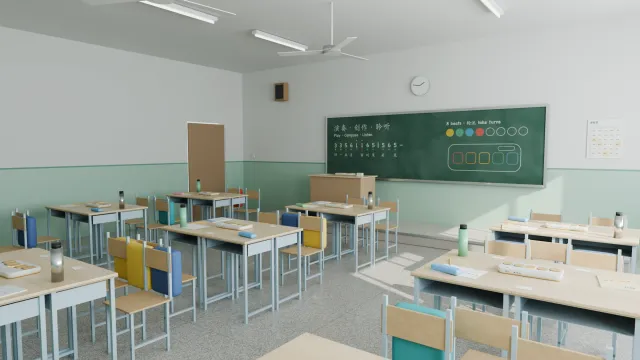
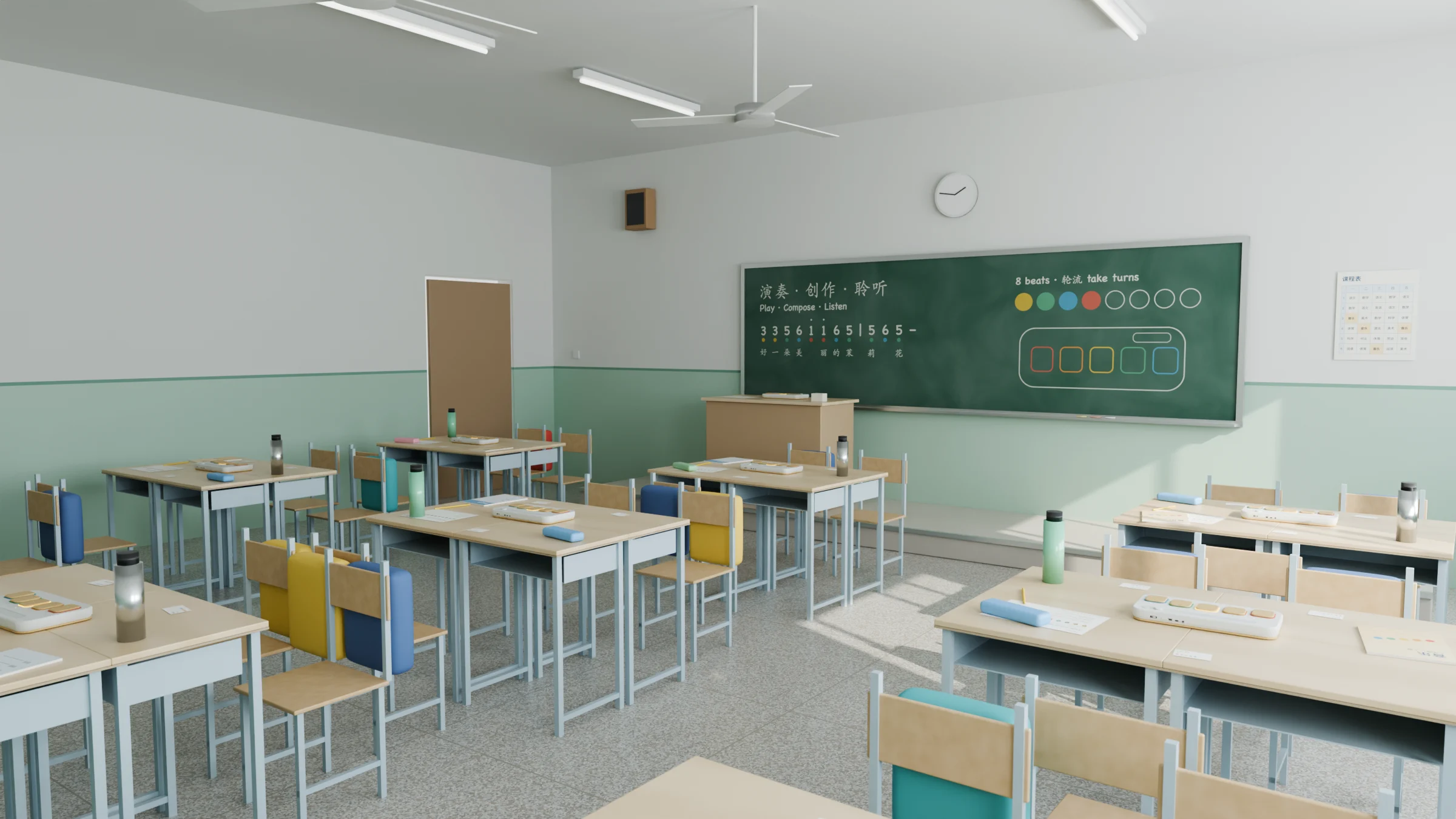
Modelled township primary-school classroom: a Resonance instrument on each group of desks, and the chalkboard showing Play, Compose, Listen in Chinese and English with the opening of Jasmine Flower in numbered notation
Township classroom visualisation

A place to play
together.

A shared instrument on each table, teacher guidance across the room, and space for children to listen and create.

The next prototype
is a lesson.

The instrument needs to be easy to begin with, easy to share and practical to keep using. A material experiment became a wooden touch surface, then a shared instrument and a short classroom activity.

Done

  • Treated and laser-processed wood that registered a touch in a follow-up test, 2025.
  • A working prototype: Arduino UNO, MPR121 and VS1053 in printed shells, 2025.
  • One shared instrument modelled inside and out, with a short classroom activity, 2026.

Not yet tested

  • Use in a real lesson, with a teacher and children.
  • How the wooden faces hold up to repeated touch and cleaning.
  • The glowing frames: a design candidate, not yet built.

Next

  • Try the activity with a teacher.
  • Observe how children take turns.
  • Test the wooden faces through repeated touch and cleaning.

Thanks and credits

Back to selected work Resonance · 2025 / Product study · 2026

Find your next question.

Back to selected work Objects, services & systems.

Trace the Line · Sheet A

Locate the involvement.

Place tokens where AI entered a real design process. The tokens mark perceived involvement, not a score.

Original Sheet A: Locate the involvement.

Where would you place it?

Drag a token, or choose a place below. Use all, some or none.

Try a placement. There is no correct answer, and this is not a score.

Reading this sheet

A real project anchors the conversation. Seven stages run from research to communication. Place tokens on or between stages to mark where AI felt involved, then choose the stage you thought longest about.

Open original image ↗ (opens in a new tab)